PortoBallast Specifications: Flow, Power and Footprint
Updated
Euro Tech's August 2026 brochure gives a treatment range of 50–300 m³/h with adjustment of UV power, a 116 kW electrical supply specification, DN200 inlet/outlet connections and a 12.192 × 2.438 × 2.896 m equipment-room envelope. These are dated manufacturer reference figures, not a confirmed as-built specification or throughput guarantee for Sea Clean's received container. Read the operating envelope and auxiliary requirements alongside the headline capacity.
Sea Clean port-side treatment and PortoBallast hub
Key takeaways
- Reference treatment range: 50–300 m³/h, with adjusting UV power.
- Published electrical supply: 116 kW, 400 V, three-phase, four-wire plus ground.
- Reference inlet/outlet: DN200; actual coupling and hose compatibility need drawings.
- Equipment-room dimensions: 12.192 × 2.438 × 2.896 m; dry/operating weight: 10,000/13,000 kg.
- Dosing-skid data and treatment-unit limits are not interchangeable.
- The August 2026 manufacturer figures are subject to change and require as-built confirmation.
How should the published treatment capacity be interpreted?
The brochure's treatment-unit table states 50–300 m³/h with adjusting UV power. It does not give permission to run any incoming water at the highest listed rate. Actual operation depends on the unit's documented configuration, water characteristics, filtration condition, UV treatment controls, transfer hydraulics and the accepted operating scope. Confirm the current manufacturer documentation and receiving inspection for the specific serial-number unit offered.
For planning, separate transfer rate from total operation time. Dividing ballast volume by an agreed sustained treatment rate estimates only the flowing period; unloading, connection, checks, start-up, sampling, interruptions, isolation and clean-down add time. Do not use an onboard ballast pump's maximum rating as the facility's achieved throughput. A quotation should state its assumptions and the conditions that would require a lower flow or a different arrangement.
What electrical and fluid connections are listed?
The published tie-in table lists power supply as 116 kilowatt, 400 V, three-phase, four-wire plus ground. It lists DN200 inlet/outlet, a DN25 fresh-water inlet with 1 bar pressure head, and a DN50 drainage point. These figures are valuable early screening data, but the brochure is not the electrical installation design. Confirm available supply, protection, cable routing, earthing, isolation and the unit's actual nameplate and connection requirements.
Compressed air is listed at 6 bar and 300 L/min through DN15, with the table noting that it is included in the system already. Establish what equipment is actually supplied rather than assuming a port must provide an external compressor. Connection size alone also does not define flange drilling, hose length, pressure rating or adapter suitability. Drawings and a surveyed interface are needed before assembling a vessel-to-shore package.
Related guidance: PortoBallast Vessel-to-Shore Connection Checklist
What incoming-water limits does the brochure give?
The stated influent limit is clean ballast water, oil-free, with total suspended solids at or below 500 mg/L and water temperature at or below 65°C. The fluid-temperature row gives 0 to +65°C. This does not classify the system as a universal treatment plant for oily bilge water, cargo washings or an unidentified industrial wastewater mixture. Known contamination needs to be disclosed and assessed before reception is agreed.
For the treatment unit, the ambient-temperature row gives −10 to +50°C and the maximum/minimum working-pressure row gives 10 bar/1 bar. Verify the applicable limits for the actual configuration, including every hose, coupling and downstream path. These values are equipment-envelope references, not permission to apply a vessel's full pump discharge pressure to an unverified transfer assembly or to operate through abnormal alarms.
How large and heavy is the containerised equipment room?
The brochure lists equipment-room dimensions as 12,192 × 2,438 × 2,896 mm, expressed here as 12.192 × 2.438 × 2.896 m, length × width × height. Dry/operating weight is listed as 10,000/13,000 kg. Those dimensions and weights describe container-scale infrastructure, not a hand-portable device. Confirm the delivered unit's actual weight, lifting information and transport envelope before specifying handling equipment or bearing loads.
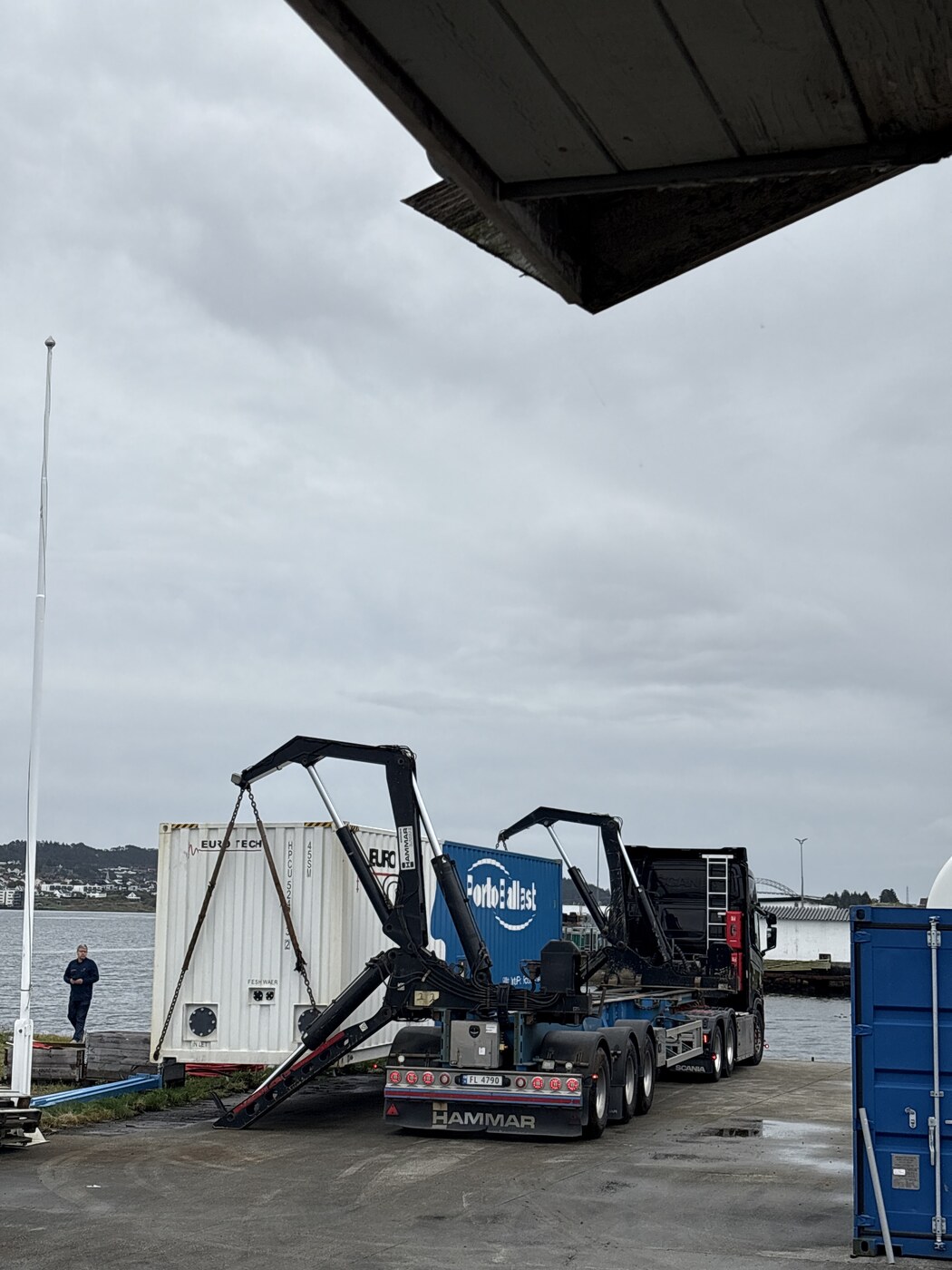
The body footprint is only part of a site layout. Allow for door operation, maintenance access, operator movement, hose bends, emergency access, drainage and any separate dosing equipment. A side-loader delivery photograph shows a handling method used at arrival, not a reusable lifting plan for every port. Ground conditions, quay load limits, trailer reach and nearby obstacles all need review by the responsible site and transport parties.
What is separately stated for the chemical dosing system?
The chemical-dosing table describes a skid with mobile wheels and integral frame, dimensions LWH 1,200 × 1,000 × 1,800 mm, sodium thiosulphate as the applicable chemical, and dosing flow of 216 L/h. It lists 400 V/230 V at 50/60 Hz, local manual plus PLC automatic control, and a 316L stainless-steel frame. These are dosing-skid figures, not an additional 216 L/h ballast-water treatment capacity.
The dosing system's ambient range is −10 to +40°C, which differs from the treatment-unit row. A dosing-pump capacity does not establish a universal neutraliser consumption rate: the required dose depends on the approved method, oxidant load, reagent preparation and actual water flow. Confirm which components are included in an offered service and keep their individual electrical, environmental and handling constraints visible.
Related guidance: PortoBallast TRO Neutralisation vs Full Ballast Treatment
Which specifications must be checked before a firm offer?
The August 2026 brochure repeatedly states that technical data are subject to change. A supplier should reconcile that reference with the equipment actually delivered, its current manuals, configuration drawings, inspection and test records, and the operational purpose. Check whether any option, such as an explosive-proof configuration or an online TRO instrument, is actually fitted. A brochure option is not a standard feature of every container.
Then review the port and vessel: ballast volume and condition, available working window, exact coupling arrangements, transfer hydraulics, site electricity, acceptable effluent route, sludge handling and testing or authority requirements. Sea Clean's first-container receipt is confirmed by its arrival report, but this specification article does not certify the unit's commissioning status. Send the relevant documents by email so the offer can distinguish confirmed facts from assumptions.
Frequently asked questions
Is 300 m³/h a guaranteed PortoBallast service rate?
No. It is the upper end of the brochure's stated 50–300 m³/h range with adjustment of UV power. Actual agreed throughput depends on the offered configuration, water quality, operating limits, transfer system and project acceptance conditions.
Does the brochure really list 116 kW?
Yes. The August 2026 treatment-unit tie-in table lists 116 kilowatt and 400 V, three-phase, four-wire plus ground. Confirm the actual unit's electrical documents and site supply design; the reference is not a measured continuous energy-consumption claim.
Can the system accept oily water or any wastewater?
That is not supported by the published influent envelope. The brochure specifies clean ballast water, oil-free, with TSS ≤500 mg/L and water temperature ≤65°C. Other streams require separate review and must not be represented as automatically acceptable.
Are these the exact specifications of Sea Clean's received unit?
They are the manufacturer's dated brochure figures, not an as-built certificate for the received serial-number unit. Current manuals, drawings, equipment identification, supplied options and acceptance records must be checked before relying on them for a project.
Sources
- Euro Tech — PortoBallast brochure, August 2026 edition — Pages 2–4: process, tie-ins, technical envelope and dosing system; manufacturer data subject to change, not Sea Clean's as-built acceptance record.
- Euro Tech Holdings — mobile hybrid launch, 9 June 2026 — Issuer's announcement: Nasdaq CLWT, containerised terminal/barge deployment and trailer transport.
- Euro Tech Holdings — Sea Clean partnership announcement, 17 June 2026 — Names Sea Clean and the planned Norwegian coastal facility. Its dispatch forecast is not the actual receipt date.
- IMO — Ballast Water Management — Convention, management plans, discharge standards and the distinction between equipment approval and operational requirements.
Related articles
- PortoBallast Vessel-to-Shore Connection Checklist
- Deploying a Containerised BWTS at Ports and Terminals
- How PortoBallast Filtration, UV and Sludge Handling Work
- PortoBallast TRO Neutralisation vs Full Ballast Treatment
- What Is a Ballast Water Port Reception Facility?
- Port-Side Ballast Water Treatment for Vessels
Discuss PortoBallast directly by email
Training, rental/operated service and contingency enquiries are reviewed individually. Include objectives or the vessel, installed BWMS, port, dates, water volume and scope. Availability, readiness, suitability, permissions and quotation require confirmation. These links prepare email drafts; no website submission inbox is used.
Explore the PortoBallast series
- First container received: 7 October 2026
- What is PortoBallast, and who is Euro Tech?
- Sea Clean's planned training facility
- Rental periods and service scope
- BWTS breakdown contingency planning
- Vessel-to-shore connection checklist
- IMO D-2, testing and port acceptance
- TRO neutralisation versus full treatment
- Filtration, UV and sludge management
- Deployment at ports and terminals
- Mobile treatment versus onboard BWMS