VGP Compliance Testing Explained: A Step-by-Step Guide
Updated
VGP compliance testing is the environmental monitoring the EPA requires of vessels discharging treated ballast water into US waters. This guide walks through the process end to end: selecting representative sampling points, collecting and preserving samples to EPA guidelines, completing the field report and Chain of Custody, laboratory analysis of indicator organisms, comparing results to permit limits, and the recordkeeping and reduced-frequency rules that follow a clean result.
Key takeaways
- VGP testing verifies that a BWTS is meeting the permit's numeric effluent limits in service, using indicator organisms in the discharge.
- Samples must come from a straight in-line section near the overboard; EPA collection needs 20-plus specified items and correct technique.
- Immediate preservation and a completed Chain of Custody make the result legally defensible; the Chain of Custody is an EPA requirement.
- A vessel must pass two consecutive sampling events to qualify for reduced annual monitoring under the permit.
- New systems are sampled two to four times in year one; an exceedance returns the vessel to twice-yearly sampling until compliance is restored.
- Sea Clean coordinates sampling with accredited ISO 17025 laboratories and can align the call with an existing port stay or survey.
What VGP Compliance Testing Actually Verifies
VGP compliance testing is the monitoring the EPA mandates to confirm that a vessel's ballast water treatment system is genuinely meeting the permit's numeric effluent limits in service, not just at commissioning. The test measures indicator organisms in the discharge to demonstrate that the system is neutralising biological content to the required standard. It is the EPA's primary tool for verifying ongoing BWTS effectiveness across the equipment's operational life.
The point of the exercise is that a type-approved system installed years earlier can still drift out of performance: UV lamps age, electrochlorination cells foul, sensors lose calibration, and filters wear. Periodic effluent testing catches that degradation before it becomes a non-compliant discharge. This is why the permit treats testing as a recurring obligation rather than a one-off certification.
Because a positive result carries real consequences, the value of the test depends entirely on it being defensible. Samples drawn from the wrong location, preserved incorrectly, or delayed in transit can multiply bacteria and generate a false exceedance that penalises a system that was in fact compliant. The process below is designed to make results accurate, verifiable and legally sound.
Step 1-2: Sampling Point Selection and Collection
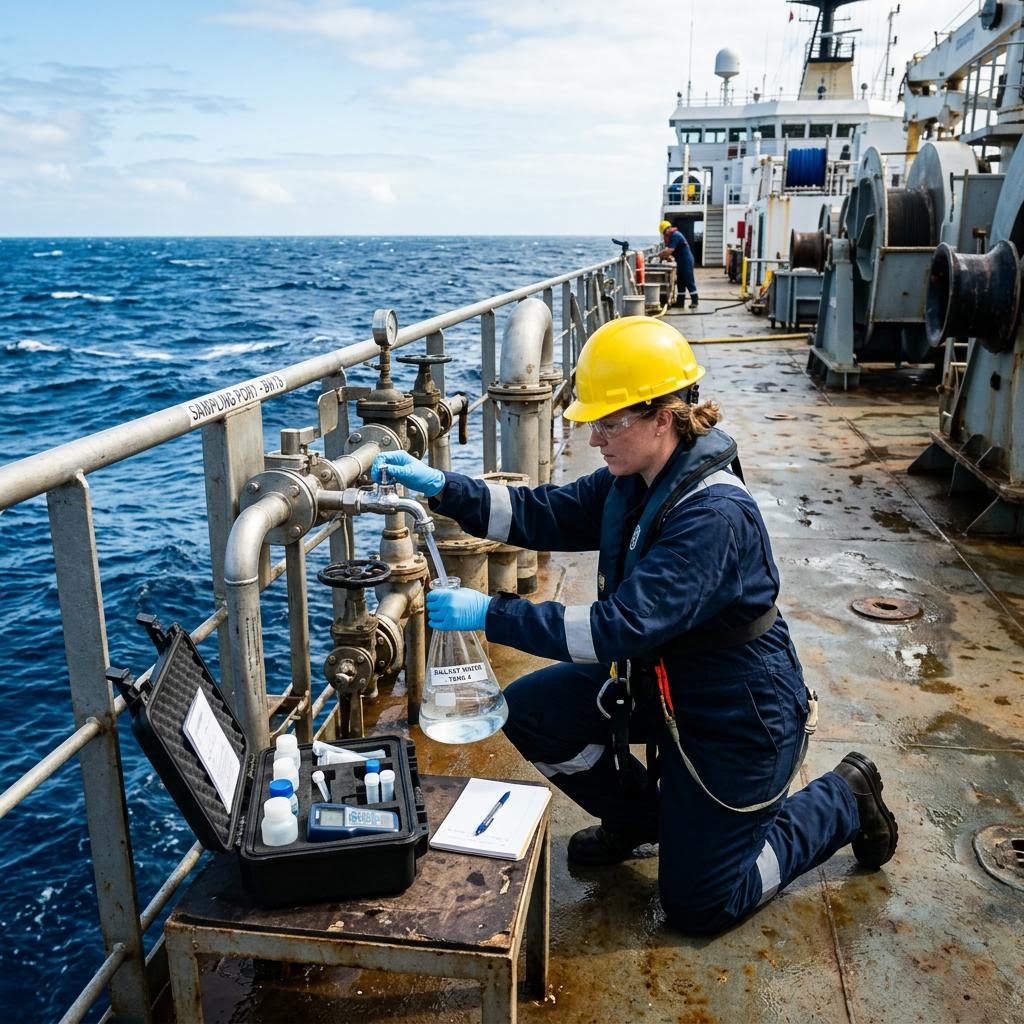
Picking the right point to sample is the first step and the most exacting. A sample has to stand for what is truly going overboard, so it is taken from the pipework's dedicated in-line tappings, on a straight run of the discharge line and as near the overboard as can be managed, keeping clear of dead legs and any mixing that would distort the reading. Inlet and outlet factors alike, together with any mixing zones, have to be weighed so the sample mirrors the genuine discharge.
Collection then follows the EPA's detailed guidelines, which call for more than 20 discrete items: a sampling pole, appropriate sample bottles, pH and field test equipment, preservation chemicals, 0.45 micron filters and additional filtration equipment, buckets with disposable liners, and labelling materials. The number and specificity of these items is precisely why the collection is technical work rather than a simple grab of water.
Sampling must not disrupt the vessel's ballast operations or safety controls, so the event is planned into the port call with the chief engineer. The person collecting must understand the system's discharge configuration to avoid drawing a sample from an unrepresentative point. This combination of hydraulic knowledge and EPA procedure is where most self-sampling errors originate.
Step 3-4: Preservation, Field Report and Chain of Custody
Immediately after collection, samples must be preserved, labelled and packed exactly as the EPA specifies, because biological samples change quickly once removed from the line. Preservation chemicals, temperature control and filtration are applied to fix the microbial content so the laboratory measures the discharge as it was, not as it evolved in transit. Any deviation here can invalidate an otherwise perfect sample.
The field report is completed at the same time, documenting where and how each sample was taken, the equipment used, field readings and the conditions of collection. This record supports the analytical result and is part of the paperwork the EPA expects to see. A gap in the field report can undermine the credibility of the whole test.
The Chain of Custody form is then completed to track every transfer of the sample from the vessel to the laboratory. A completed Chain of Custody is an explicit EPA requirement and must accompany the final report. It is the document that proves the sample analysed is the sample collected, unbroken and untampered, which is what makes the result legally defensible.
Step 5-6: Laboratory Analysis and Comparison to Limits
Samples are then analysed at an accredited laboratory using EPA-recognised methods. Sea Clean coordinates this analysis with accredited ISO 17025 laboratories rather than performing it in-house, scheduling the work and arranging correct transport so operators do not have to source and vet a lab under time pressure. The laboratory quantifies the relevant indicator organisms to the EPA's methodology so results are comparable and verifiable.
The analytical results are then compared against the VGP's numeric limits to judge whether the treatment system is operating within acceptable bounds. This comparison determines the next step, because the permit's requirements differ depending on the outcome. A result within limits confirms the system is neutralising organisms as designed; an exceedance triggers corrective action and a return to more frequent monitoring.
The permit's incentive structure hinges on this step. A vessel must meet the standard in two consecutive sampling events to move onto the reduced annual sampling schedule, so a single clean test is not enough to relax monitoring. Understanding this consecutive-result rule helps operators plan the timing of tests rather than being surprised by continued frequent sampling.
Step 7-8: Documentation, Reporting and Recordkeeping
Once results are compared to the standard, the full set of documentation is assembled: the field report, Chain of Custody, laboratory analytical results and the compliance summary. This package serves as the record of the vessel's compliance effort and is what the operator submits or retains for regulatory reporting. Clear, complete documentation is what turns a good result into demonstrable compliance.
The operator then retains detailed records of every sampling and analysis event. These records must be available for review by regulatory authorities, and given the EPA's increased scrutiny of records, incomplete files are themselves an enforcement risk. Retaining the data in an organised, retrievable form is as important as the sampling itself.
The permit's monitoring frequency reflects performance: newly commissioned systems are typically sampled two to four times in the first year to establish baseline performance, results below limits in two consecutive events can reduce sampling to once per year, and any subsequent exceedance returns the vessel to twice-yearly monitoring until compliance is re-established. Tracking where a vessel sits on this schedule is central to planning testing efficiently.
Coordinating a Project-Managed Sampling Call
Because the process spans point selection, EPA-specified collection, preservation, custody, an accredited laboratory and structured reporting, most operators treat it as a project-managed service rather than a crew task. A specialist boards, collects to current EPA practice, completes the paperwork, moves the samples to the laboratory and returns a full report with the Chain of Custody. This removes the two biggest failure points: unrepresentative sampling and mishandled transport.
Planning also lets the operator choose a cost-effective port for the test. Sampling can be aligned with an existing port call, an annual survey or a BWTS service attendance so the vessel is not diverted purely to be sampled. Coordinating the sampling window against the trading pattern keeps both cost and disruption down.
Sea Clean provides this coordinated service, attending vessels across the North Sea within 24 hours and worldwide as flights, visas and port access allow, drawing samples to EPA guidance and coordinating analysis with accredited ISO 17025 laboratories. Send the vessel name, IMO number, BWTS make and model, intended ports and timing to post@seaclean.no for a quotation and a sampling plan.
Frequently asked questions
How often must VGP ballast water sampling be done?
A newly commissioned system is typically sampled two to four times in the first year to establish baseline performance. Results below the permit limits in two consecutive events can reduce sampling to once per year. Any later exceedance returns the vessel to twice-yearly monitoring until compliance is re-established.
Where should VGP ballast water samples be taken?
Samples should be drawn from the in-line sampling points of the ballast water pipework, from a straight section of the discharge line as close to the overboard as practicable. This ensures the sample represents the actual discharge and avoids dead legs or mixing zones that would distort the result.
Why does the Chain of Custody matter so much?
The Chain of Custody documents every transfer of the sample from the vessel to the laboratory, proving the sample analysed is the sample collected. It is an explicit EPA requirement and must accompany the final report; without it, an otherwise valid result may not be accepted as defensible compliance evidence.
Does Sea Clean analyse the samples itself?
No. Sea Clean is not an accredited test laboratory. It coordinates the sampling and analysis, drawing samples to EPA guidance and arranging analysis with accredited ISO 17025 laboratories, then returning a full report with the Chain of Custody. Contact post@seaclean.no to arrange a sampling call.
Sources
Related articles
- EPA VGP Guide for Vessel Operators: Ballast Water Rules
- VGP Analytes and Monitoring Requirements for Ballast Water
- VGP Compliance Sampling Service for US Ballast Discharge
- Accredited Laboratories and Authorised Parties in Ballast Water Testing
- USCG Ballast Water Compliance for Ships Calling the United States
- The US EPA VGP and VIDA Framework for Ballast Water