Accredited Laboratories and Authorised Parties in Ballast Water Testing
Updated
Ballast water testing involves several distinct roles, and confusion about who does what causes real problems for vessels. This article explains the difference between an accredited testing laboratory, a party authorised by the flag administration or class, and a service company that coordinates and supports sampling. It sets out clearly that Sea Clean AS is a sampling and supply support company, not an accredited laboratory, and describes exactly how it works with the parties that perform and certify analysis.
Key takeaways
- A valid ballast water test depends on a chain of distinct roles: sampling, analysis, authorisation and documentation.
- Accredited laboratories assessed to ISO/IEC 17025 perform and certify detailed analysis within their accredited scope.
- Flag administrations or class may authorise a party to carry out or witness testing such as commissioning testing.
- A sampling and support company coordinates, attends and supplies but does not certify the analysis.
- Sea Clean is not an accredited laboratory and does not hold testing accreditation or certify results.
- Sea Clean coordinates and supports sampling with accredited labs and authorised parties who certify the analysis.
Why the Roles Need to Be Clear
Ballast water testing is not done by a single entity. A regulated result depends on a chain of roles: someone who takes the sample, someone who analyses it, someone who is authorised to do so for compliance purposes, and the documentation that ties it all together. Confusing these roles leads vessels to assume they have a valid result when they do not.
The distinction matters most for commissioning testing and for any test a vessel relies on at port state control. A measurement is only authoritative if it is produced by a party competent and recognised to produce it, under the right method, with traceable documentation.
This article sets out the roles plainly, including Sea Clean's own role, so superintendents and technical purchasers can arrange testing correctly and avoid paying for work that does not satisfy the requirement.
Accredited Testing Laboratories
An accredited testing laboratory is one assessed against the international standard ISO/IEC 17025 by a recognised accreditation body, which confirms it is technically competent to perform specific tests and produce traceable, defensible results. For ballast water, this covers the detailed analysis methods used to count viable organisms and assess indicator microbes.
Accreditation is specific: a laboratory is accredited for particular methods and parameters, not for everything, and the scope of accreditation defines what its results can be used for. This is why detailed ballast water analysis is sent to a laboratory accredited for those methods rather than to any laboratory.
The accredited laboratory takes responsibility for the analytical result and certifies it. That certification is what gives the result weight with administrations, class and port state control, and it is something only the laboratory itself can provide.
Parties Authorised by Flag or Class
Separately from laboratory accreditation, the flag administration or a recognised organisation acting on its behalf may authorise a party to carry out or witness certain testing, such as commissioning testing under the BWMS Code. This authorisation is about being recognised to perform the test for regulatory purposes, which is distinct from laboratory accreditation but often overlapping in practice.
For commissioning testing, the test is conducted to satisfy the administration that the installed system performs, and the involvement of an authorised party and, where required, a surveyor gives the result its standing. The exact arrangements vary by flag, which is why the requirements are confirmed for the specific vessel and administration.
A vessel arranging testing should confirm that the party performing or witnessing it is appropriately authorised for that vessel's flag, and that the analysis is done by a laboratory accredited for the methods. Getting both right is what makes the result usable.
The Role of a Sampling and Support Company
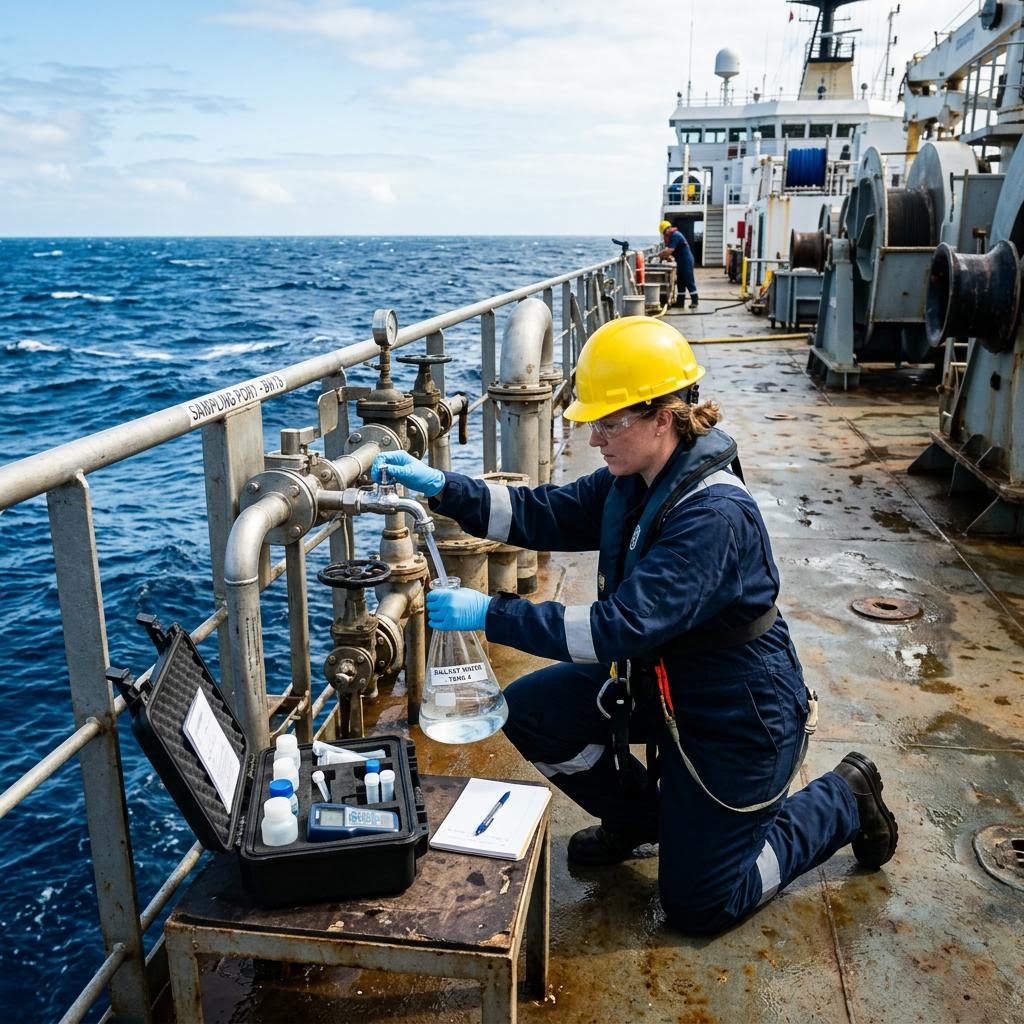
Between the vessel and the accredited or authorised parties sits a practical need: someone has to organise the sampling, supply the reagents and consumables, attend during the port call, take or assist with representative samples, and manage the handover and documentation. This is the role Sea Clean fills.
A sampling and support company makes testing happen smoothly, but it is not the body that certifies the analysis. Its value is in coordination, attendance, supply and on-board indicative screening, all of which reduce the chance of a wasted or invalid test, while the authoritative result comes from the accredited laboratory or authorised party.
Drawing this line clearly protects everyone. The vessel knows what it is buying, the accredited parties retain their proper responsibility, and the result stands up to scrutiny because each role was filled by the right entity.
Where Sea Clean Stands
Sea Clean is a maritime supply and service company. It is not an accredited testing laboratory and does not hold testing accreditation, and it does not certify analytical results. It does not present itself as an accredited, approved or authorised independent test body, because that would be inaccurate.
What Sea Clean does is coordinate and support ballast water sampling and BWMS commissioning testing in cooperation with accredited laboratories (ISO/IEC 17025) and parties authorised by the flag administration or class. It supplies TRO test kits, reagents and sampling support, attends to facilitate the test, and supplies BWTS spare parts; the accredited or authorised party performs and certifies the analysis.
Being precise about this is part of doing the job correctly. A vessel that understands Sea Clean's role can rely on it for the practical side of testing while ensuring the certified analysis comes from the party recognised to provide it.
How Sea Clean Coordinates the Right Parties
When a vessel needs commissioning testing or compliance verification, Sea Clean helps identify and coordinate with an accredited laboratory and, where required, a party authorised for the vessel's flag, then arranges the sampling, attendance and logistics around the port call. This saves the vessel from assembling the chain itself.
We supply the consumables and indicative tools, manage the handover of laboratory-bound samples within the laboratory's time limits, and keep the documentation consistent so the certified result can be presented to a surveyor and retained on board. For Norway and North Sea ports this is direct; elsewhere it is arranged as flights, visas and port access allow.
To arrange testing through the correct parties, send the vessel name, IMO number, flag, port, ETA and BWMS type to post@seaclean.no. We will coordinate the accredited laboratory or authorised party and the sampling support needed for a valid, certified result.
Frequently asked questions
What does ISO/IEC 17025 accreditation mean for a laboratory?
It means an accreditation body has assessed the laboratory as technically competent to perform specific tests and produce traceable, defensible results. Accreditation is method-specific, so detailed ballast water analysis goes to a laboratory accredited for those particular methods.
Is Sea Clean an accredited ballast water testing laboratory?
No. Sea Clean is not an accredited testing laboratory and does not hold testing accreditation or certify analytical results. It coordinates and supports sampling, supplies TRO kits and reagents, and attends to facilitate testing, while an accredited laboratory or authorised party performs and certifies the analysis.
What is the difference between accreditation and authorisation?
Accreditation (ISO/IEC 17025) confirms a laboratory's technical competence to perform specific tests. Authorisation is when a flag administration or recognised organisation recognises a party to carry out or witness testing for regulatory purposes, such as commissioning testing. A valid test often needs both.
How does Sea Clean help a vessel arrange valid testing?
Sea Clean helps identify and coordinate with an accredited laboratory and, where required, an authorised party for the vessel's flag, then arranges sampling, attendance and logistics around the port call. The accredited or authorised party performs and certifies the result; Sea Clean handles the practical support.
Sources
Related articles
- Detailed Ballast Water Analysis in an Accredited Laboratory
- Ballast Water Commissioning Testing: What Happens On Board
- Coordinating Ballast Water Sampling During a Port Call
- Remote BWTS Commissioning and Service Support
- Fluorometry for Rapid Ballast Water Screening
- USCG Ballast Water Compliance for Ships Calling the United States