EPA VGP Guide for Vessel Operators: Ballast Water Rules
Updated
The Vessel General Permit (VGP) is the EPA's Clean Water Act authorisation for discharges incidental to normal vessel operation in US waters, including treated ballast water. This guide sets out where the permit came from, which vessels it covers, the numeric ballast water limits and Best Management Practices it imposes, the annual inspection and self-sampling obligations, and how the transition to VIDA affects operators trading to the United States today.
Key takeaways
- The VGP is an EPA Clean Water Act NPDES permit created after a 2005 court ruling ended the incidental-discharge exemption; the 2013 version remains binding.
- It covers commercial vessels 79 ft and above and 26 discharge categories, with ballast water limits matching the IMO D-2 standard.
- Operators must file a Notice of Intent, run routine and annual self-inspections, calibrate sensors and keep detailed records and reports.
- Self-sampling is allowed under strict handling rules; a completed Chain of Custody with the result is an explicit EPA requirement.
- EPA enforcement has intensified, targeting missing NOIs, skipped annual inspections and BWMS non-compliance across several regions.
- VIDA's EPA standards are finalised but not yet enforceable pending USCG implementing rules, which are expected to follow, so the 2013 VGP still governs today.
Where the VGP Came From and Why It Exists
The Vessel General Permit came about because, in 2005, a US federal court held that the EPA could no longer leave the routine operational discharges of vessels outside the Clean Water Act's permitting scheme, the National Pollutant Discharge Elimination System (NPDES). That carve-out had lasted some three decades. In its place the EPA brought out its first VGP during 2008, extending NPDES cover nationwide to the incidental discharges of commercial craft of 79 feet and over.
The 2008 permit was superseded by the 2013 VGP, which tightened the framework considerably. It set numeric technology-based effluent limits for ballast water matching the IMO D-2 standard, added monitoring obligations covering ballast water, bilgewater and graywater, and required lubricants used where machinery meets the sea, such as stern tube and rudder bearing lubricants and deck hydraulics, to be of an environmentally acceptable type unless technically infeasible. The 2013 VGP was scheduled to expire in December 2018.
Rather than lapse, the 2013 VGP has continued in force under administrative continuation because Congress passed the Vessel Incidental Discharge Act (VIDA) in the same month it was due to expire. That means the 2013 VGP remains the binding, enforceable standard for operators today, even though a successor regime is under development. Understanding the permit is therefore not a historical exercise but a live compliance requirement.
Which Vessels and Discharges the Permit Covers
The permit reaches commercial craft, neither pleasure boats nor military, that measure 79 feet or more and work in US waters, which in practice covers the three-nautical-mile territorial sea and the inland waters. It also catches the ballast discharges of shorter craft below that length and of fishing boats whatever their size. Pleasure boats fall instead under a separate small-vessel framework rather than the VGP.
Beyond ballast water, the permit regulates 26 specific discharge categories that occur in the ordinary course of running a ship: deck runoff, bilgewater, graywater, exhaust gas scrubber washwater, anti-fouling hull coatings, chain locker effluent, seawater cooling and more. Each category has its own effluent limits and Best Management Practices, so a vessel's obligations extend well beyond the ballast water treatment system alone.
For ballast water specifically, the permit requires that a vessel discharging into US waters use a treatment system meeting the numeric limits and, in practice, hold US Coast Guard type approval under 46 CFR 162.060. The EPA (environmental discharge limits) and the USCG (equipment type approval and enforcement) operate in parallel, so a compliant vessel must satisfy both authorities rather than treat them as alternatives.
Ballast Water Numeric Limits and Best Management Practices
The 2013 VGP's numeric ballast water limits mirror the IMO D-2 discharge standard: fewer than 10 viable organisms per cubic metre for organisms 50 microns or larger, fewer than 10 viable organisms per millilitre for organisms between 10 and 50 microns, and indicator microbe limits of less than 1 CFU per 100 ml for toxicogenic Vibrio cholerae, less than 250 CFU per 100 ml for E. coli, and less than 100 CFU per 100 ml for intestinal enterococci. These are the same thresholds a type-approved system is built to achieve.
Alongside the numeric limits, the permit sets Best Management Practices for the treatment system itself. Operators must carry out functional checks of all components, verify alarm logs, apply software updates, and calibrate sensors for parameters such as UV intensity, flow, temperature and pressure. The EPA explicitly anticipates that certain sensor types, notably TRO, pH and turbidity probes, will need calibration more frequently than annually, and a vessel may not discharge ballast water while those sensors are inoperable.
The permit also carries forward the wider ballast water management discipline: minimising uptake in areas of known contamination, avoiding sediment accumulation, and maintaining the system so it can meet the standard consistently rather than only at commissioning. These practices reinforce that the VGP treats the treatment system as an operational asset that must demonstrably work throughout its life, not a box ticked at installation.
Annual Inspections, Recordkeeping and Self-Sampling
The VGP imposes a defined self-inspection regime. Operators must conduct routine visual inspections and a comprehensive annual inspection of the vessel's discharge-related equipment, together with an annual report and, on first enrolment, a Notice of Intent (NOI) filed through the EPA's electronic system. Failure to file an NOI or to complete annual inspections has been a specific focus of recent EPA enforcement.
Recordkeeping runs alongside the physical checks. Inspection findings, corrective actions, sampling events and analytical results must be logged and retained, and monitoring data must be reported to the EPA on the schedule the permit specifies. The Ballast Water Record Book required under the BWM Convention supports but does not replace the VGP's own reporting; operators trading to the US must keep both current.
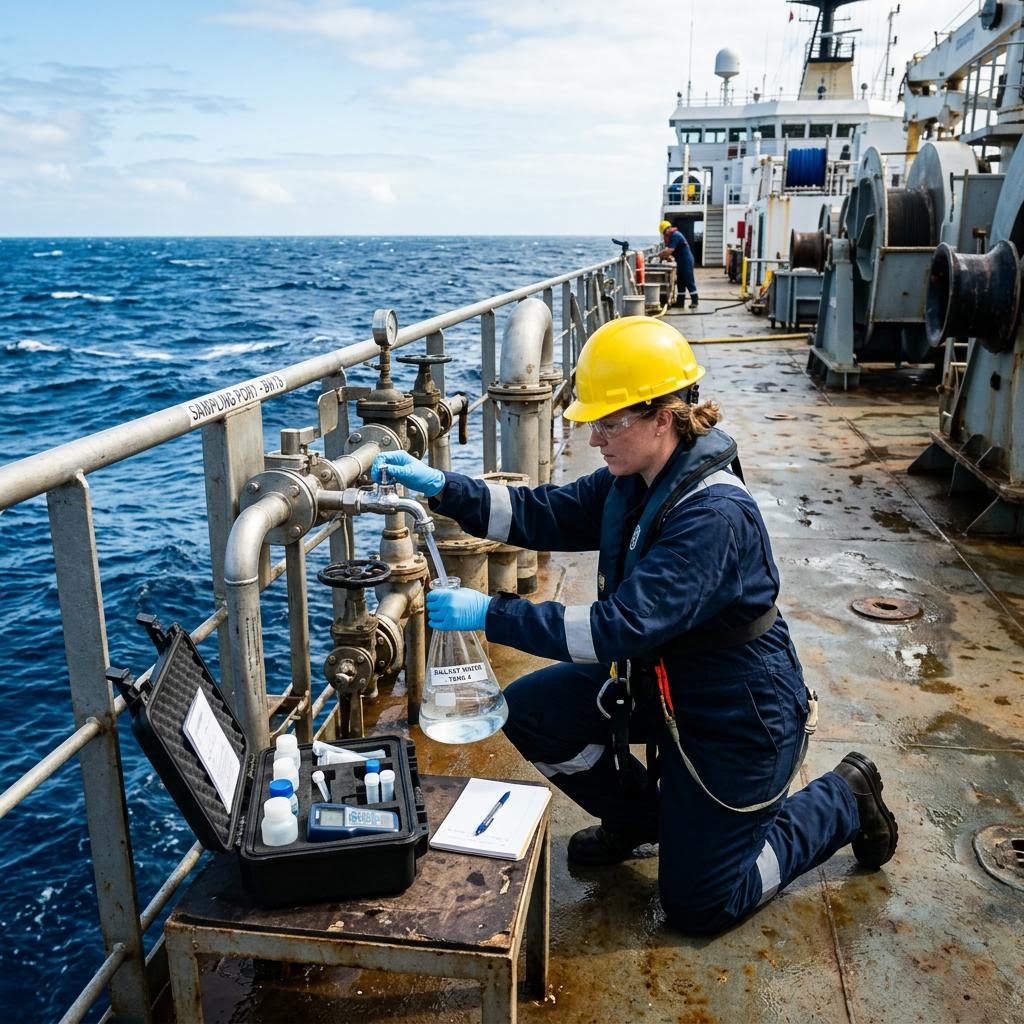
The VGP permits self-sampling, but under strict conditions on collection, preservation and timely transport of samples, all documented within specified timeframes. Because a mishandled sample can multiply bacteria and produce a false exceedance, many operators coordinate sampling through a specialist so that samples are drawn from representative points and moved to an accredited laboratory correctly. A completed Chain of Custody accompanying the result is an EPA requirement, not an optional extra.
Enforcement Reality and the VIDA Transition
For much of the permit's early life, EPA enforcement was limited, with minor breaches attracting warning letters and modest fines while more serious cases drew penalties broadly in the range of tens of thousands of dollars. That posture has changed. The EPA has increased scrutiny of vessel records, conducted inspections and issued information requests under the Clean Water Act, with significant enforcement actions reported in EPA Regions VI, IX and X.
The successor regime, VIDA, has advanced but is not yet fully enforceable. The EPA finalised its Vessel Incidental Discharge National Standards of Performance in September 2024 and published them in the Federal Register on 9 October 2024 with a November 2024 effective date. The USCG rulemaking that will make those standards enforceable is expected to follow, but no firm date is set; until it takes effect, the 2013 VGP terms continue to apply.
For a superintendent, the practical position is straightforward: comply fully with the 2013 VGP now, and prepare for VIDA's updated ballast water management practices in parallel. Sea Clean coordinates VGP compliance sampling with accredited ISO 17025 laboratories, supplies TRO reagents and calibration support, and can attend vessels across the North Sea within 24 hours to close inspection-readiness gaps. Send vessel and system details to post@seaclean.no for a quotation and a sampling plan matched to a cost-effective port call.
Building a Practical VGP Compliance Programme
A workable VGP programme is one the crew can actually follow. It should map each of the vessel's applicable discharge categories to a clear procedure, assign responsibility for routine and annual inspections, schedule sensor calibration to the manufacturer's recommended intervals, and set out exactly how a sampling event is arranged, logged and reported. Procedures that are practical and unambiguous reduce the risk of the recordkeeping gaps the EPA now targets.
The programme must also include a route for reporting and correcting non-compliance promptly. If a violation is discovered, the operator is expected to act immediately and report it appropriately; delay or concealment turns a manageable deficiency into a far more serious matter. Building an internal review into pre-arrival planning for US port calls catches problems before an inspector does.
Sea Clean supports this work end to end: engineer attendance for BWTS function checks and sensor calibration, coordination of accredited-lab sampling with full Chain of Custody, and supply of genuine Headway spare parts alongside independent service for other makes. Contact post@seaclean.no with the vessel name, IMO number, BWTS make and model, intended US ports and next survey window, and we will build the attendance and sampling schedule around the trading pattern.
Frequently asked questions
Does the VGP replace USCG ballast water type approval?
No. The EPA VGP sets environmental discharge limits and monitoring obligations, while the USCG requires ballast water treatment systems to hold type approval under 46 CFR 162.060 and enforces equipment compliance. A vessel trading to US waters must satisfy both authorities, not choose between them.
Can crew take VGP ballast water samples themselves?
The 2013 VGP permits self-sampling, but only under strict rules on collection point, preservation and timely transport, all logged within set timeframes. Because a mishandled sample can produce a false exceedance, many operators coordinate sampling through a specialist and an accredited ISO 17025 laboratory with full Chain of Custody documentation.
Is the VGP still in force now that VIDA is signed?
Yes. Although VIDA was signed in December 2018 and the EPA finalised its national standards in 2024, the standards are not enforceable until the USCG issues its implementing regulations, which are expected to follow but have no confirmed date. Until those rules take effect, the 2013 VGP terms continue to apply under VIDA's transition provisions.
How can Sea Clean help with VGP compliance?
Sea Clean coordinates VGP compliance sampling with accredited ISO 17025 laboratories, attends vessels for BWTS function checks and sensor calibration, and supplies TRO reagents and spare parts. Sea Clean is not itself an accredited lab; it manages the sampling and testing process. Contact post@seaclean.no with vessel and system details for a quotation.
Sources
Related articles
- VGP Compliance Testing Explained: A Step-by-Step Guide
- VIDA vs VGP: Key Differences Vessel Operators Must Know
- The US EPA VGP and VIDA Framework for Ballast Water
- VGP Compliance Sampling Service for US Ballast Discharge
- USCG Ballast Water Compliance for Ships Calling the United States
- Ballast Water Compliance in the European Union