USCG Ballast Water Compliance for Ships Calling the United States
Updated
Ships trading to the United States face a ballast water regime run by the US Coast Guard that is separate from the IMO Ballast Water Management Convention and stricter on equipment approval. This article explains USCG type approval, the Alternate Management System provision, exchange and reporting duties, and how Sea Clean supports onboard sampling, TRO testing and reagent supply in cooperation with accredited laboratories and authorised parties.
Key takeaways
- US ballast water rules are run by the USCG and are separate from, and stricter on equipment approval than, the IMO Convention.
- Only systems holding USCG type approval from a recognised Independent Laboratory are accepted in US waters; IMO approval alone is not enough.
- The Alternate Management System provision was transitional and its five-year periods have largely expired.
- The USCG numeric discharge standard mirrors IMO D-2, and ballast water exchange is now a fallback rather than a primary method.
- Reporting, a ship-specific Ballast Water Management Plan and complete records are central to passing a US examination.
- Sea Clean supports sampling, TRO testing and reagent supply but is not an accredited laboratory; accredited parties certify the analysis.
Two Regimes in One Voyage
A vessel calling the United States must satisfy the US national ballast water regime, which is administered by the US Coast Guard under 33 CFR Part 151 and supported by the US Environmental Protection Agency's discharge permitting. This sits alongside, and is independent of, the IMO Ballast Water Management Convention that governs most international voyages. The two regimes overlap in intent but differ in the detail that matters at an inspection.
The most important practical difference is equipment approval. The IMO regime accepts ballast water management systems type-approved by any flag administration under the BWMS Code, while the USCG only accepts systems that hold its own type approval issued after testing by a USCG-recognised independent laboratory. A system accepted internationally is not automatically accepted in US waters.
Because of this, an owner planning US trade has to confirm the installed system's USCG status before arrival rather than assume that IMO compliance is enough. Sea Clean works with operators to clarify which regime applies on a given voyage and to make sure sampling, testing and documentation match the requirement actually being enforced at the port of call.
USCG Type Approval and the AMS Provision
USCG type approval is granted only after a system completes land-based and shipboard testing through an Independent Laboratory recognised by the Coast Guard, with biological efficacy assessed against the discharge standard in the regulations. The list of type-approved systems is published by the Coast Guard and grows as manufacturers complete the process. An owner can check a specific make and model against this list before committing to a US itinerary.
The Alternate Management System provision was a transitional measure that allowed a system type-approved by a foreign administration, and accepted by the USCG as an AMS, to be used for up to five years from the date a vessel was first required to comply. AMS acceptance was never a permanent substitute for USCG type approval, and the five-year clocks have largely expired, so most vessels now need a fully type-approved system.
Where a system's AMS period has ended and no type-approved option is yet fitted, the vessel must either install a compliant system or rely on a compliance alternative such as discharging to a reception facility or using only water from a US public water system. Sea Clean helps operators understand which of these routes is realistic for a given trade and supports the testing and reagent needs that follow from the chosen path.
Discharge Standards and Ballast Water Exchange
The USCG numeric discharge standard mirrors the IMO D-2 limits, expressed as a maximum concentration of living organisms in defined size classes per unit volume, plus limits on indicator microbes. Meeting this standard normally depends on a working type-approved treatment system rather than on water management alone. The standard is what a sample is ultimately judged against if detailed analysis is carried out.
Ballast water exchange remains relevant in specific situations, for example where a system is temporarily inoperable and the master invokes a contingency measure, or for older arrangements before treatment was required. Exchange must be done in line with the regulatory distance and depth criteria and recorded, but it is treated as a fallback rather than a primary compliance method under the current regime.
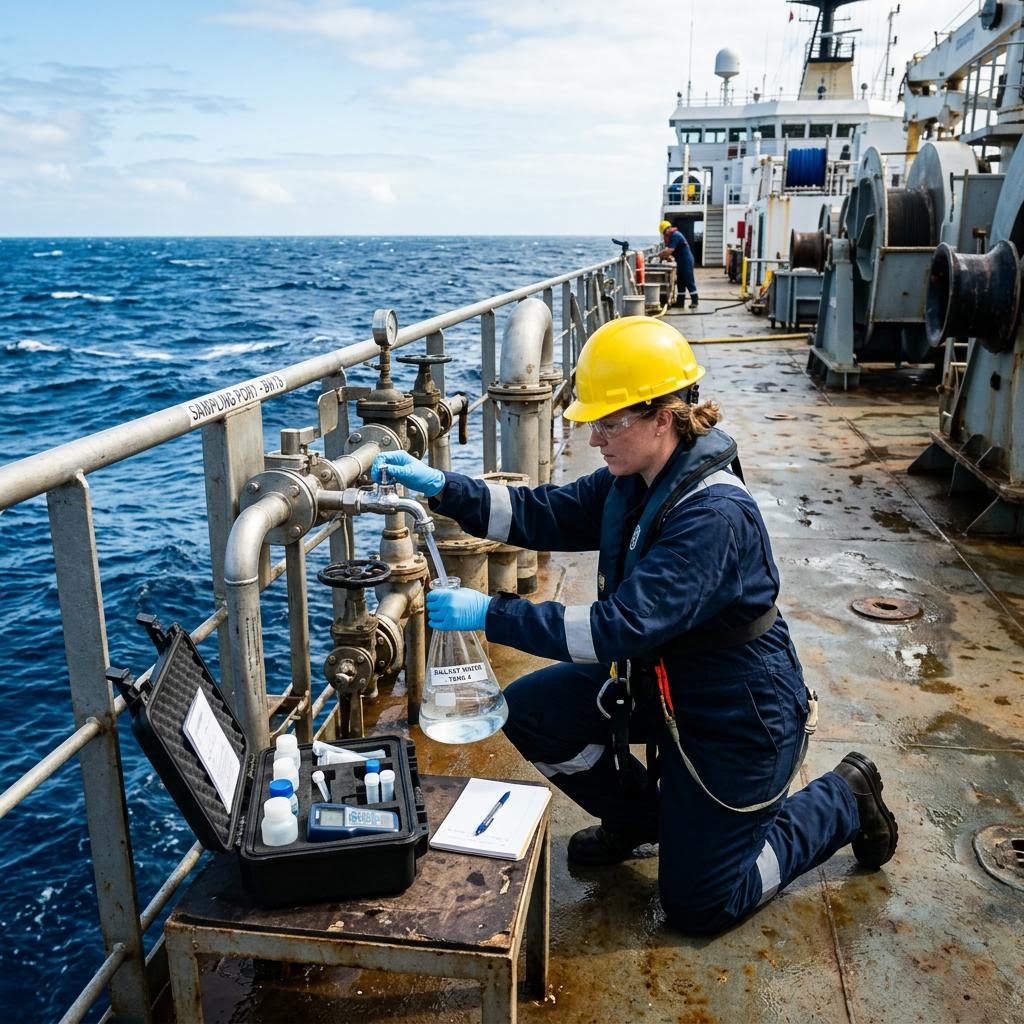
For day-to-day compliance the practical focus is keeping the installed system operating within its approved parameters and being able to demonstrate that through records and, where required, sampling. Sea Clean supplies TRO test kits and sodium thiosulfate neutraliser used in onboard residual monitoring, which helps crews keep electrochlorination and similar systems inside their approved discharge envelope.
Reporting, Recordkeeping and the BWMP
Vessels bound for US ports must submit ballast water management reporting, historically through the National Ballast Information Clearinghouse, and keep ballast water records on board for the period set by the regulations. Reports cover ballast taken up, managed and discharged, and must be available for inspection. Late, missing or inconsistent reporting is one of the most common reasons a vessel draws attention from an examiner.
Every vessel needs a Ballast Water Management Plan specific to the ship, describing the installed system, sampling points, safety precautions and the procedures crew follow for uptake, treatment and discharge. The plan should match what is actually fitted and done on board; a generic plan that does not reflect the real system invites findings during an examination.
Sea Clean supports operators by aligning sampling and TRO testing documentation with the vessel's plan and records, so that the paperwork presented at a US call is internally consistent. We do not certify compliance ourselves; the accredited laboratory or authorised party that performs any detailed analysis issues the test result, and the master retains it with the ballast records.
Examinations and Sampling in US Ports
USCG Port State Control style examinations of foreign vessels, and inspections of US-flag ships, check the installed system, its approval status, the management plan, records and reports. Examiners may also take or witness ballast water samples, using indicative screening for a rapid on-board indication and, where warranted, sending samples for detailed analysis. A clean documentary trail and an operating system are the foundations of a smooth examination.
Indicative analysis gives a fast yes or no signal about whether discharge is likely within limits, using methods such as portable fluorometry or ATP measurement, while detailed analysis in an accredited laboratory provides the defensible organism counts. Sea Clean's role is to support representative sampling and supply the consumables and reagents, with the accredited party performing the analysis that carries regulatory weight.
Where a deficiency is found, the outcome can range from a requirement to rectify before the next voyage to detention in serious cases. Being able to show a maintained system, complete records and a credible contingency arrangement is the most effective way to keep an examination from escalating, and Sea Clean helps assemble that evidence base ahead of a US call.
How Sea Clean Supports US-Bound Vessels
Sea Clean is a Norwegian maritime company based in the Haugesund and Karmsund area with a presence in Rotterdam, supplying BWTS spare parts, ballast water reagents and ship chandler stores, and providing service and engineer attendance. For US trades, our contribution is preparing the vessel before arrival rather than acting as a testing authority. We are not an accredited testing laboratory and do not issue accredited analysis ourselves.
Practical support includes confirming the installed system's USCG status with the operator, supplying TRO test kits and sodium thiosulfate for onboard residual monitoring, and coordinating representative sampling in cooperation with accredited laboratories and parties authorised by the flag administration or class. This keeps the burden of proof in the right hands while making sure the vessel has the equipment and procedures to satisfy an examiner.
Owners planning a US itinerary can contact post@seaclean.no with the vessel name, IMO number, installed BWMS make and intended ports to start coordination. Early engagement gives time to resolve any approval gap, restock reagents and align documentation before the ship enters US jurisdiction.
Frequently asked questions
Is an IMO type-approved BWMS accepted in US waters?
Not automatically. The USCG only accepts systems holding its own type approval, issued after testing by a USCG-recognised Independent Laboratory. A system approved under the IMO BWMS Code by a flag administration must separately hold USCG type approval to be used for compliance in US ports.
Does the Alternate Management System provision still help?
Rarely. AMS acceptance allowed a foreign type-approved system to be used for up to five years from a vessel's first compliance date, and those periods have largely expired. Most vessels now need a fully USCG type-approved system or must use a compliance alternative such as a reception facility or US public water.
Does Sea Clean carry out the official US ballast water test?
No. Sea Clean is not an accredited testing laboratory. We support representative onboard sampling, supply TRO test kits and reagents, and coordinate with accredited laboratories and authorised parties who perform and certify any detailed analysis used for compliance.
What documents should be ready for a USCG examination?
Keep the ship-specific Ballast Water Management Plan, ballast water records, submitted reports and evidence of the installed system's approval status available. Records should match what is actually fitted and done on board, since inconsistencies are a common source of findings during an examination.