VGP Compliance Sampling Service for US Ballast Discharge
Updated
Vessels discharging ballast water in United States waters have long fallen under the EPA Vessel General Permit (VGP), which imposes its own monitoring obligations on top of the USCG ballast water discharge standard. VGP compliance sampling covers not just organism counts but residual biocides, pH and other analytes, all requiring accredited laboratory analysis. This article explains what VGP ballast water monitoring involves, how it differs from IMO commissioning, and how Sea Clean coordinates the sampling and accredited analysis.
Key takeaways
- The EPA Vessel General Permit imposes ballast monitoring obligations distinct from the USCG discharge standard for vessels discharging in US waters.
- VIDA is reshaping the regime; the VGP remains in force during the transition until the new VIDA regulations take effect.
- VGP monitoring covers treatment by-products — residual biocide, neutralising agent, pH and specified analytes — not just organism counts.
- Onboard operational TRO measurement cannot substitute for the accredited, defensible analytical results VGP compliance sampling requires.
- Sea Clean is not an accredited lab; it coordinates sampling logistics and engages accredited ISO 17025 laboratories for the analysis.
- Chemistry analytes have hold-time constraints, so planning the sampling before the US call and against the ETA is decisive.
The VGP Framework and What It Requires
The EPA's Vessel General Permit, issued under the Clean Water Act, has regulated the routine operational discharges from vessels in US waters, ballast water among them. Under the 2013 VGP, vessels using ballast water treatment are subject to specific monitoring requirements aimed at demonstrating that the discharge meets both the biological limits and the constraints on treatment by-products.
The Vessel Incidental Discharge Act (VIDA) is reshaping this regime: it directs the EPA to set national standards of performance and the USCG to develop implementing regulations, with the VGP remaining in force during the transition until the new VIDA regulations take effect. Operators trading to the US therefore need to track which framework currently applies to their calls, because the monitoring detail differs.
The practical point for a superintendent is that discharging treated ballast in US waters can trigger monitoring obligations distinct from the IMO regime. Meeting the USCG discharge standard is necessary but not by itself sufficient for VGP purposes, and the additional analyte and biocide monitoring is where vessels are most often caught unprepared.
What VGP Sampling Measures
Beyond the biological performance of the treatment system, VGP monitoring for treated ballast focuses on treatment by-products and water-quality parameters. For systems that use oxidising biocides — electrochlorination and chemical-injection designs — this centres on residual biocide and its neutralisation, because discharging above the permitted residual is a violation independent of the organism count.
Monitoring typically addresses parameters such as residual biocide concentration, the associated neutralising agent, pH, and other analytes the permit specifies for the treatment type in use. These are chemistry measurements that require proper sampling and accredited laboratory analysis, not simply the onboard TRO reading the crew uses for operational control.
The distinction between the crew's onboard operational monitoring and the formal compliance sampling is important. Onboard TRO measurement governs day-to-day dosing and neutralisation; VGP compliance sampling produces the accredited, defensible analytical result the permit's monitoring and reporting provisions require. The two serve different purposes and cannot substitute for each other.
How VGP Differs From IMO Commissioning
IMO commissioning testing under MEPC.325(75) is a one-off validation, at installation, that a newly fitted system's treatment processes work as intended, assessed by indicative analysis rather than a definitive laboratory D-2 determination. VGP monitoring is an ongoing operational obligation tied to discharging in US waters, and it emphasises treatment by-products and water chemistry alongside biological performance rather than being a single installation check.
The two also differ in geography and trigger: IMO commissioning applies globally at installation, while VGP monitoring is triggered by trading to the United States and reflects US federal water-quality law. A vessel can be fully commissioned under IMO and still need to meet distinct VGP monitoring requirements the first time it discharges treated ballast in US waters.
Because the frameworks overlap but are not identical, a vessel trading between IMO-regime ports and the US needs to satisfy both, and the monitoring records must be kept for each as required. Understanding which sampling answers which regulatory question prevents the mistake of assuming an IMO commissioning result covers a US discharge obligation.
The Sampling and Analysis Chain
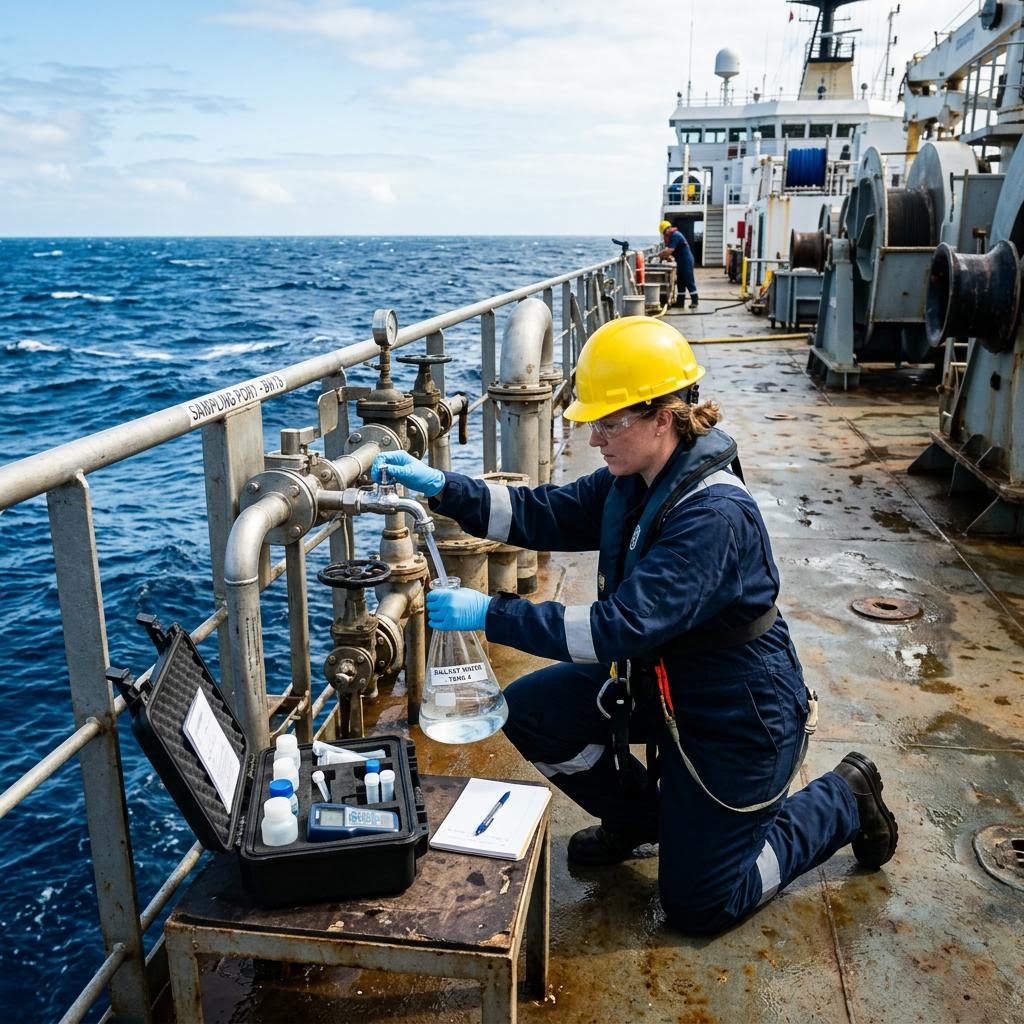
VGP compliance sampling requires a representative sample of the treated discharge, collected during an actual discharge operation from an appropriate sampling point, and handled to preserve the parameters being measured. Chemistry analytes such as residual biocide and pH have their own handling and hold-time constraints, so sample collection, preservation and delivery must be planned around the analysis method.
Analysis must be performed by a laboratory competent and accredited for the parameters in question, typically to ISO 17025, using methods acceptable under the permit. Sea Clean is not itself an accredited test laboratory; its role is to coordinate the sampling logistics and to engage accredited ISO 17025 laboratories to carry out the analysis and produce the defensible results the permit's reporting requires.
Coordinating the sampling around the vessel's real discharge operation and the laboratory's requirements is the crux of the exercise, exactly as with IMO commissioning. A sample collected at the wrong point, at the wrong time in the discharge, or handled outside the analyte's hold time produces a result that reflects logistics rather than compliance.
Sea Clean's Coordination Role
Sea Clean coordinates VGP ballast water compliance sampling by aligning the sampling with the vessel's discharge operation, arranging a suitable sampling point, and engaging accredited ISO 17025 laboratories to analyse for the required analytes. This turns a fragmented set of obligations — sampling, chemistry analysis, record-keeping — into a coordinated exercise managed through one contact.
On the engineering side, Sea Clean's attendance can confirm that the treatment and neutralisation stages are performing so that the discharge chemistry is actually within limits before the compliance sample is drawn, reducing the risk of a sample that documents a problem. For Headway OceanGuard systems this is done with manufacturer backing; for other brands the support is independent and not manufacturer-authorized.
Sea Clean does not act as a regulator or issue permits, and it does not perform the accredited analysis itself; it coordinates the sampling and the accredited laboratory work and supports the operator in assembling the monitoring records. This honest division of roles keeps the compliance evidence defensible and clearly sourced.
Planning VGP Sampling Around a US Call
The reliable approach is to plan VGP sampling before the US call rather than reacting to a request on arrival. Provide the vessel name and IMO number, BWTS make and model, the US discharge port and ETA, and the treatment type to post@seaclean.no so Sea Clean can arrange the accredited laboratory and the sampling around the discharge operation.
Because chemistry analytes have hold-time constraints and accredited laboratory capacity must be booked, early notice against the ETA is decisive — the same lesson that applies to IMO commissioning sampling. Sea Clean coordinates worldwide sampling by arrangement as port access allows, working with accredited laboratories appropriate to the discharge location.
Handling VGP sampling alongside a function check or health check lets Sea Clean confirm the system is performing before the compliance sample is drawn, so the monitoring records document a compliant discharge rather than exposing a treatment shortfall at the worst moment. Early, coordinated planning is what keeps a US call from becoming a compliance problem.
Frequently asked questions
How is VGP sampling different from IMO commissioning testing?
IMO commissioning is a one-off validation, at installation, that a newly fitted system's treatment processes work as intended, assessed by indicative analysis rather than a definitive laboratory D-2 determination. VGP monitoring is an ongoing obligation triggered by discharging in US waters, emphasising treatment by-products and water chemistry such as residual biocide and pH alongside biological performance.
Does the VGP still apply, or has VIDA replaced it?
VIDA directs the EPA and USCG to develop new national standards and regulations, but the VGP remains in force during the transition until the VIDA implementing regulations take effect. Operators trading to the US should track which framework currently applies to their calls.
Does Sea Clean perform the VGP laboratory analysis?
No. Sea Clean is not an accredited test laboratory. It coordinates the sampling logistics and engages accredited ISO 17025 laboratories to analyse for the required analytes and produce the defensible results the permit's monitoring and reporting provisions require.
When should I arrange VGP sampling for a US call?
Before arrival. Chemistry analytes have hold-time constraints and accredited laboratory capacity must be booked, so send the vessel and system details, the US discharge port and ETA, and the treatment type to post@seaclean.no early so sampling is arranged around the discharge operation.
Sources
Related articles
- The US EPA VGP and VIDA Framework for Ballast Water
- USCG Ballast Water Compliance for Ships Calling the United States
- BWMS Commissioning Testing and Sampling Coordination
- Accredited Laboratories and Authorised Parties in Ballast Water Testing
- Ballast Water Compliance in the European Union
- Ballast Water Compliance in Norwegian Waters