VGP Analytes and Monitoring Requirements for Ballast Water
Updated
The 2013 VGP requires monitoring of specific analytes across several discharge streams, not just ballast water. This article details the indicator bacteria measured in ballast water effluent, the residual biocide sampling required for chemical treatment systems, and the separate analyte and frequency rules the permit sets for graywater, bilgewater and exhaust gas scrubber washwater, so operators know exactly what must be sampled, how often, and under what conditions.
Key takeaways
- Ballast water effluent is monitored for total heterotrophic bacteria, E. coli and intestinal enterococci alongside the D-2-aligned viable-organism limits.
- Chemical and electrochlorination systems require bi-annual residual biocide sampling in addition to annual bacteria sampling.
- Graywater sampling applies to certain post-19-Dec-2013 new-builds with crew capacity 15+ and overnight accommodation, twice yearly at least 14 days apart.
- Bilgewater on post-19-Dec-2013 new-builds over 400 GT is sampled annually for oil and grease; scrubber washwater has its own two-then-one schedule.
- TRO, pH and turbidity sensors need more frequent calibration than annually, and a vessel may not discharge while they are inoperable.
- Sea Clean coordinates all-stream sampling with accredited ISO 17025 labs and supplies TRO reagents and sodium thiosulfate.
Why the VGP Specifies Analytes at All
The VGP does not simply require a vessel to hold a treatment system; it requires the operator to prove, through measured analytes, that each regulated discharge meets the permit's limits in service. Analytes are the specific substances or organisms measured in a sample, and the permit defines them per discharge stream so that a result is objective and comparable. This is how the EPA converts a general obligation into an enforceable, testable standard.
For ballast water, the analytes are chosen as practical indicators of biological content that would otherwise require impractically comprehensive organism counts. Measuring a defined set of indicator bacteria gives a reliable, repeatable signal of whether the treatment system is neutralising biological material to standard. This indicator approach underpins the whole monitoring regime.
Because the analytes and frequencies differ by discharge stream and by vessel characteristics such as build date, gross tonnage and crew capacity, operators must map their specific vessel to the permit's requirements rather than assume a single sampling regime covers everything. Getting this mapping right is the foundation of a defensible VGP monitoring programme.
Ballast Water Indicator Bacteria
For ballast effluent the permit calls for testing set indicator microbes rather than a full biological survey. Total heterotrophic bacteria serve as a broad gauge of how much life remains in, and how clean, the water being released. A high count is a sign the treatment plant is not reducing the biological load as it ought to.
E. coli is measured as a key faecal indicator, monitored to confirm the discharge does not present a public health risk, and intestinal enterococci are measured as a second faecal indicator that helps assess the possible presence of sewage-derived pathogens. Together these three analytes give a rounded picture of both general biological content and specific health-relevant contamination in the discharge.
These indicator limits sit alongside the numeric viable-organism limits of the D-2-aligned standard, so a full ballast water assessment addresses both the size-class organism counts and the indicator bacteria. Tests must be carried out to the EPA's specified methods so results are accurate, verifiable and legally defensible; a result produced outside recognised methodology is difficult to rely on in an enforcement context.
Residual Biocide Sampling for Chemical Systems
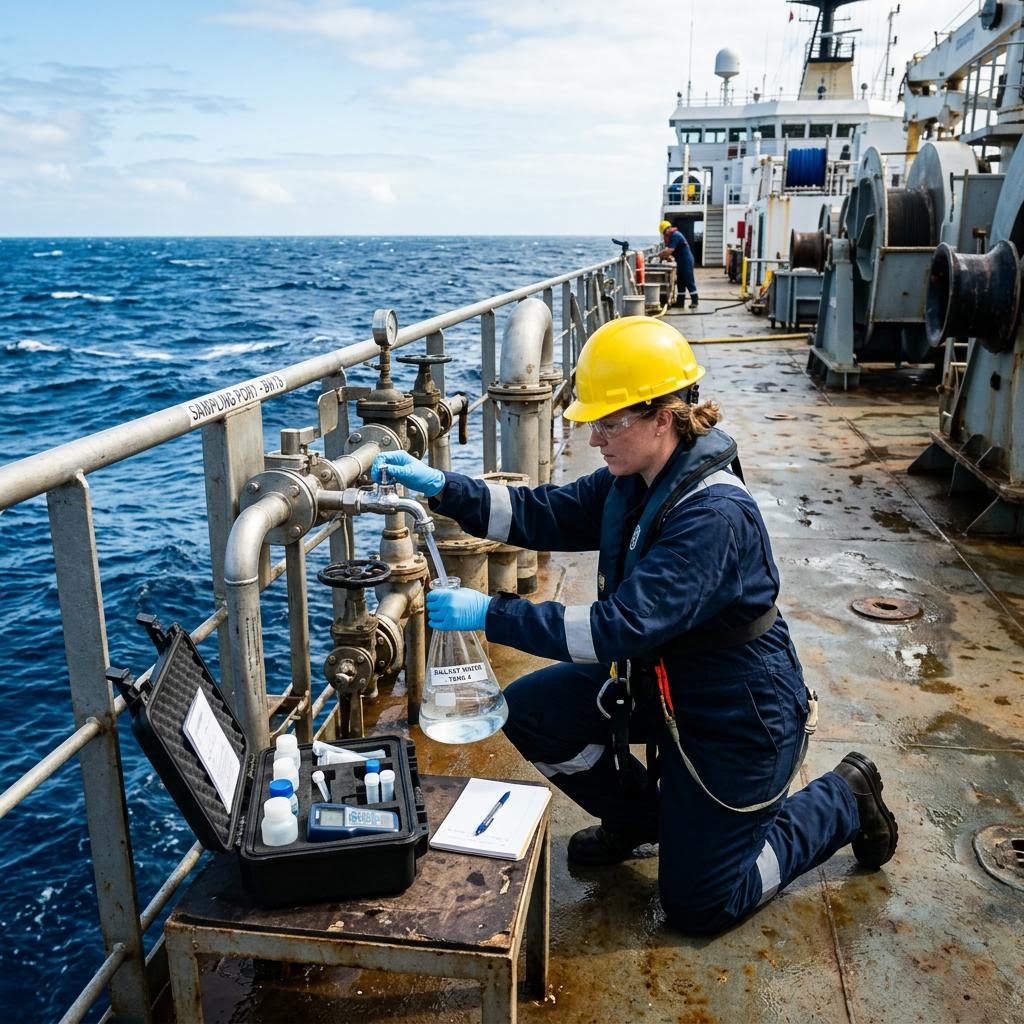
Vessels using an active-substance treatment system, such as electrochlorination or chemical injection, must also monitor residual biocide in the discharge. The VGP requires biocide residual sampling on a bi-annual basis for these systems, in addition to the annual water sampling for bacteria, because a discharge that carries an excessive oxidant residual is itself an environmental concern even if it is biologically clean.
Residual biocide monitoring is closely tied to the treatment system's neutralisation stage. Systems that generate an oxidant, typically expressed as Total Residual Oxidant (TRO), must neutralise it before discharge, commonly with sodium thiosulfate, so the discharge falls within acceptable residual limits. The biocide sampling confirms that this neutralisation is working, not just that the system is dosing.
This links analyte monitoring directly to sensor calibration. Because TRO sensors are among the probes the EPA expects to require more frequent calibration than annually, and because a vessel may not discharge while those sensors are inoperable, residual biocide analytes and sensor accuracy are two halves of the same compliance picture. Sea Clean supplies TRO test reagents and sodium thiosulfate and coordinates the supporting sampling, so operators can demonstrate both dosing and neutralisation within limits.
Graywater, Bilgewater and Scrubber Analytes
The permit's analyte monitoring reaches well past ballast water. Under Part 2.2.15 of the 2013 permit, newly built vessels laid down on or after 19 December 2013 that can carry a crew of 15 or more and offer overnight berths have to sample their graywater, taking two samples a year spaced at least 14 days apart. This reflects that untreated graywater can match domestic sewage for pollutant load, some of its constituents running to roughly triple the levels of ordinary untreated household wastewater.
For bilgewater, Part 2.2.2 obliges the owner of a newly built vessel laid down from 19 December 2013 onward, above 400 gross tons, that might release bilgewater into US waters, to take one sample a year of the treated bilge effluent and test it for oil and grease. This runs alongside the MARPOL regime of the 15 ppm oily-water-separator limit, yet stands as a separate permit test with a record of its own.
For wet exhaust gas scrubber systems, Part 2.2.26 requires two samples in the first year of coverage or system operation, at least 14 days apart, one of which may be taken as part of an annual survey and, in the first year, one as part of installation verification. After the first year, at least one sample per calendar year is required and may be combined with the annual survey. Mapping each of these stream-specific rules to the individual vessel is essential, because build date, tonnage and crew capacity determine which apply.
Monitoring Frequency and Calibration Interplay
The permit's ballast water sampling frequency is performance-linked, and it must be read together with the analyte and calibration rules. New systems are sampled two to four times in the first year to build baseline data, and results within limits over two consecutive events can reduce sampling to annual, while a later exceedance returns the vessel to twice-yearly monitoring. Bacteria sampling is annual and biocide residual sampling bi-annual once on the reduced ballast water schedule.
Alongside the effluent analytes, the VGP requires annual system function checks and calibration of sensors for UV, flow, temperature and pressure, with more frequent calibration expected for pH, TRO and turbidity probes. The rule that a vessel may not discharge while these sensors are inoperable ties calibration directly to operational availability, so a lapsed calibration is not merely an audit finding but a bar on discharge.
Because analyte sampling, biocide residual monitoring and sensor calibration all sit on interlocking schedules, operators benefit from consolidating them into a single planned attendance where possible. This avoids repeat mobilisations and keeps the vessel's records aligned across streams. Coordinating the events against a survey or an existing port call is the efficient way to keep every analyte requirement current.
Managing the Analyte Programme in Practice
A clear analyte matrix, listing each applicable discharge stream, the analytes required, the sampling frequency and the trigger conditions, keeps a VGP programme auditable. It should reflect the specific vessel's build date, gross tonnage, crew capacity and treatment technology, because these determine which graywater, bilgewater and scrubber obligations apply. Without that matrix, it is easy to miss a stream and generate an enforcement gap.
Because sampling for bacteria, biocide residual, graywater, bilgewater and scrubber washwater each requires correct collection, preservation and an accredited-lab analysis, most operators coordinate the whole programme through a specialist. Sea Clean coordinates sampling with accredited ISO 17025 laboratories and returns each result with a completed Chain of Custody, so the documentation is defensible across all applicable analytes.
Sea Clean attends vessels across the North Sea within 24 hours and other regions by arrangement as flights, visas and port access allow, and supplies TRO reagents, sodium thiosulfate and calibration support for the sensors tied to these analytes. Send the vessel name, IMO number, build date, gross tonnage, crew capacity and BWTS make and model to post@seaclean.no for a tailored analyte and sampling plan.
Frequently asked questions
Which bacteria does the VGP require for ballast water?
The 2013 VGP requires ballast water effluent to be analysed for total heterotrophic bacteria as a general biological indicator, plus E. coli and intestinal enterococci as faecal indicators. These indicator analytes sit alongside the numeric viable-organism limits that align with the IMO D-2 standard.
How often is residual biocide sampled under the VGP?
Vessels with active-substance systems such as electrochlorination or chemical injection must carry out residual biocide sampling on a bi-annual basis, in addition to the annual water sampling for bacteria. This confirms that the system's neutralisation stage is keeping the discharged oxidant residual within acceptable limits.
Do all vessels have to sample graywater and bilgewater?
No. Graywater sampling applies to new-builds constructed on or after 19 December 2013 with a maximum crew capacity of 15 or more that provide overnight accommodation. Bilgewater sampling applies to new-builds from the same date over 400 gross tons that may discharge bilgewater. Build date, tonnage and crew capacity determine which apply.
Can Sea Clean supply the reagents for biocide monitoring?
Yes. Sea Clean supplies TRO test reagents and sodium thiosulfate neutraliser and provides sensor calibration support, and coordinates the associated sampling with accredited ISO 17025 laboratories. Sea Clean is not itself an accredited lab. Contact post@seaclean.no with the vessel and system details for a tailored plan.
Sources
Related articles
- VGP Compliance Testing Explained: A Step-by-Step Guide
- EPA VGP Guide for Vessel Operators: Ballast Water Rules
- Total Residual Oxidant (TRO) Monitoring and Neutralisation
- VGP Compliance Sampling Service for US Ballast Discharge
- USCG Ballast Water Compliance for Ships Calling the United States
- The US EPA VGP and VIDA Framework for Ballast Water