Ballast Water Compliance in the European Union
Updated
The European Union does not run a separate ballast water equipment scheme like the United States; compliance rests on the IMO Ballast Water Management Convention as enforced by member states through port state control under the Paris MOU, with EMSA providing coordination and guidance. This article explains how the regime works in EU ports, the role of commissioning testing under MEPC.325(75), and how Sea Clean supports sampling and reagent supply with accredited laboratories.
Key takeaways
- The EU has no separate ballast water equipment scheme; compliance rests on the IMO Convention enforced through port state control.
- IMO BWMS Code type approval is accepted across EU ports with no additional EU type approval required.
- All relevant ships must meet the D-2 standard, normally through a working type-approved treatment system.
- Commissioning testing under MEPC.325(75) validates a newly installed system and is performed with accredited or authorised parties.
- Paris MOU port state control checks the plan, record book, certificate and operating state, and may take samples.
- Sea Clean supports sampling, reagents and commissioning in cooperation with accredited laboratories but is not itself an accredited test body.
The EU Approach: Convention Plus Port State Control
Unlike the United States, the European Union has not created a distinct ballast water equipment approval regime. Compliance in EU waters is built on the IMO Ballast Water Management Convention, which all EU coastal states have ratified, and enforced through port state control coordinated under the Paris Memorandum of Understanding. The practical rules a ship meets are the Convention's, applied by national authorities.
This means a ballast water management system type-approved by a flag administration under the IMO BWMS Code is accepted across EU ports, provided it is installed, maintained and operated correctly. There is no separate EU type approval to obtain on top of the IMO approval. The variability between EU ports lies in inspection practice and intensity rather than in the underlying standard.
The European Maritime Safety Agency supports member states with guidance, training and information systems that help harmonise how ballast water requirements are checked. EMSA does not itself detain ships; enforcement remains with national port state control officers. Sea Clean helps operators prepare for that enforcement by aligning equipment, records and sampling with what officers expect to see.
The D-2 Standard and Installed Systems
Under the Convention all relevant ships must now meet the D-2 discharge standard, which limits the concentration of living organisms in defined size classes and sets limits for indicator microbes. Meeting D-2 normally depends on a working type-approved treatment system rather than on ballast water exchange, which under the D-1 standard was the earlier compliance route now largely phased out.
EU port state control officers check that the installed system matches the vessel's documentation, holds valid type approval, and is being operated within its approved parameters. A system that is fitted but bypassed, inoperative or run outside its limits is treated as non-compliance even if the hardware is present. The condition and operation of the system matter as much as its existence.
Sea Clean supplies genuine Headway OceanGuard parts and multi-brand BWMS spares, plus the TRO test kits and sodium thiosulfate neutraliser used to keep oxidant-based systems within their approved discharge envelope. Keeping a system serviceable and demonstrably operating to standard is the foundation of EU compliance.
Commissioning Testing in EU Ports
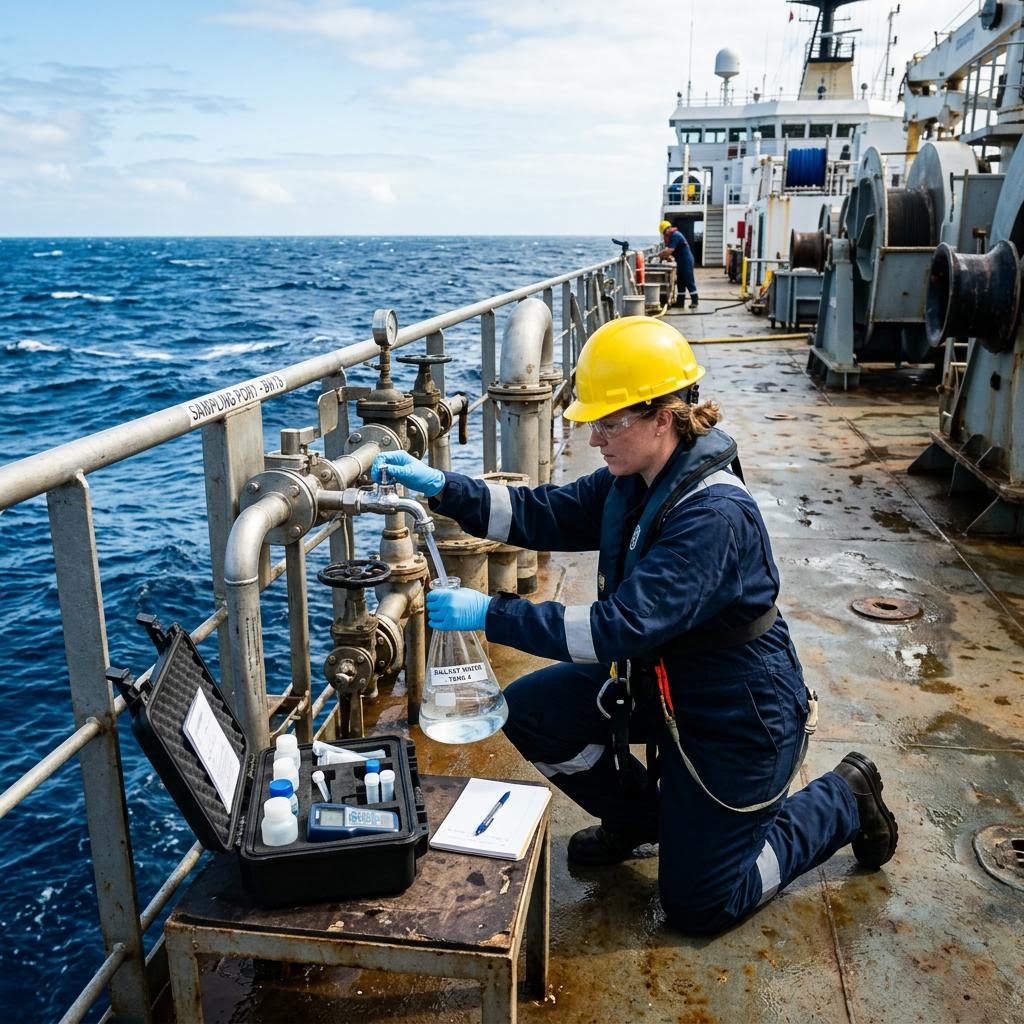
Commissioning testing of newly installed ballast water management systems follows IMO resolution MEPC.325(75), which requires a representative sample of treated water to be analysed to confirm the system performs as intended before it enters service. This testing is carried out in cooperation with the flag administration or recognised organisation and an accredited or otherwise authorised testing party, not by the equipment supplier alone.
The test typically combines indicative analysis for a rapid on-board indication with detailed analysis where required to confirm the organism counts against the standard. The result is documented and retained so the vessel can show, at later inspections, that the system was validated on installation. A failed or absent commissioning test is a serious finding.
Sea Clean coordinates and supports commissioning testing in EU ports, attending to facilitate representative sampling, supplying the test kits and reagents, and working with accredited laboratories and authorised parties who perform and certify the analysis. We are not an accredited testing laboratory ourselves and do not issue the certified result; the authorised party does.
Port State Control Inspections
Paris MOU inspections in EU ports check ballast water as part of the wider examination, looking at the management plan, the ballast water record book, the international ballast water management certificate, crew familiarity and the operating state of the system. Officers may use the targeting factors of the MOU to select ships, so vessels with poor histories or risk profiles see more scrutiny.
Where doubt exists, officers can take or witness samples, using indicative methods for a quick screening result and, if warranted, referring samples for detailed laboratory analysis. The MOU has run concentrated inspection campaigns on ballast water, during which adherence is checked more systematically across participating states. A documented, operating system and consistent records keep these inspections routine.
Sea Clean supports vessels by helping assemble a coherent record set, supplying reagents and consumables, and coordinating sampling with accredited parties when detailed analysis is needed. The defensible result always comes from the accredited laboratory, with our role being to make the sampling and documentation reliable.
Records, Certificates and the Management Plan
Every ship subject to the Convention carries an approved Ballast Water Management Plan specific to the vessel, a Ballast Water Record Book recording each operation, and an International Ballast Water Management Certificate where applicable. EU port state control will expect these to be present, current and consistent with each other and with the installed equipment.
The record book must capture uptake, treatment, internal transfer and discharge with enough detail to reconstruct what happened on a voyage. Gaps, contradictions or entries describing equipment the ship does not have are common findings. The plan should describe the real sampling points and procedures the crew actually use.
Sea Clean helps operators keep TRO testing and sampling documentation aligned with the plan and record book so the package holds together at inspection. We can also advise on restocking reagents and verifying system operation before an EU call. Contact post@seaclean.no with the vessel particulars to begin coordination.
How Sea Clean Supports EU Calls
Sea Clean is a Norwegian maritime company in Haugesund and Karmsund with a Rotterdam presence, well placed to support vessels across northern Europe and beyond. We supply BWTS spare parts and ballast water reagents, provide service and engineer attendance, and coordinate commissioning and sampling support in cooperation with accredited laboratories and authorised parties.
Our European base means parts, reagents and technician attendance can reach many EU ports quickly, with Rotterdam acting as a convenient hub for north-west European calls. For ports outside our direct attendance range we arrange sampling and parts supply through courier, forwarding and local agents. We do not claim accreditation as a test body; accredited parties certify the analysis.
Operators planning EU calls can contact post@seaclean.no with the vessel name, IMO number, installed BWMS make and intended ports. Early engagement lets us stage reagents and parts, arrange any commissioning support and align documentation before arrival.
Frequently asked questions
Does the EU require a separate ballast water type approval?
No. The EU relies on the IMO Ballast Water Management Convention, so a system type-approved by a flag administration under the IMO BWMS Code is accepted across EU ports. Enforcement is through port state control under the Paris MOU rather than a distinct EU equipment scheme.
What is commissioning testing and who performs it?
Commissioning testing under MEPC.325(75) confirms a newly installed system performs to standard by analysing a representative sample of treated water before the system enters service. It is carried out with the flag administration or recognised organisation and an accredited or authorised testing party, not by the supplier alone.
What does EMSA do for ballast water compliance?
The European Maritime Safety Agency supports member states with guidance, training and information systems that help harmonise how ballast water requirements are checked. EMSA does not detain ships; enforcement stays with national port state control officers.
How does Sea Clean support an EU port call?
Sea Clean supplies BWTS parts and reagents, provides engineer attendance, and coordinates commissioning and sampling support with accredited laboratories and authorised parties. With a Rotterdam presence we can reach many EU ports quickly, while the certified analysis remains with the accredited party.
Sources
Related articles
- Ballast Water Compliance in Norwegian Waters
- Ballast Water Compliance in the United Kingdom
- Ballast Water Commissioning Testing: What Happens On Board
- Ballast Water Testing and Sampling at the Port of Rotterdam
- Ballast Water Compliance in Japan
- USCG Ballast Water Compliance for Ships Calling the United States