Measuring Organism Viability in Ballast Water
Updated
The D-2 standard is written in terms of living organisms per volume in defined size classes, so the central question in detailed analysis is whether an organism is alive. This article explains the size classes, the difference between viability and motility, and the staining and microscopy methods accredited laboratories use to count living organisms. It clarifies what indicative methods can and cannot show and how Sea Clean AS supports sampling while accredited laboratories perform and certify the counts.
Key takeaways
- D-2 limits living organisms in two plankton size classes plus specified indicator microbes for human health.
- Viability assessment distinguishes living from dead organisms, not just particles of the right size.
- Motility methods judge movement; viability methods judge metabolic activity, which matters for small phytoplankton.
- FDA/CMFDA staining and PAM fluorometry are common viability methods for the 10 to 50 micrometre class.
- The larger class is concentrated from big sample volumes and counted by microscopy with gentle handling.
- Indicative methods screen rapidly but only accredited laboratories produce certified D-2 organism counts.
The D-2 Standard and Size Classes
The IMO D-2 standard sets numerical limits on the concentration of viable organisms a vessel may discharge, divided by size. The two plankton size classes are organisms greater than or equal to 50 micrometres in minimum dimension, limited to fewer than 10 per cubic metre, and organisms from 10 to less than 50 micrometres, limited to fewer than 10 per millilitre.
Below those, the standard also limits specified indicator microbes, including toxicogenic Vibrio cholerae, Escherichia coli and intestinal enterococci, which are assessed by microbiological methods rather than by counting plankton. These limits address human-health concerns separately from the plankton classes.
Because the standard counts living organisms, the analysis must distinguish living from dead, not merely count particles of the right size. This is the core technical challenge of detailed ballast water analysis and the reason viability assessment methods matter so much.
Viability Versus Motility
Two broad ideas are used to decide whether an organism counts as living. Motility-based assessment treats an organism as alive if it moves, either spontaneously or in response to a stimulus, which is straightforward for many zooplankton in the larger size class.
Viability-based assessment treats an organism as alive if it is metabolically active or has intact cell function, even if it is not visibly moving. This matters for the smaller 10 to 50 micrometre class, which includes many phytoplankton and protists that do not show obvious movement but may still be alive and capable of reproducing.
The distinction is not academic: a treatment that immobilises organisms without killing them might pass a motility test but fail a viability test, and vice versa. Type approval and commissioning testing specify which methods are acceptable so results are comparable and defensible.
Staining Methods for the Smaller Size Class
For the 10 to less than 50 micrometre class, vital stains are widely used to indicate metabolic activity. The FDA and CMFDA stain pair (fluorescein diacetate and its chloromethyl derivative) relies on enzymes inside living cells cleaving the non-fluorescent stain into a fluorescent product, so cells that fluoresce are treated as alive.
Other approaches measure photosynthetic activity, such as pulse-amplitude-modulated (PAM) fluorometry, which detects whether phytoplankton can still photosynthesise. These methods give a measure of how many cells remain functionally alive after treatment, which is what the standard cares about.
Stain-based methods require careful handling, controlled incubation and skilled interpretation, which is why they are performed in laboratory conditions by trained analysts. They also have known limitations and false-positive or false-negative behaviours that an accredited laboratory understands and accounts for.
Microscopy and Counting the Larger Class
For the greater than or equal to 50 micrometre class, organisms are concentrated from a large sample volume and examined under a microscope, where an analyst counts living individuals using movement or response to a stimulus as the viability criterion. Because the limit is fewer than 10 per cubic metre, large volumes must be filtered to find the few organisms present.
The concentration step is delicate: filtering and handling must avoid killing organisms before they are assessed, or the count will understate the living population. This is why detailed-analysis samples are collected gently and transported under controlled conditions.
Counting is labour-intensive and depends on the analyst's training, so reproducibility comes from standardised laboratory procedures and accreditation. The result is a defensible count that can be tied back to the discharge through the sampling documentation.
Indicative Methods and Their Limits
Indicative methods aim to give a rapid, on-board screening result rather than a full count. Tools such as portable fluorometers, ATP measurement and simple motility observation can suggest whether the treated water is broadly within or well outside the standard, which is useful for early warning.
However, indicative methods do not produce the certified, size-class organism counts the D-2 standard requires, and a passing indicative result is not proof of compliance. They are better understood as triage: a clear failure is a strong signal to investigate, while a pass still leaves detailed analysis as the authoritative test.
Sea Clean supplies indicative tools and reagents and supports their use on board, but treats them as screening aids. Where an authoritative result is needed, the sample goes to an accredited laboratory that performs and certifies the viability analysis.
How Sea Clean Supports Viability Testing
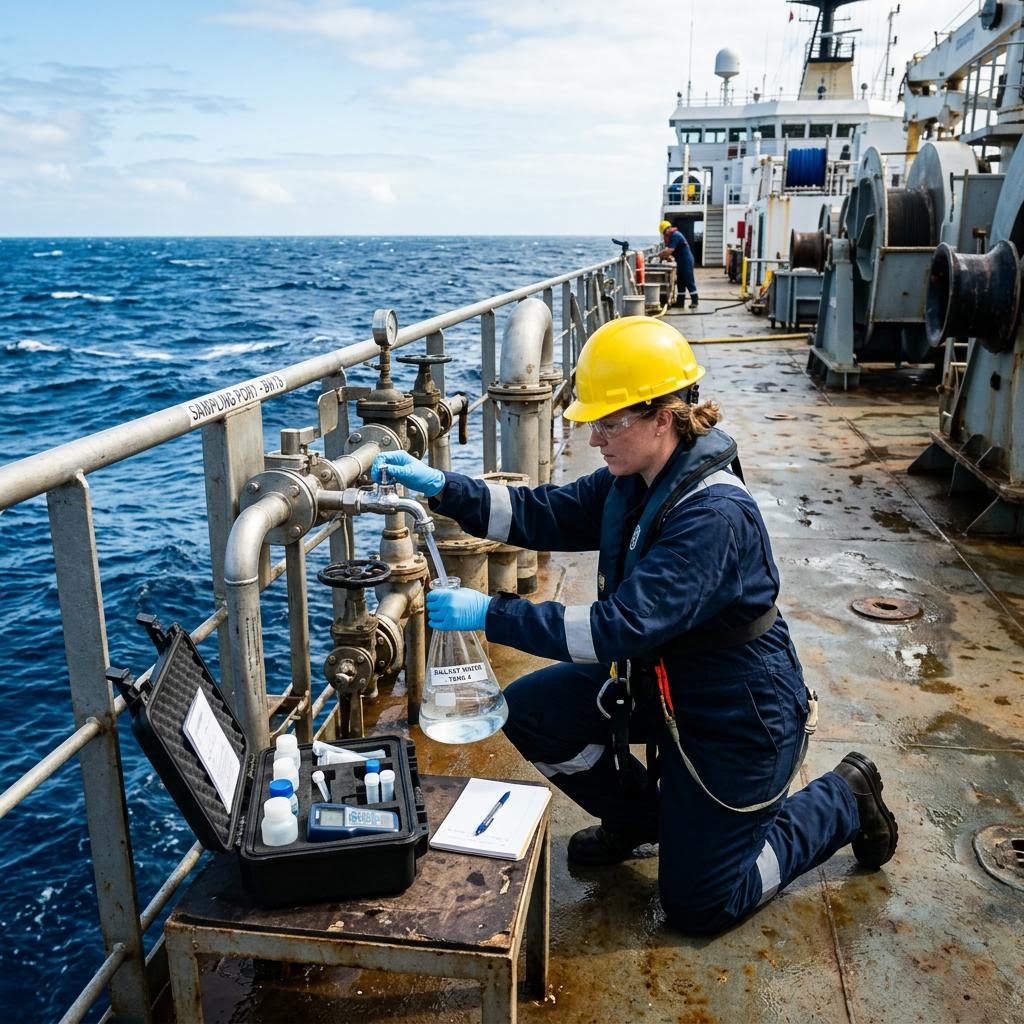
Sea Clean coordinates and supports the sampling that feeds viability analysis, working in cooperation with accredited laboratories (ISO/IEC 17025) and parties authorised by the flag administration or class. We attend to help collect representative, gently handled samples and to manage the chain of custody to the laboratory.
We supply the TRO test kits, reagents and indicative screening tools used on board, and we arrange the logistics so laboratory-bound samples reach the analyst within the required time and condition. The accredited laboratory carries out the staining, microscopy or microbiological work and certifies the count; Sea Clean does not certify analytical results.
For commissioning testing under MEPC.325(75) or for compliance verification, send the vessel name, IMO number, port, ETA and BWMS type to post@seaclean.no so we can coordinate the right laboratory or authorised party and the necessary sampling support.
Frequently asked questions
What are the D-2 size classes?
The D-2 standard limits living organisms greater than or equal to 50 micrometres to fewer than 10 per cubic metre and organisms from 10 to less than 50 micrometres to fewer than 10 per millilitre. It also limits specified indicator microbes such as toxicogenic Vibrio cholerae, E. coli and intestinal enterococci.
What is the difference between viability and motility?
Motility judges an organism as alive if it moves, which works well for larger zooplankton. Viability judges an organism as alive if it is metabolically active even without visible movement, which matters for small phytoplankton that may be alive but immobile after treatment.
What is FDA/CMFDA staining?
It is a vital stain method where living cells with active enzymes convert a non-fluorescent stain into a fluorescent product, so cells that fluoresce are counted as alive. It is widely used for the 10 to 50 micrometre size class and is carried out by trained analysts in laboratory conditions.
Can indicative testing confirm D-2 compliance?
No. Indicative tests such as portable fluorometry or ATP measurement screen the water quickly and are useful for early warning, but they do not produce the certified size-class organism counts the D-2 standard requires. Authoritative results come from an accredited laboratory.
Sources
Related articles
- Detailed Ballast Water Analysis in an Accredited Laboratory
- Fluorometry for Rapid Ballast Water Screening
- Indicative vs Detailed Ballast Water Analysis
- Accredited Laboratories and Authorised Parties in Ballast Water Testing
- USCG Ballast Water Compliance for Ships Calling the United States
- The US EPA VGP and VIDA Framework for Ballast Water