Fluorometry for Rapid Ballast Water Screening
Updated
Fluorometry is one of the most common tools for rapid, on-board screening of ballast water because it gives a result in minutes without a laboratory. This article explains how chlorophyll and stain-based fluorescence work, what a portable fluorometer reading means, and where pulse-amplitude-modulated (PAM) measurement fits. It is clear about the limits of indicative fluorometry and how Sea Clean AS uses it to support, not replace, the accredited analysis that certifies compliance.
Key takeaways
- Fluorometry gives a rapid on-board screen of living biological material, suited to the 10 to 50 micrometre class.
- Chlorophyll fluorescence indicates photosynthetic biomass but does not perfectly separate living from recently dead cells.
- PAM fluorometry measures active photosynthesis and is a more direct viability indicator than total chlorophyll.
- Stain-based fluorescence ties readings to living-cell activity but needs correct stain handling to be meaningful.
- Readings depend on calibration, method and water type and can be skewed by turbidity and non-target fluorescence.
- Fluorometry is screening triage; accredited laboratories produce the certified D-2 counts compliance requires.
What Fluorometry Measures
Fluorometry measures light emitted by certain molecules after they absorb light of a shorter wavelength. In ballast water screening, the molecules of interest are either chlorophyll inside photosynthetic organisms or fluorescent products created by vital stains in living cells, so the emitted light gives an indication of how much living biological material is present.
Because the measurement is optical and fast, a portable fluorometer can give a reading within minutes of taking a sample, which is why it is a leading indicative tool. It is particularly suited to the smaller 10 to less than 50 micrometre size class, dominated by phytoplankton that contain chlorophyll.
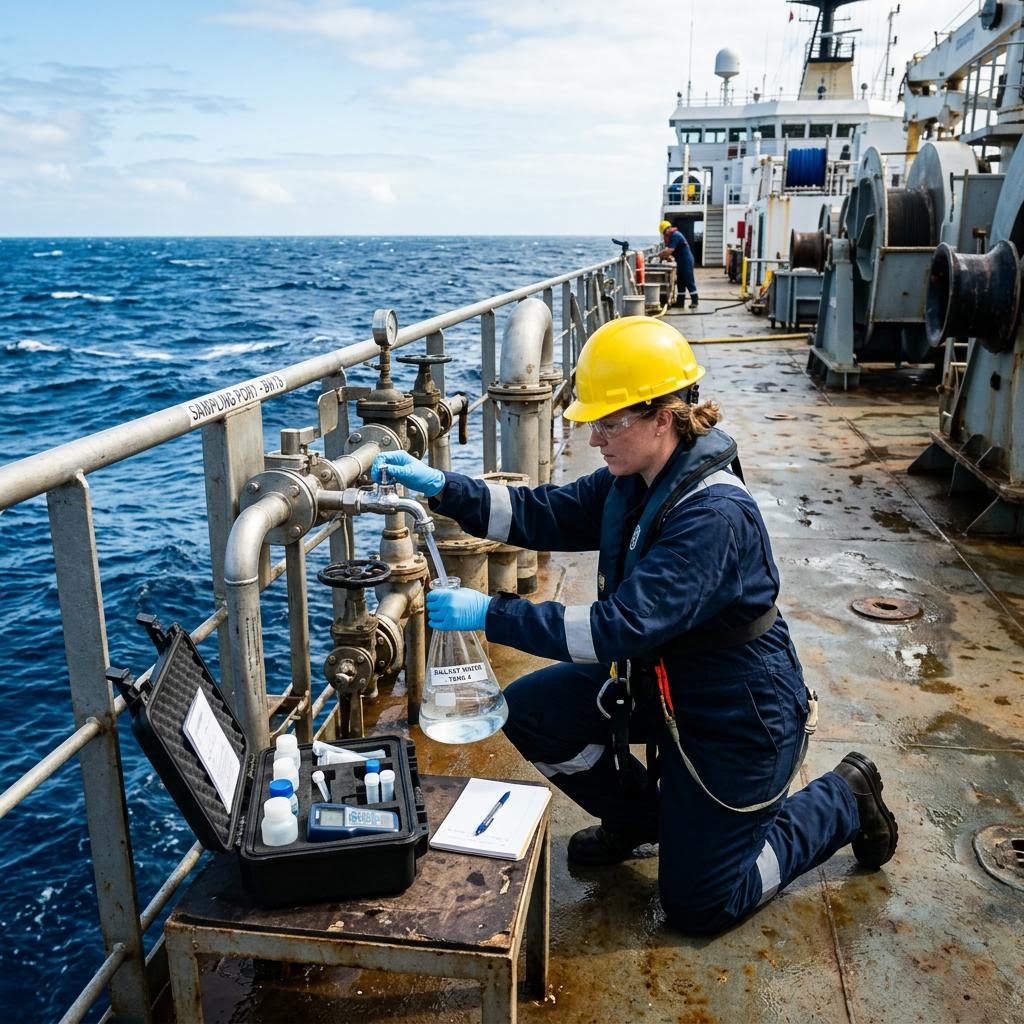
The appeal is speed and simplicity: a crew member or attending party can screen a discharge sample on board without sending it ashore. The trade-off is that the result is a proxy for living biomass or activity, not a direct organism count.
Chlorophyll Fluorescence and Phytoplankton
Chlorophyll fluoresces when illuminated, and the strength of that fluorescence relates to the amount of photosynthetic material in the sample. A high chlorophyll fluorescence in treated water suggests living phytoplankton remain, while a low reading suggests the treatment has reduced the photosynthetic population.
Chlorophyll fluorescence alone does not distinguish perfectly between living and recently killed cells, because chlorophyll can persist for a time after a cell dies. This is one reason a single chlorophyll reading is treated as a screening indicator rather than a definitive viability measure.
Despite that limitation, chlorophyll fluorometry is a quick way to flag a treatment that is clearly underperforming. A discharge with high chlorophyll fluorescence relative to expectations is a strong signal to investigate the system before relying on it for a regulated discharge.
PAM Fluorometry and Photosynthetic Activity
Pulse-amplitude-modulated (PAM) fluorometry goes a step further by measuring whether phytoplankton can still photosynthesise, which is a more direct indicator of viability than total chlorophyll. It applies controlled light pulses and analyses the fluorescence response to assess the functional state of the photosynthetic apparatus.
Because PAM reflects active photosynthesis, it is better at distinguishing living, functional cells from dead material than simple chlorophyll measurement. This makes it a more informative screening method for assessing whether treatment has actually disabled the organisms rather than just damaged their structure.
PAM is still an indicative method: it informs the 10 to 50 micrometre class but does not by itself produce the certified count the D-2 standard requires. It is used as a higher-quality screen, often alongside other checks, rather than as a compliance certificate.
Stain-Based Fluorescence for Viability
Some fluorometric approaches combine a vital stain with fluorescence detection. The FDA-type stains used in laboratory viability work create a fluorescent product only in living cells, so reading that fluorescence indicates how many cells are metabolically active.
On board, simplified stain-and-read tools aim to bring some of this viability information into a rapid format. They are more directly tied to living-cell activity than chlorophyll alone, but they require correct stain handling and incubation to give meaningful readings.
As with all indicative methods, the value is in screening and early warning. A clear failure on a stain-based fluorescence check is a reliable prompt to investigate, while a pass does not remove the need for accredited analysis when an authoritative result is required.
Interpreting Readings and Their Limits
A fluorometer produces a number, and the meaning of that number depends on calibration, the method, the water type and the threshold being applied. Interpreting it correctly means understanding what the instrument measures and comparing against an appropriate reference or threshold rather than treating any reading as a pass or fail in isolation.
Indicative fluorometry has known limitations: it can be affected by turbidity, by non-target fluorescent material, and by the persistence of chlorophyll in dead cells. These are reasons a result is treated as a screen, and why a borderline or unexpected reading is followed up rather than accepted at face value.
Used sensibly, fluorometry is valuable triage. It tells the crew or attending party whether the treated water is broadly acceptable or clearly problematic, focusing attention and resources where they are needed before committing to detailed laboratory analysis.
How Sea Clean Uses Fluorometry in Support
Sea Clean uses fluorometry and other indicative tools to support on-board screening and self-monitoring, supplying the consumables and reagents the methods need and helping the crew take and interpret samples. This gives early warning of treatment problems between accredited tests.
We are clear that indicative fluorometry does not certify D-2 compliance. Where an authoritative result is required, Sea Clean coordinates sampling and attendance with accredited laboratories (ISO/IEC 17025) and parties authorised by the flag administration or class, who perform and certify the analysis.
Combining rapid screening with planned accredited testing gives a vessel both day-to-day confidence and a defensible compliance position. To set up indicative screening support or to coordinate accredited testing, send the vessel name, IMO number, BWMS type and requirement to post@seaclean.no.
Frequently asked questions
How fast is a fluorometry screening result?
A portable fluorometer can give a reading within minutes of taking a sample, without sending it ashore. That speed makes it a leading indicative tool for on-board screening, though the result is a proxy for living biomass or activity rather than a certified organism count.
What is the difference between chlorophyll and PAM fluorometry?
Chlorophyll fluorometry measures total photosynthetic material, which can persist briefly after cells die. PAM fluorometry measures whether cells can still photosynthesise, making it a more direct indicator of viability and better at separating living, functional cells from dead material.
Can fluorometry confirm a ballast discharge is compliant?
No. Fluorometry is an indicative screening method that flags clear problems and gives early warning, but it does not produce the certified size-class organism counts the D-2 standard requires. Authoritative compliance results come from an accredited laboratory.
What can distort a fluorometer reading?
Turbidity, non-target fluorescent material, calibration state and the persistence of chlorophyll in dead cells can all affect readings. For this reason a result is treated as a screen, and unexpected or borderline readings are followed up rather than accepted at face value.
Sources
Related articles
- Measuring Organism Viability in Ballast Water
- Indicative Analysis Methods for Ballast Water
- Indicative vs Detailed Ballast Water Analysis
- Detailed Ballast Water Analysis in an Accredited Laboratory
- USCG Ballast Water Compliance for Ships Calling the United States
- The US EPA VGP and VIDA Framework for Ballast Water