Remote BWTS Commissioning and Service Support
Updated
When a vessel is at sea or in a port an engineer cannot reach in time, remote support keeps a ballast water treatment system in service. This article explains what remote commissioning and service support can and cannot achieve, how guided crew procedures and log review work, and how Sea Clean AS combines remote diagnosis with parts dispatch and later attendance.
Key takeaways
- Remote support bridges the gap between a fault arising and a physical attendance being possible.
- Commissioning testing needs on-site representative sampling and cannot be completed purely remotely.
- Guided crew procedures suit calibration, alarm clearing and consumable changes within the crew's competence and safety limits.
- Exported logs and alarm histories often identify the root cause so the right part is dispatched before an engineer travels.
- Sea Clean supports Headway remotely as authorized agent and provides independent remote diagnosis for other makers.
- Remote diagnosis plus parts dispatch and later attendance reduces downtime and turns two port calls into one.
Where Remote Support Fits
Not every BWTS issue justifies, or allows time for, an engineer to fly to the vessel. A control alarm that the crew can clear with guidance, a sensor that needs recalibration, or a fault that needs diagnosis before the right parts are ordered are all situations where remote support is the practical first step. It bridges the gap between a problem arising and a physical attendance being possible.
Remote support is most effective when the crew are competent and the system has accessible logs and a clear alarm history. The engineer ashore works through the vessel's own personnel, so the quality of the information sent back, and the crew's ability to carry out instructions safely, set the limits of what can be achieved.
It is honest to recognise the boundary: some faults need hands, tools and parts on board and cannot be resolved remotely. Remote support then becomes a diagnostic exercise that defines exactly what an attending engineer must bring, which avoids a wasted trip and shortens the eventual repair.
Remote Commissioning Limits and Reality
Commissioning testing under MEPC.325(75) requires representative discharge sampling and analysis during an actual ballast operation, which cannot be done purely remotely. Where physical attendance for the test is impractical, the realistic role of remote support is preparation: confirming the system is operating correctly, reviewing the function test, and coordinating the sampling and analysis with an accredited party.
Sea Clean is not an accredited testing laboratory and does not hold testing accreditation. For commissioning it coordinates with accredited laboratories and parties authorised by the flag or class, who perform and certify the analysis. Remote support helps the crew prepare the system and the documentation so an on-site sampling attendance, by Sea Clean or another party, is efficient when it happens.
For routine service rather than commissioning, remote support can guide many maintenance and recovery tasks the crew are competent to perform, with the engineer verifying each step through logs, photographs and live communication.
Guided Crew Procedures
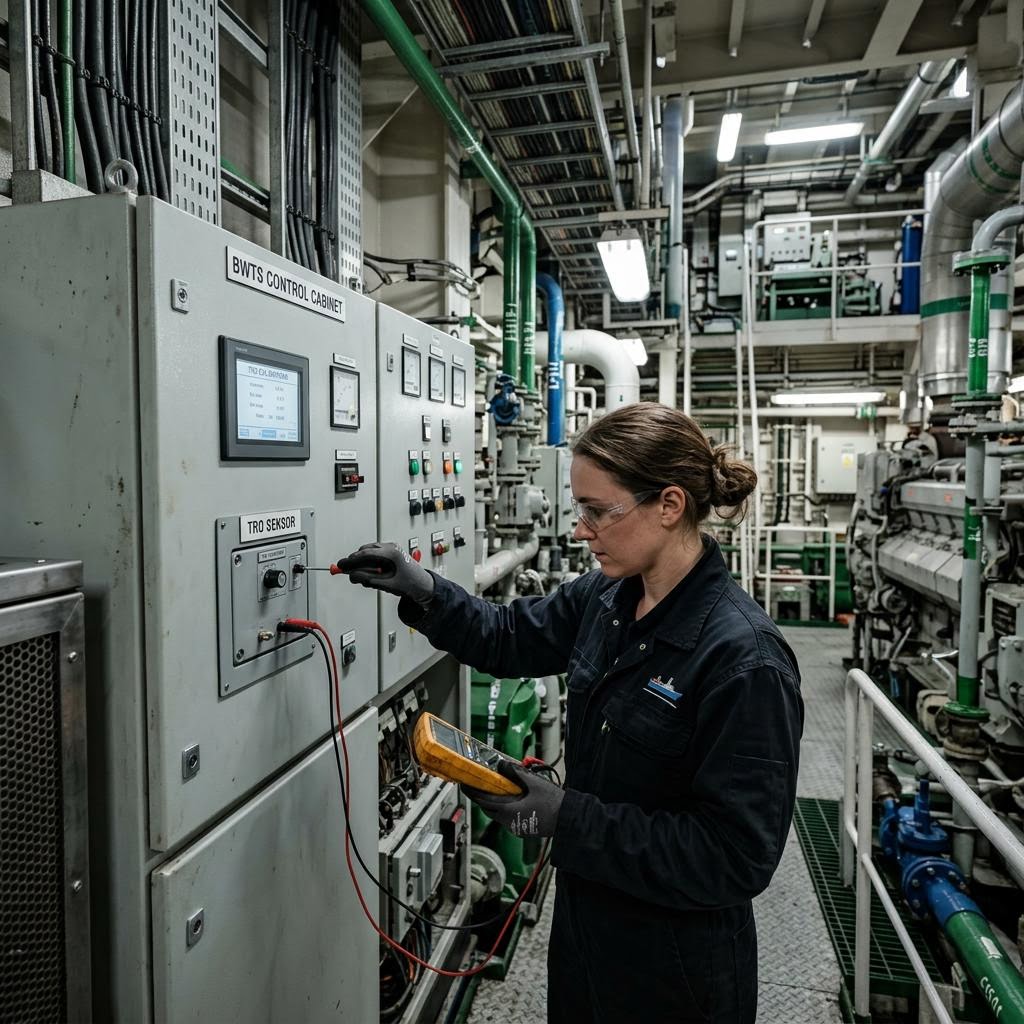
In a guided procedure the engineer ashore prepares a step-by-step sequence for the crew, covering the safety isolation, the action, and the checks at each stage. Photographs or video of the equipment, the control screen and the alarm list let the engineer confirm the state of the system before instructing the next step. This works well for sensor calibration, alarm clearing, valve checks and routine consumable changes.
Safety governs what can be attempted. Work on energised electrical equipment, pressurised systems or anything outside the crew's competence is not delegated remotely; instead the task waits for an attending engineer. The engineer ashore is responsible for not instructing the crew beyond what is safe and feasible on board.
A clear record of each guided procedure, with the steps taken and the results, becomes part of the vessel's maintenance evidence and informs any later attendance. It also helps the next port or surveyor see that the system has been actively maintained.
Log Review and Fault Diagnosis
Modern systems record alarms, operating parameters and treatment data that can be exported and sent ashore for analysis. Reviewing the alarm history, the TRO or UV intensity trends, flow rates and power data often identifies the root cause without anyone touching the equipment. A sensor drifting out of calibration, a filter differential rising over time, or a cell losing output each leave a signature in the logs.
Diagnosis from logs lets the right part be identified and dispatched before an engineer travels, so the attendance, when it happens, is a fitting and testing visit rather than an investigation. This is often the difference between one port call to fix a fault and two.
Sea Clean reviews exported logs and alarm histories for Headway systems as the authorized agent, and provides independent diagnostic support for Techcross, Erma First, Sunrui and other makers using the data the system provides. The independent basis of non-Headway support is stated so the operator understands the work is not OEM-sanctioned.
Combining Remote Support With Parts and Attendance
The strongest use of remote support is as the front end of a wider service: diagnose remotely, dispatch the identified parts and reagents to the next suitable port, and arrange an engineer to fit and test them. Sea Clean supplies genuine Headway parts and sources multi-brand parts through its network, with TRO test kits and sodium thiosulfate neutraliser for verification and neutralisation.
Parts and reagents are routed by courier or freight to a port on the vessel's schedule, with the local agent coordinating delivery to the quay. Where attendance is needed, an engineer is mobilised within 0-24 hours for Norway and North Sea calls, and as flights, visas and access allow for ports further afield.
This sequence reduces both downtime and cost: the vessel keeps trading while parts are in transit, and the eventual attendance is short because the fault is already understood. Contact post@seaclean.no with the system make, the alarm or symptom and the exported logs to begin remote support.
Preparing a Vessel for Effective Remote Support
Remote support is most effective when the crew know how to export logs, photograph the equipment and control screens, and communicate clearly about what they see. A short familiarisation with the system's data export and a habit of recording alarms as they occur make later remote diagnosis far quicker.
Keeping the system's documentation, wiring diagrams and parts list accessible on board lets the engineer ashore reference the exact components and guide the crew to the right place. A current spares holding of common consumables means many remotely diagnosed faults can be cleared with parts already on board.
Sea Clean can advise on the data and spares that make remote support effective for a given system, as part of planned service support between ports. Building this capability in advance turns a mid-voyage fault into a managed event rather than a port emergency.
Frequently asked questions
Can a BWTS be commissioned entirely remotely?
No. Commissioning testing under MEPC.325(75) requires representative discharge sampling and analysis during an actual ballast operation, which needs on-site presence. Remote support can prepare the system and documentation and coordinate with an accredited party, but the sampling and certified analysis must be done on board and by an authorised party.
What faults can be fixed without an engineer attending?
Sensor recalibration, alarm clearing, valve checks and routine consumable changes that fall within the crew's competence and safety limits can often be handled through guided procedures. Faults needing work on energised electrical or pressurised equipment, or specialist parts and tools, require an attending engineer.
How does log review help?
Exported alarm histories and operating data such as TRO or UV intensity trends, flow rates and filter differentials often reveal the root cause without touching the equipment. This lets the correct part be identified and dispatched before travel, so the eventual attendance is a fitting and testing visit rather than an investigation.
Does Sea Clean offer remote support for all brands?
Sea Clean provides remote support for Headway OceanGuard as the authorized Headway agent, and independent remote diagnostic support for Techcross, Erma First, Sunrui and other makers using the data the system provides. Support for non-Headway systems is independent and not OEM-sanctioned, which is stated plainly.