Ballast Water Commissioning Testing: What Happens On Board
Updated
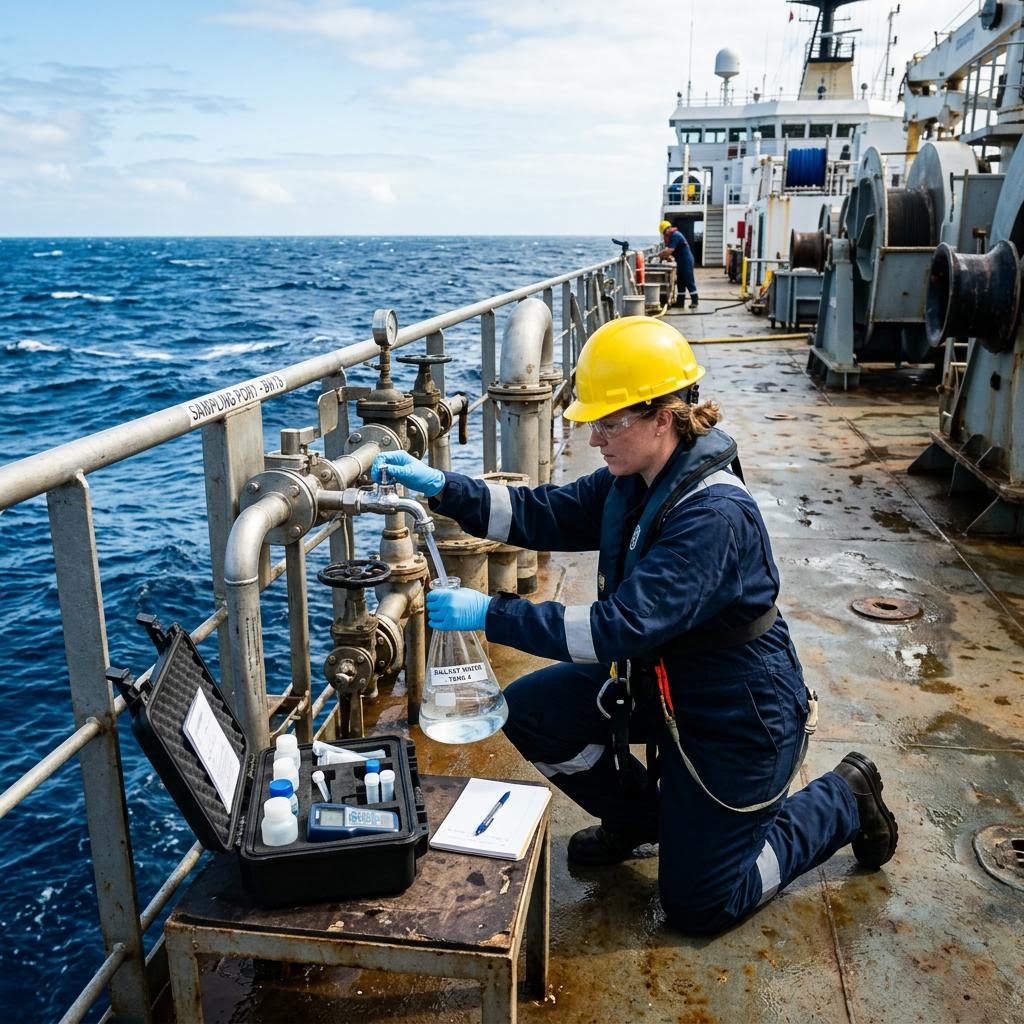
Ballast water commissioning testing under IMO resolution MEPC.325(75) verifies that a newly installed treatment system can meet the D-2 discharge standard in service, through representative sampling and analysis of the actual discharge. This article walks through what happens on board during a commissioning test, the roles of the authorised party and accredited laboratory, and how Sea Clean AS coordinates and supports the process without itself performing the analysis.
Key takeaways
- Commissioning testing under MEPC.325(75) verifies a newly installed BWMS meets D-2 in actual service.
- It catches installation and integration faults that type approval alone cannot reveal.
- Authorised parties carry out the test and accredited laboratories perform the biological analysis.
- Samples are drawn from a representative discharge point during a real ballast operation.
- D-2 checks viable organism concentrations across size classes, not mere presence.
- Sea Clean coordinates and supports the test and is not itself an accredited testing laboratory.
Why Commissioning Testing Exists
Commissioning testing was introduced because type approval alone does not prove that a particular installation, on a particular ship, was assembled and integrated correctly. A system that passed type approval in a test rig can still underperform on board if piping, sensors, power or control integration are faulty.
IMO resolution MEPC.325(75) made commissioning testing a requirement for newly installed ballast water management systems, verifying performance through representative sampling of the actual discharge rather than relying on the type-approval certificate. It is a one-time check at installation, distinct from the recurring surveys and inspections that follow.
The result confirms to the flag administration, class and the owner that the installed system functions as intended in service. A passed commissioning test becomes part of the vessel's compliance file and supports the issuance or endorsement of the ballast water certificate.
Who Does What
Commissioning testing is carried out by parties authorised by the flag administration or class, with the biological analysis performed by an accredited laboratory operating to ISO/IEC 17025. The sampling and analysis must be independent and competent, which is why these roles sit with authorised and accredited parties rather than the equipment maker or the ship alone.
The ship's crew operates the treatment system through a normal ballast cycle, the authorised party draws representative samples, and the accredited laboratory analyses them against the D-2 limits. Class surveyors and flag may be involved in accepting the result and endorsing documentation.
Sea Clean's role is coordination and support: we help arrange the attendance, provide sampling support and in-date reagents, and attend on board to facilitate the test. We are not an accredited testing laboratory and do not perform or certify the analysis; that is done by the accredited laboratory and authorised party.
The On-Board Sequence
On the day, the system is run through a representative ballast operation, typically an uptake and then a discharge, so that the sample reflects water that has actually passed through the full treatment train. The operating parameters, such as flow rate, UV dose or TRO concentration, are recorded alongside the sampling.
Samples are drawn from a representative point in the discharge line, ideally from a dedicated sampling facility installed for the purpose, using a method that does not damage the organisms before analysis. Both the discharge sample and, where relevant, the uptake are handled so the laboratory can assess viable organism concentrations against the D-2 size classes.
Indicative analysis may be run on board for a rapid read, but the commissioning result depends on detailed analysis by the accredited laboratory. The crew, the authorised party and the support team coordinate timing so sampling aligns with the actual ballast operation.
What the D-2 Standard Checks
The D-2 standard sets numeric limits on viable organisms in the discharge across two size classes, organisms greater than or equal to 50 micrometres and organisms from 10 to less than 50 micrometres, plus limits on certain indicator microbes. Commissioning sampling targets these classes to confirm the discharge is within the limits.
Organism viability, not merely presence, is what matters, so the analytical methods distinguish living organisms capable of reproduction from dead or non-viable material. This is why competent, accredited analysis is essential and why a simple turbidity or count alone is insufficient.
A discharge that meets all the D-2 limits demonstrates the installed system performs to standard at commissioning. A result outside the limits points to an installation or operating problem that must be resolved and, normally, retested.
When Results Fall Short
If a commissioning sample fails, the cause is investigated before retesting: common issues include sampling errors, incorrect operation, filter or UV problems, insufficient oxidant dosing, or integration faults in sensors and controls. The point of commissioning is to find and fix such issues at installation rather than discover them later under inspection.
Resolving a failure may involve adjusting operation, replacing or cleaning components, correcting control settings, or addressing a piping or sensor fault, followed by a repeat test. The authorised party and accredited laboratory confirm the corrected result.
Sea Clean can support rectification with BWMS spare parts, reagents and engineer attendance to help bring the installation into specification before a retest, working alongside the authorised party. The analysis itself remains with the accredited laboratory.
Coordinating a Commissioning Test
A smooth commissioning test depends on coordination: the ship's schedule, the authorised party's availability, the accredited laboratory's logistics, the sampling facility and the reagents all need to align with a real ballast operation. Booking these in advance avoids a wasted attendance when the ship cannot run a representative cycle.
Owners should confirm the sampling point arrangement, the operating conditions to be demonstrated, and the documentation the flag or class expects, before the test day. Clear scope agreed beforehand keeps the attendance efficient.
Sea Clean coordinates and supports the attendance and sampling in cooperation with accredited laboratories and authorised parties, and supplies the reagents and any parts likely to be needed. Send the vessel name, IMO number, system details and intended test window to post@seaclean.no to begin coordination.
Frequently asked questions
Is commissioning testing the same as type approval?
No. Type approval certifies the system design in a test rig, while commissioning testing under MEPC.325(75) verifies that the specific installation on a specific ship performs to the D-2 standard in service. It is a one-time check at installation.
Who performs the analysis in a commissioning test?
An accredited laboratory operating to ISO/IEC 17025 performs the biological analysis, and a party authorised by the flag or class carries out the test. Sea Clean coordinates and supports the process but does not perform or certify the analysis.
What happens if a commissioning sample fails?
The cause is investigated, whether sampling error, operation, component faults or integration issues, and corrected before a repeat test. Sea Clean can support rectification with parts, reagents and attendance, with the accredited laboratory confirming the corrected result.
What does the D-2 standard measure during commissioning?
D-2 sets numeric limits on viable organisms in two size classes (≥50 µm and 10 to <50 µm) plus indicator microbes. Commissioning sampling checks the discharge against these limits, assessing organism viability rather than mere presence.
Sources
Related articles
- Indicative vs Detailed Ballast Water Analysis
- Detailed Ballast Water Analysis in an Accredited Laboratory
- Accredited Laboratories and Authorised Parties in Ballast Water Testing
- Remote BWTS Commissioning and Service Support
- Ballast Water Testing and Sampling at the Port of Hamburg
- USCG Ballast Water Compliance for Ships Calling the United States