Can a TRO Reagent Shipment Be Used After an Uncertain Temperature Excursion?
Updated
There is no universal safe excursion time for every TRO reagent formulation. Hold the affected stock, identify the supplied product and obtain a documented disposition using its handling requirements and the available transport evidence.
Request BWTS spare parts, annual calibration or ballast-water testing
Key takeaways
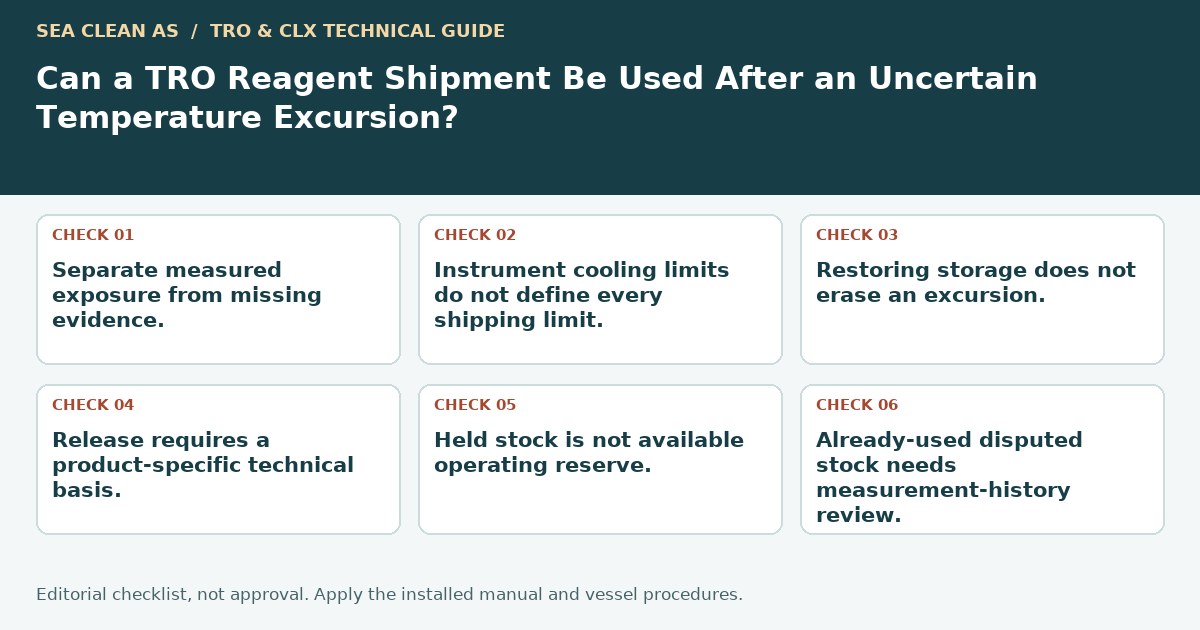
- Separate measured exposure from missing evidence.
- Instrument cooling limits do not define every shipping limit.
- Restoring storage does not erase an excursion.
- Release requires a product-specific technical basis.
- Held stock is not available operating reserve.
- Already-used disputed stock needs measurement-history review.
Define the incident precisely
Record whether the concern is a temperature logger result, missing transport evidence, damaged insulation or only an assumption about weather.
Capture shipment dates, condition at receipt and the product reference. Distinguish known exposure from uncertainty; both need assessment, but they are not the same factual incident.
Do not borrow another formulation's limit
The XT manual describes cooling for its activated indicator in the instrument.
That operating condition is not a universal transport specification for unopened wet, dry or differently packaged products. Use the supplied formulation's labels, safety documentation and written handling instructions rather than a generic product-page storage range.
Segregate affected stock
Mark the material held pending review and prevent accidental issue to an analyser.
Keep it under the required normal storage conditions without claiming that subsequent cooling reverses damage. Preserve unopened components and identifiers so the supplier can assess the actual lot and exposure history.
Request a documented disposition
Ask the supplier or manufacturer to evaluate product identity, lot, exposure data and intended use, and to specify release, further assessment or replacement.
Do not invent an allowable number of warm hours. Any test-based release needs a suitable procedure and acceptance basis, not simply a visible pink reaction.
Plan replacement separately from release
If a ballast operation is approaching, seek replacement availability in parallel with assessment.
Provide the actual instrument, port window and usable onboard stock. A shipment on hold must not be counted as operational reserve until it has been released; a replacement enquiry does not guarantee delivery or attendance.
Provide the reference, affected quantity and vessel delivery window without assuming stock or a transport release. Enquire about replacement reagent for a held shipment
Investigate affected measurements if already used
Record where and when the shipment was fitted, activation dates and relevant comparison results.
A technical review should assess the period of reliance and whether additional checks are required under vessel procedures. Changing calibration to align a doubtful reagent with one sample is not a defensible release decision.
If the shipment was already fitted, provide its installation period and measurement records. Review instrument reliance on disputed reagent stock
Frequently asked questions
How many warm hours are safe for every TRO kit?
There is no single defensible limit across formulations; obtain product-specific guidance.
Does cooling the delivery make it acceptable again?
Not automatically. Normal storage does not reverse or resolve its previous exposure.
Does a pink reaction demonstrate full reagent suitability?
No. A release test needs an appropriate method and acceptance basis.
Can held stock count towards the vessel's reserve?
Not until the condition has been assessed and the stock released.
Sources
- HF scientific CLX-XT operation and maintenance manual, revision 5.0 — Sections 4.2–4.3 distinguish activated-indicator cooling and life; the incident workflow is editorial guidance, not a transport stability study.
- HF scientific CLX-XT engineering specification
Related articles
- What Should a Vessel Check When a TRO Reagent Delivery Arrives?
- Should CLX-XT Cooling Stay Powered Between Ballast Operations?
- Why Should TRO Reagent Orders Identify the Analyser, Not Just the BWTS Brand?
- Why Does a CLX Liquid Indicator Still Need DPD Activation?
- What Is a Ballast Water Treatment System? Explained
- How Does BWTS Installation Work? Step by Step
Request spares, calibration or ballast-water testing
Include BWMS brand/model, vessel/IMO number, port/terminal, date/ETA and scope or part numbers. These links prepare an email draft; you must send it yourself.
- Request a parts quote — Sensors, TRO reagents, calibration kits and replacement parts. Confirm compatibility, availability and delivery for your installed system.
- Request a calibration booking — Annual instrument calibration with a calibration certificate for the work completed. OEM instructions, drift or applicable rules may require earlier work.
- Request testing coordination — Arrange sampling and testing with an appropriately qualified party for your IMO D-2, commissioning or other stated purpose.
Authorised Headway agent. Other-brand enquiries are independently reviewed; no OEM authorisation is claimed. Sea Clean is not an accredited laboratory or approving authority. Calibration does not demonstrate biological D-2 compliance. Attendance, testing scope and parts delivery are confirmed per enquiry.