What Should a Vessel Check When a TRO Reagent Delivery Arrives?
Updated
Receiving inspection should establish that the delivered reagent is the item ordered and is suitable to release for the intended instrument. Separate receipt of a parcel from acceptance of its identity, contents and handling history.
Request BWTS spare parts, annual calibration or ballast-water testing
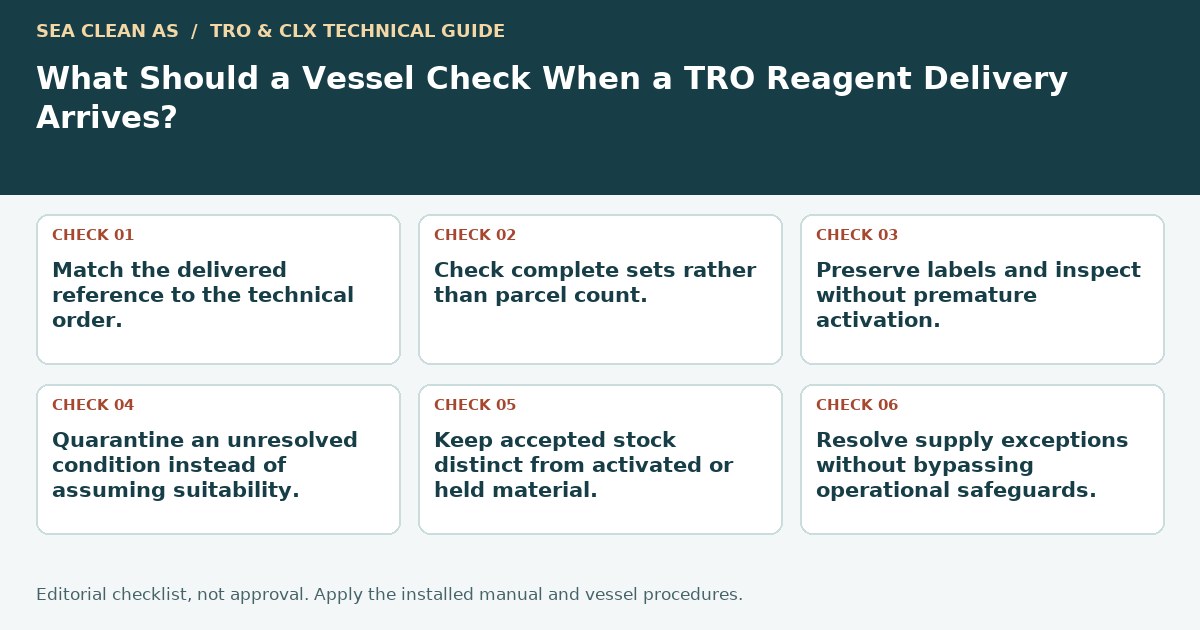
Key takeaways
- Match the delivered reference to the technical order.
- Check complete sets rather than parcel count.
- Preserve labels and inspect without premature activation.
- Quarantine an unresolved condition instead of assuming suitability.
- Keep accepted stock distinct from activated or held material.
- Resolve supply exceptions without bypassing operational safeguards.
Compare the order and delivered reference
Check the full part reference, formulation and named manufacturer against the purchase order.
A description such as annual TRO pack should not override a different number on the label. Record the fitted analyser model so acceptance is tied to a technical requirement rather than only a vessel stores category.
Count components before stowage
Use the actual pack specification to count bottle sets, powder components and instructions.
The cited XT 09991 configuration includes multiple indicator sets and a buffer bottle; a single refill should not be accepted as a complete annual set. Document shortages while the packaging is still available.
Use the product enquiry with the ordered reference and delivered component list when a set is incomplete or unclear. Clarify 09991 pack contents before acceptance
Inspect labels and closures
Look for legible lot and expiry information, damaged closures, leakage or unclear bottle identity.
Retain photographs and supplier paperwork. Do not open or mix spare indicators simply to check that the parcel arrived; activation changes their usage history and should follow the instructed preparation process.
Review handling evidence
Compare shipping and receiving conditions with the instructions for the supplied formulation.
If evidence suggests an excursion or the packaging is compromised, place the item on hold and request a supplier disposition. A calendar expiry date alone cannot demonstrate that the reagent was correctly handled in transit.
Release to identified storage
After acceptance, label receipt status and place the stock in the required storage location with its usable-life information.
Keep activated, unopened and held items distinguishable. Record which instruments can use the reference so another crew member does not issue it merely because it is stored beside other chlorine reagents.
Close exceptions through the right route
A supplier replacement request should state reference, quantity, lot and observed problem.
Where the disputed delivery affects an impending ballast operation, coordinate technical advice alongside resupply and the vessel's approved contingency procedure. Shipping urgency is not a basis for fitting uncertain reagent or suppressing an instrument alarm.
Include the next operation window and the reason the reagent remains on hold. Coordinate technical review when a delivery cannot be released
Frequently asked questions
Is signed parcel receipt the same as reagent acceptance?
No. Identity, completeness, condition and applicable handling requirements still need checking.
Should spare indicators be mixed during receipt inspection?
No. Avoid starting their in-use lives unnecessarily.
Can a valid expiry date settle a transport concern?
Not alone. Obtain a disposition based on the actual formulation and handling evidence.
What should a shortage report include?
The ordered and supplied references, expected contents, missing quantities and packaging evidence.
Sources
- HF scientific CLX-XT operation and maintenance manual, revision 5.0 — Sections 3.1, 4.3 and 11.2 support inspection, pack identity and activation distinctions; receipt workflow is editorial procurement guidance.
- HF scientific CLX-XT engineering specification
Related articles
- Can a TRO Reagent Shipment Be Used After an Uncertain Temperature Excursion?
- Does a CLX 09991 Annual Pack Mean One Bottle Lasts a Year?
- Why Should TRO Reagent Orders Identify the Analyser, Not Just the BWTS Brand?
- Why Does a CLX Liquid Indicator Still Need DPD Activation?
- What Is a Ballast Water Treatment System? Explained
- How Does BWTS Installation Work? Step by Step
Request spares, calibration or ballast-water testing
Include BWMS brand/model, vessel/IMO number, port/terminal, date/ETA and scope or part numbers. These links prepare an email draft; you must send it yourself.
- Request a parts quote — Sensors, TRO reagents, calibration kits and replacement parts. Confirm compatibility, availability and delivery for your installed system.
- Request a calibration booking — Annual instrument calibration with a calibration certificate for the work completed. OEM instructions, drift or applicable rules may require earlier work.
- Request testing coordination — Arrange sampling and testing with an appropriately qualified party for your IMO D-2, commissioning or other stated purpose.
Authorised Headway agent. Other-brand enquiries are independently reviewed; no OEM authorisation is claimed. Sea Clean is not an accredited laboratory or approving authority. Calibration does not demonstrate biological D-2 compliance. Attendance, testing scope and parts delivery are confirmed per enquiry.