Why Does a CLX Liquid Indicator Still Need DPD Activation?
Updated
Liquid packaging does not always mean ready-to-install indicator. The cited CLX-XT manual requires its supplied DPD powder to be mixed into the matching indicator bottle; the buffer is separately ready to use.
Request BWTS spare parts, annual calibration or ballast-water testing
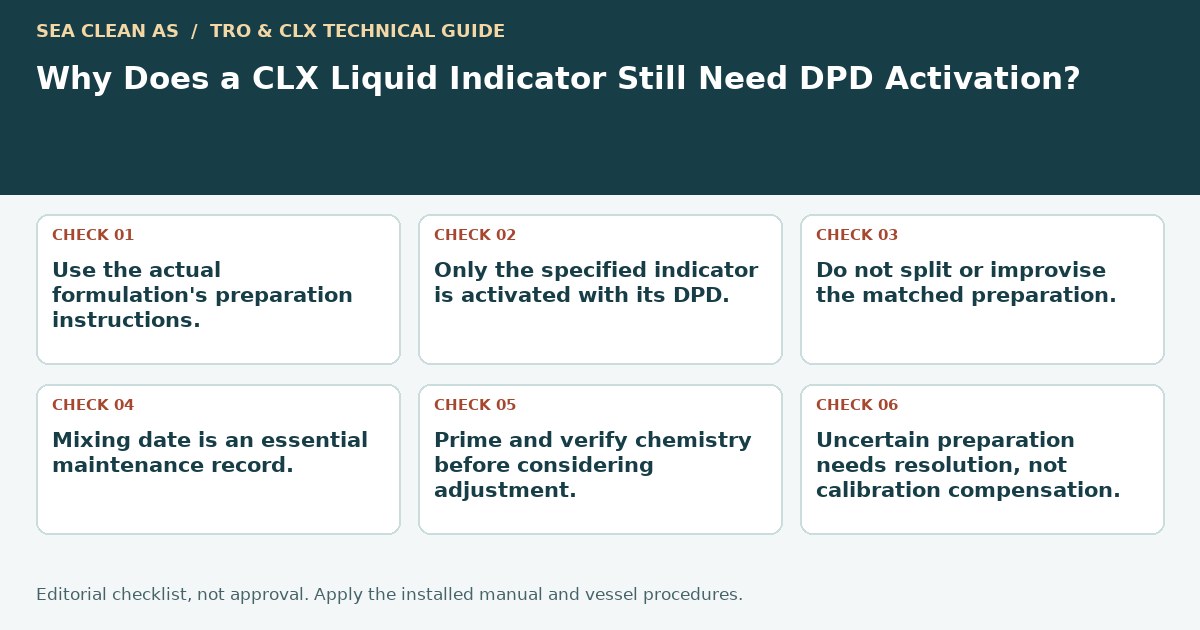
Key takeaways
- Use the actual formulation's preparation instructions.
- Only the specified indicator is activated with its DPD.
- Do not split or improvise the matched preparation.
- Mixing date is an essential maintenance record.
- Prime and verify chemistry before considering adjustment.
- Uncertain preparation needs resolution, not calibration compensation.
Identify the supplied formulation
Read the bottle labels and instructions that accompany the actual kit.
Section 11.2 describes a small liquid indicator bottle and a matching DPD powder bottle. Do not transfer this preparation instruction to another reagent reference merely because its packaging is liquid or its product description uses the same part family.
Send the kit and instrument identifiers when requesting the matching reagent set and preparation documentation. Identify the supplied 09991 indicator configuration
Keep the buffer out of the activation step
The buffer and indicator perform different roles in the DPD method.
The manual requires both for measurement but describes the buffer as ready to use. Adding the indicator powder to the buffer, or treating a buffer bottle as spare indicator, changes the analytical chemistry rather than completing the specified preparation.
Prepare one matched indicator set
The manufacturer describes adding the supplied powder to its matching indicator and dissolving it fully.
Use the instructed handling precautions and a clean work area. Do not estimate a partial powder dose, split unmatched components or add improvised water quantities to stretch a set; the manual does not validate those substitutions.
Start the life record at mixing
Activation starts the indicator's oxidation and in-use life.
Label the mixing date and retain the component lot information before installation. Keeping future sets unactivated avoids starting all their clocks together. Cooling slows degradation; it does not turn a previously activated bottle into an unopened shelf-life item.
Install and prime the correct channels
Follow section 11.2 for placing the indicator in the cooling chamber and connecting the separate bottle channels.
Priming draws both reagents into the lines. If no colour develops with a suitable known oxidant sample, check preparation and delivery before adjusting calibration to compensate for a reagent that was never activated.
Resolve uncertainty before operational reliance
An unlabelled mixed bottle or uncertain preparation should be treated as an unresolved consumable condition.
Preserve photographs and kit identifiers and obtain the correct instructions. A technical review can distinguish missing activation, line delivery faults and genuine measurement issues without treating an apparently normal display as proof of reliable monitoring.
For absent colour or uncertain bottle preparation, provide photographs, mixing dates and priming observations. Request review of indicator preparation and delivery
Frequently asked questions
Is every liquid CLX indicator ready to install?
No. The cited CLX-XT liquid set requires a specified DPD activation step; check your supplied formulation.
Should I activate the buffer?
Not for the set described in section 11.2; that buffer is ready to use.
Should I mix all spare indicators when the pack arrives?
Avoid starting their in-use clocks unnecessarily. Prepare replacement sets according to the applicable instructions.
Can calibration correct an unactivated indicator?
No. Establish correct reagent preparation and delivery before evaluating calibration.
Sources
- HF scientific CLX-XT operation and maintenance manual, revision 5.0 — Sections 4.3 and 11.2 describe the liquid set's DPD activation and mixing-date label.
- HF scientific CLX-XT engineering specification
Related articles
- Does a CLX 09991 Annual Pack Mean One Bottle Lasts a Year?
- Can CLX Buffer and Indicator Bottles Be Swapped or Topped Up?
- Why Does a CLX PRIME Cycle Run Without Reagent Colour?
- What Should a Vessel Check When a TRO Reagent Delivery Arrives?
- Can Free-Chlorine DPD Reagent Replace a Total-Chlorine CLX Set?
- What Is a Ballast Water Treatment System? Explained
Request spares, calibration or ballast-water testing
Include BWMS brand/model, vessel/IMO number, port/terminal, date/ETA and scope or part numbers. These links prepare an email draft; you must send it yourself.
- Request a parts quote — Sensors, TRO reagents, calibration kits and replacement parts. Confirm compatibility, availability and delivery for your installed system.
- Request a calibration booking — Annual instrument calibration with a calibration certificate for the work completed. OEM instructions, drift or applicable rules may require earlier work.
- Request testing coordination — Arrange sampling and testing with an appropriately qualified party for your IMO D-2, commissioning or other stated purpose.
Authorised Headway agent. Other-brand enquiries are independently reviewed; no OEM authorisation is claimed. Sea Clean is not an accredited laboratory or approving authority. Calibration does not demonstrate biological D-2 compliance. Attendance, testing scope and parts delivery are confirmed per enquiry.