How Does BWTS Installation Work? Step by Step
Updated
BWTS installation is a defined sequence: site survey and 3D scan, system selection, engineering and class-approved drawings, procurement, physical fitting (steelwork, piping, electrical, control integration), and commissioning testing under MEPC.325(75). A retrofit typically takes 3–6 months of planning before a yard or riding-crew installation of 1–3 weeks. Class approval of drawings runs in parallel and must be complete before commissioning.
Request BWTS spare parts, annual calibration or ballast-water testing
Key takeaways
- BWTS installation follows six steps: survey and 3D scan, selection, class-approved engineering, procurement, fitting, and commissioning.
- 3D laser scanning produces a millimetre-accurate point cloud so equipment can be modelled and clashes avoided before steel is cut.
- The system must be sized to the ship's ballast pump flow in m³/h and chosen to suit the trade's salinity, temperature, and hazardous-area needs.
- Class-approved drawings are required before fabrication; running approval in parallel with procurement compresses the schedule.
- Long-lead equipment procurement is often the critical path, so reactors, power supplies, and cabinets are ordered early.
- Commissioning testing under MEPC.325(75) is one-time indicative testing, not a full D-2 compliance validation.
Step 1: Survey and 3D Scanning
Every installation begins with an on-board survey of the engine room, pump room, and ballast piping to establish available space, pipe routing, and power availability. On modern retrofits this is done with 3D laser scanning, which produces a point-cloud model accurate to a few millimetres and removes the guesswork from fitting a large system into a congested engine room.
The scan captures existing structure, machinery, cable trays, and pipe runs so engineers can model the new equipment virtually before any steel is cut. This is far cheaper than discovering clashes during the yard period, when rework costs escalate quickly.
The survey also records the existing ballast system's pump capacity and pressure, because the chosen BWTS must be rated for the ship's ballasting flow without unacceptable pressure drop. Undersizing the system to save space is a common and expensive mistake.
Step 2: System Selection and Sizing
The system must be sized to the ship's ballast pump capacity in m³/h, and the technology chosen to suit the trade. A UV system suits ships trading in variable or low salinity; an electrochlorination system suits large-flow ships trading mostly in seawater. Explosion-proof requirements apply to tankers, narrowing the choice further.
Selection must also account for the operating envelope: salinity range, temperature range, and minimum UV transmittance defined on the candidate type approval certificate. A system that cannot reach dose on the ship's typical loading ports is compliant on paper but useless in service.
For ships trading to the United States, USCG type approval under 46 CFR 162.060 is required in addition to IMO approval. Confirming approvals against the actual trade before committing to a model avoids a costly and non-compliant installation.
Step 3: Engineering and Class-Approved Drawings
Detailed engineering converts the 3D model into fabrication drawings: equipment foundations, pipe spools, penetrations, cable routing, and control interfaces. These drawings must be submitted to the ship's classification society for approval before fabrication, covering piping, electrical, structural, and hazardous-area aspects.
Class review checks that the installation does not compromise stability, that pipe supports and penetrations are sound, that hazardous-area equipment carries the correct certification, and that the control and safety interlocks are adequate. Approval in principle may precede the yard period, with final approved-for-construction drawings issued once details are fixed.
Running class approval in parallel with procurement compresses the schedule. Waiting until drawings are approved before ordering long-lead items — the electrolyser, UV reactor, or power supply — can add months to the project.
Step 4: Procurement and Prefabrication
Long-lead equipment is ordered early. Reactors, electrolysers, filters, power supplies, and control cabinets can carry lead times of several weeks to a few months depending on the manufacturer and order book, so procurement is often the critical path of the whole project.
Pipe spools and steel foundations can be prefabricated ashore from the approved drawings and the 3D model while the ship continues trading. Prefabrication shortens the time the ship spends out of service, which is the most expensive part of any retrofit.
Consumables and commissioning spares — TRO reagents, calibration standards, spare lamps, seals — are ordered in this phase so the system can be commissioned and handed over without waiting on parts.
Step 5: Physical Fitting
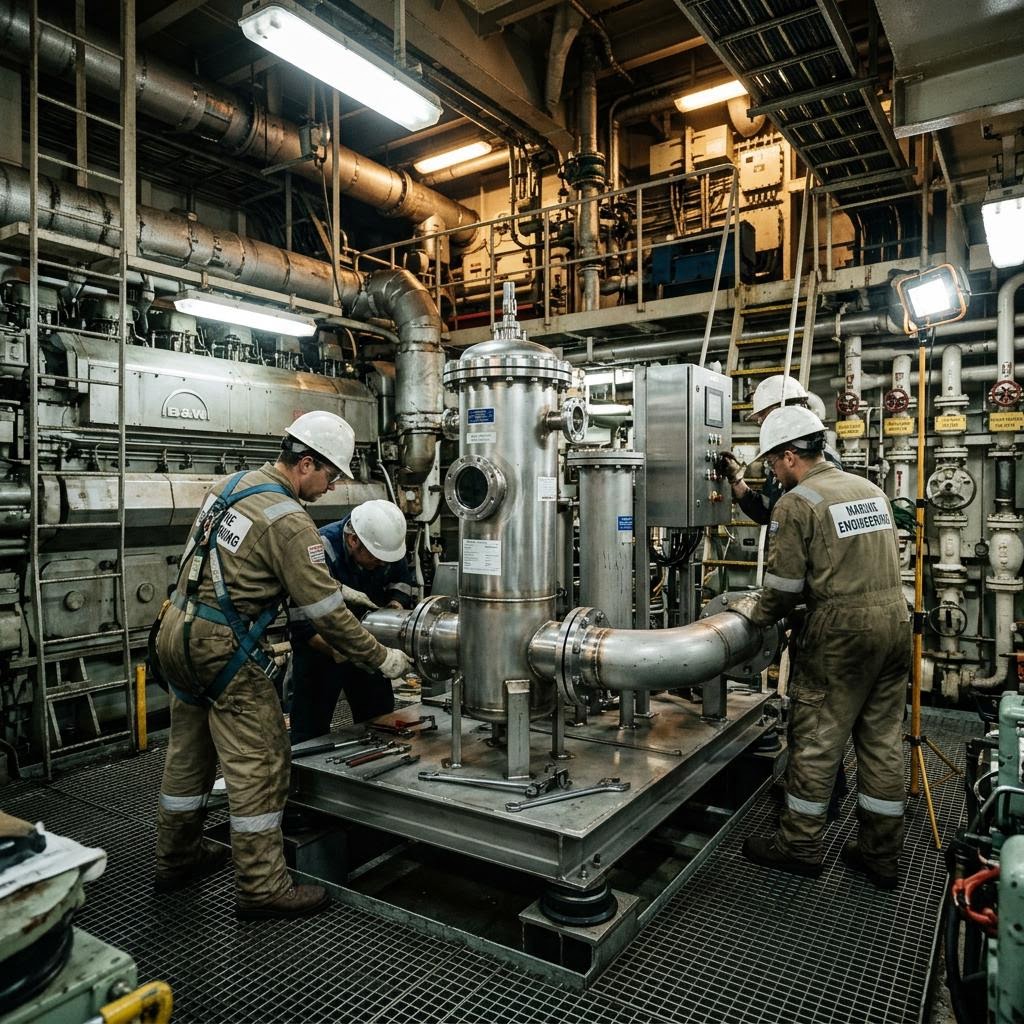
The physical installation covers steelwork for foundations, cutting in and welding the new pipe spools, running power and control cabling, and mounting the equipment. This can happen during a scheduled drydock, at a repair berth, or with a riding crew while the ship trades, depending on scope and downtime tolerance.
Electrical integration ties the BWTS into the ship's power supply, verifying that the switchboard and generators can carry the additional load, especially the high draw of electrochlorination during ballasting. Control integration links the system to the ballast control so pumps, valves, and treatment operate as one sequence.
Hydrostatic testing of new piping and functional testing of valves and interlocks close out the fitting phase. Only once the mechanical and electrical installation is proven does commissioning begin.
Step 6: Commissioning and Handover
Commissioning proves the installed system works as designed: the filter backflushes, the reactor or electrolyser reaches dose or TRO target at rated flow, alarms and interlocks function, and neutralisation drops residual below the discharge limit. The manufacturer's or an authorised engineer's function test precedes the regulatory commissioning test.
Commissioning testing under MEPC.325(75) is a one-time verification that includes indicative biological sampling. It confirms the system operates according to specification; it is indicative testing, not a full validation that the ship meets D-2 in all conditions. The distinction matters for what the certificate proves.
Handover includes crew training, the ballast water management plan, the type approval certificate, and the commissioning test report for class and port state control. Sea Clean AS provides installation and commissioning support and attends 0–24h in Norway and the North Sea, and by arrangement elsewhere. Contact post@seaclean.no.
Frequently asked questions
How long does a BWTS installation take?
Plan on 3–6 months of engineering and procurement before the physical work, then a yard or riding-crew installation of roughly 1–3 weeks depending on scope. Long-lead equipment procurement is usually the critical path.
Do I need class approval to install a BWTS?
Yes. The installation drawings — piping, electrical, structural, and hazardous-area — must be approved by the ship's classification society before fabrication and installation, and the commissioning test report is submitted for class and port state control.
Can a BWTS be installed without drydocking?
Often yes. Many retrofits are done at a repair berth or with a riding crew while the ship trades, provided the ballast piping and structure allow it. Drydock is chosen when the work coincides with other underwater or steel work.
What is 3D scanning used for in a BWTS retrofit?
It captures the exact geometry of a congested engine room as a point cloud so engineers can model the new equipment, plan pipe routing, and detect clashes virtually before the yard period, cutting costly on-site rework.
Sources
- IMO MEPC.325(75) commissioning testing — Commissioning testing of ballast water management systems
- DNV rules for ballast water management systems
Related articles
Request spares, calibration or ballast-water testing
Include BWMS brand/model, vessel/IMO number, port/terminal, date/ETA and scope or part numbers. These links prepare an email draft; you must send it yourself.
- Request a parts quote — Sensors, TRO reagents, calibration kits and replacement parts. Confirm compatibility, availability and delivery for your installed system.
- Request a calibration booking — Annual instrument calibration with a calibration certificate for the work completed. OEM instructions, drift or applicable rules may require earlier work.
- Request testing coordination — Arrange sampling and testing with an appropriately qualified party for your IMO D-2, commissioning or other stated purpose.
Authorised Headway agent. Other-brand enquiries are independently reviewed; no OEM authorisation is claimed. Sea Clean is not an accredited laboratory or approving authority. Calibration does not demonstrate biological D-2 compliance. Attendance, testing scope and parts delivery are confirmed per enquiry.