Why Should TRO Reagent Orders Identify the Analyser, Not Just the BWTS Brand?
Updated
The BWTS brand identifies the treatment system, not necessarily the fitted measurement instrument or reagent version. A useful order starts with the analyser nameplate and current consumables list, then identifies the vessel and delivery requirements.
Request BWTS spare parts, annual calibration or ballast-water testing
Key takeaways
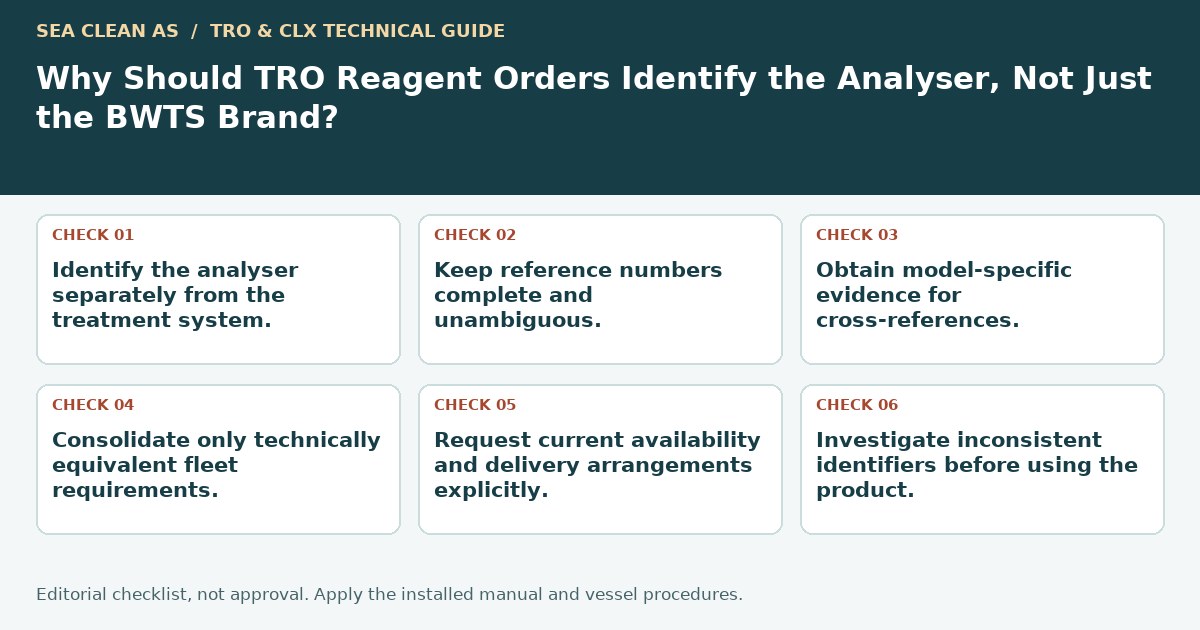
- Identify the analyser separately from the treatment system.
- Keep reference numbers complete and unambiguous.
- Obtain model-specific evidence for cross-references.
- Consolidate only technically equivalent fleet requirements.
- Request current availability and delivery arrangements explicitly.
- Investigate inconsistent identifiers before using the product.
Identify each installed instrument
Photograph the analyser nameplate and record model, serial number and instrument tag.
Two vessels with the same BWTS family can have different analyser generations or delivered configurations. Separate treatment-system identity from instrument identity in the purchasing register so a brand-level description does not conceal the actual consumable requirement.
Preserve the complete reference
Retain leading zeroes and suffixes in reagent and accessory references.
Check the current manual against the existing bottle labels and last verified order. A shorthand item such as TRO chemical does not distinguish a complete reagent set, individual component, calibration material or tubing/cuvette accessory.
Link the reference to technical evidence
The CLX-XT manual and specification list model-specific reagents and accessories.
Use the equivalent documents for other fitted analysers. A supplier cross-reference can assist identification, but it should name the installed equipment and supporting basis rather than substitute a BWTS brand list for compatibility evidence.
Separate fleet lines that are not equivalent
Create one purchasing line per technically distinct configuration.
Consolidate quantities only after checking formulation, pack content and handling requirements. Fleet purchasing efficiency comes from verified equivalence, not from merging different instruments into one generic total-chlorine product description.
State the commercial inputs
Give vessel/IMO, requested quantity, port, ETA/ETD and receiving agent, together with acceptable documentation and remaining-life requirements.
Request a quotation confirming the supplied reference and delivery arrangements. Neither a product page nor an old purchase order establishes current stock or a guaranteed delivery window.
Include the nameplate, full reference and required quantities when using the reagent product route. Prepare an analyser-specific TRO reagent enquiry
Resolve conflicting records before installation
Where the last order, bottle and manual disagree, preserve all three and ask for technical reconciliation.
Sea Clean can support EC systems across makes and variants; Headway work is authorised and other makes are independent. Reagent identity, dates and access should be resolved without changing the system's approved operating basis.
Send the current manual, fitted bottle and prior order for technical reconciliation. Resolve conflicting reagent references with BWTS support
Frequently asked questions
Is the BWTS brand sufficient to order TRO reagent?
No. Include the fitted analyser model and complete consumable reference.
Can I combine all fleet reagent quantities?
Only after establishing that the required configurations and formulations are equivalent.
Should leading zeroes remain on the order?
Yes. Preserve the complete manufacturer's reference, including suffixes.
What if the previous order differs from the manual?
Resolve the discrepancy with current equipment and supply documentation before installation.
Sources
- HF scientific CLX-XT operation and maintenance manual, revision 5.0 — Sections 5.4 and 12 identify the CLX-XT reagent and accessory references; purchasing checks are Sea Clean editorial guidance.
- HF scientific CLX-XT engineering specification
Related articles
- Is CLX-XT2 Dry Reagent 09994 the Same as 09952?
- What Should a Vessel Check When a TRO Reagent Delivery Arrives?
- Does a TRO Reagent Pack Include Everything Needed for Calibration?
- How Does CLX Cycle Time Change Reagent Purchase Quantities?
- What Is a Ballast Water Treatment System? Explained
- How Does BWTS Installation Work? Step by Step
Request spares, calibration or ballast-water testing
Include BWMS brand/model, vessel/IMO number, port/terminal, date/ETA and scope or part numbers. These links prepare an email draft; you must send it yourself.
- Request a parts quote — Sensors, TRO reagents, calibration kits and replacement parts. Confirm compatibility, availability and delivery for your installed system.
- Request a calibration booking — Annual instrument calibration with a calibration certificate for the work completed. OEM instructions, drift or applicable rules may require earlier work.
- Request testing coordination — Arrange sampling and testing with an appropriately qualified party for your IMO D-2, commissioning or other stated purpose.
Authorised Headway agent. Other-brand enquiries are independently reviewed; no OEM authorisation is claimed. Sea Clean is not an accredited laboratory or approving authority. Calibration does not demonstrate biological D-2 compliance. Attendance, testing scope and parts delivery are confirmed per enquiry.