Should CLX-XT Cooling Stay Powered Between Ballast Operations?
Updated
The cited XT manual requires its indicator cooling chamber to remain powered for the stated extended reagent life. Stopping measurement and removing all power are not equivalent. Long-term storage has a separate reagent-removal procedure.
Request BWTS spare parts, annual calibration or ballast-water testing
Key takeaways
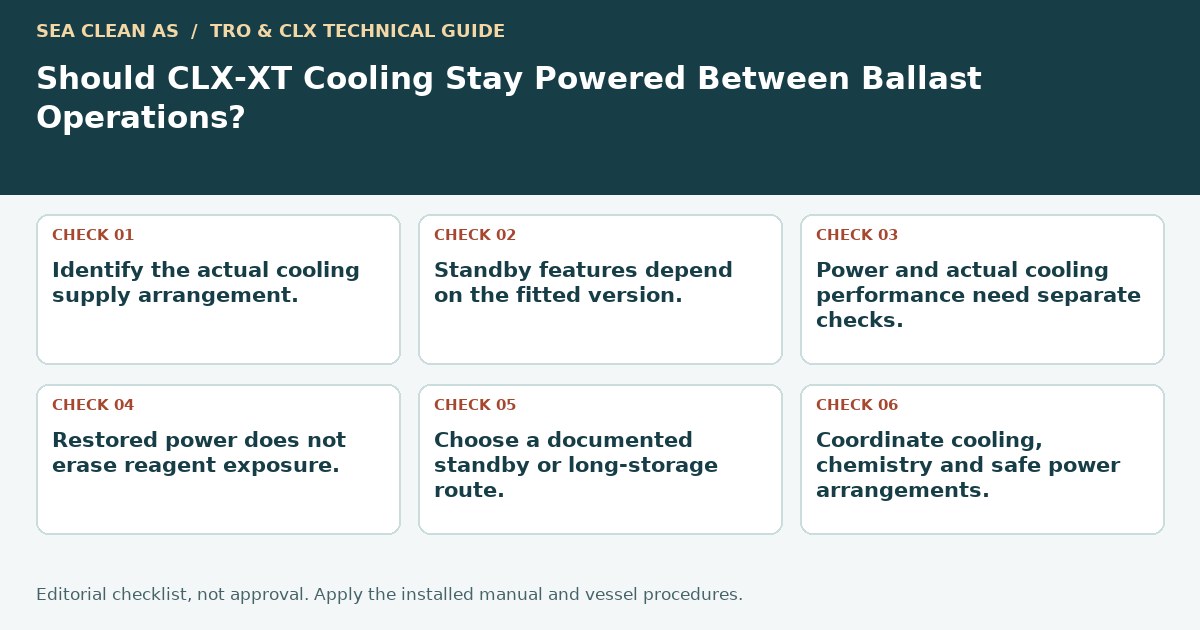
- Identify the actual cooling supply arrangement.
- Standby features depend on the fitted version.
- Power and actual cooling performance need separate checks.
- Restored power does not erase reagent exposure.
- Choose a documented standby or long-storage route.
- Coordinate cooling, chemistry and safe power arrangements.
Separate the instrument's power functions
The XT manual describes a cooling supply separately from the measurement supply.
Its purpose is to slow degradation of the activated indicator, including between measurement periods. Check the actual wiring arrangement because some delivered configurations combine connections differently; a dark display alone does not establish the cooler's condition.
Understand what standby preserves
In supported control modes, standby stops routine cycles while preserving the required powered functions.
Section 9.4 also describes an optional timed reagent-purge feature that requires constant power. Do not assume every delivered software version has the feature or that its presence removes the need for the correct cooling condition.
Keep ventilation available
Section 4.2 requires the cooling fan not to be blocked.
Inspect the available ventilation and check the chamber through the specified maintenance method. A powered circuit does not prove effective cooling if the fan path is obstructed or the chamber is not maintaining its intended condition.
Assess a loss of cooling
Record the affected activated bottles, interruption duration and available temperature evidence.
The manual explains why warm conditions can degrade indicator and lower readings, but it does not provide a universal release rule after every excursion. Obtain a suitable disposition instead of assuming power restoration reverses the history.
Plan chemistry according to operating mode
If the instrument will be retained in powered standby, follow its applicable life and maintenance limits.
If it will be inactive for a long period, use the dedicated storage instructions, including reagent removal and flushing. Reserve supply should match the chosen mode and recommissioning date.
Include activation dates and intended restart timing when specifying replacement chemistry. Plan 09991 renewal for the actual standby/storage arrangement
Review the power and reagent plan together
A service review should include vessel operating pattern, supply arrangements, chamber observations and mixing dates.
Sea Clean can coordinate cooling faults and replacement chemistry as distinct parts of the job. Do not change the instrument wiring or isolate a required supply without competent assessment and vessel approval.
Share the fitted supply arrangement and interruption or temperature observations. Review cooling performance and the standby power plan
Frequently asked questions
Is standby the same as switching all power off?
No. Supported standby retains required powered functions.
Does cooling extend indicator life indefinitely?
No. The activated indicator's defined replacement limit still applies.
Does a powered cooler guarantee correct temperature?
No. Ventilation and actual chamber performance must also be checked.
What changes for prolonged storage?
Use the manual's separate reagent-removal, flushing and shutdown instructions.
Sources
- HF scientific CLX-XT operation and maintenance manual, revision 5.0 — Sections 4.2, 5.3.2, 9.4 and 11.4 distinguish cooling power, standby purge and storage.
- HF scientific CLX-XT engineering specification
Related articles
- What Must Be Checked Before Restarting a CLX-XT After Long Storage?
- Does CLX AutoPurge Remove the Need to Check After a Power Loss?
- Can a TRO Reagent Shipment Be Used After an Uncertain Temperature Excursion?
- Does a CLX 09991 Annual Pack Mean One Bottle Lasts a Year?
- What Is a Ballast Water Treatment System? Explained
- How Does BWTS Installation Work? Step by Step
Request spares, calibration or ballast-water testing
Include BWMS brand/model, vessel/IMO number, port/terminal, date/ETA and scope or part numbers. These links prepare an email draft; you must send it yourself.
- Request a parts quote — Sensors, TRO reagents, calibration kits and replacement parts. Confirm compatibility, availability and delivery for your installed system.
- Request a calibration booking — Annual instrument calibration with a calibration certificate for the work completed. OEM instructions, drift or applicable rules may require earlier work.
- Request testing coordination — Arrange sampling and testing with an appropriately qualified party for your IMO D-2, commissioning or other stated purpose.
Authorised Headway agent. Other-brand enquiries are independently reviewed; no OEM authorisation is claimed. Sea Clean is not an accredited laboratory or approving authority. Calibration does not demonstrate biological D-2 compliance. Attendance, testing scope and parts delivery are confirmed per enquiry.