Troubleshooting the Headway OceanGuard BWTS
Updated
Most Headway OceanGuard faults fall into a few categories: filter differential pressure and backflush problems, EUT treatment unit issues, TRO analyser alarms, flow and valve faults, and neutralisation problems on discharge. This article walks through the common alarm patterns, the likely causes and the checks that separate an instrumentation fault from a real treatment fault, and explains how Sea Clean AS supports diagnosis and repair as an authorized Headway agent.
Key takeaways
- Read the alarm history and live parameters before acting; the pattern usually identifies the real cause better than the headline alarm.
- Distinguish measurement faults (sensors, sample lines, valves) from genuine treatment faults to avoid swapping parts needlessly.
- High filter differential pressure usually means loading, a fouled element or a backflush valve/actuator problem.
- Rising EUT voltage for the same output points to electrode scaling or wear; power-supply faults are diagnosed separately.
- Most TRO alarms stem from reagent, sample line, cell or sensor issues rather than the treatment unit itself.
- Escalate faults affecting D-2 validity or risking a PSC finding early; urgent Norway/North Sea attendance is typically within 0-24h.
A Structured Approach to OceanGuard Alarms
When an OceanGuard alarm appears, the first step is to read the alarm history and the live parameters rather than reacting to a single message. The system reports filter differential pressure, flow, treatment unit voltage and current, TRO reading and valve states, and the pattern across these values usually points to the real cause more reliably than the headline alarm text.
A useful discipline is to ask whether the fault is in measurement or in process. An out-of-range sensor, a blocked sample line or a sticking valve produces alarms that mimic a treatment failure, and swapping treatment components on that basis wastes time and parts. Confirming the supporting instrumentation first prevents that.
Recording the conditions at the time of the alarm, such as the water source, temperature, salinity, flow rate and tank operation, gives the context needed to interpret it. Sea Clean uses this information to advise remotely or to prepare the right parts before an attendance.
Filter Differential Pressure and Backflush
High differential pressure across the filter is one of the most common OceanGuard alarms. It usually reflects sediment or biological loading in turbid or coastal water, a fouled or damaged element, or a backflush that is not clearing the screen effectively. The first checks are the actual differential value against the expected baseline and whether backflush is initiating and completing.
If backflush is not working, the cause is often the backflush valve, its actuator or drive, or insufficient backflush flow or pressure, rather than the element itself. A torn or wrong-mesh element will also raise differential pressure or, conversely, let too much material through to the treatment unit, so the element condition and specification should be confirmed.
Repeated high-differential trips in dirty water may indicate the flow rate is too high for the conditions or that the maintenance interval needs shortening for that trade. Sea Clean supplies genuine filter elements, seals and backflush components and can advise on intervals for the vessel's typical water quality.
EUT Treatment Unit Faults
Treatment-side faults show up as the EUT unit failing to reach its target output, drawing abnormal current or voltage, or tripping on a power fault. Rising voltage to achieve the same output commonly indicates electrode scaling or wear, while erratic current can point to a connection or power-supply problem.
Scaling is more likely in hard or warm water and can sometimes be addressed by inspection and cleaning, but worn electrodes require replacement with genuine parts. Power-supply and rectifier faults are diagnosed electrically and should not be confused with electrode wear, since the remedy is different.
Because the treatment unit is central to meeting the D-2 standard, OceanGuard EUT faults warrant careful diagnosis rather than guesswork. As an authorized Headway agent, Sea Clean can refer persistent treatment-unit issues to Headway technical support and supply the matched electrodes, seals and power components needed.
TRO Analyser Alarms
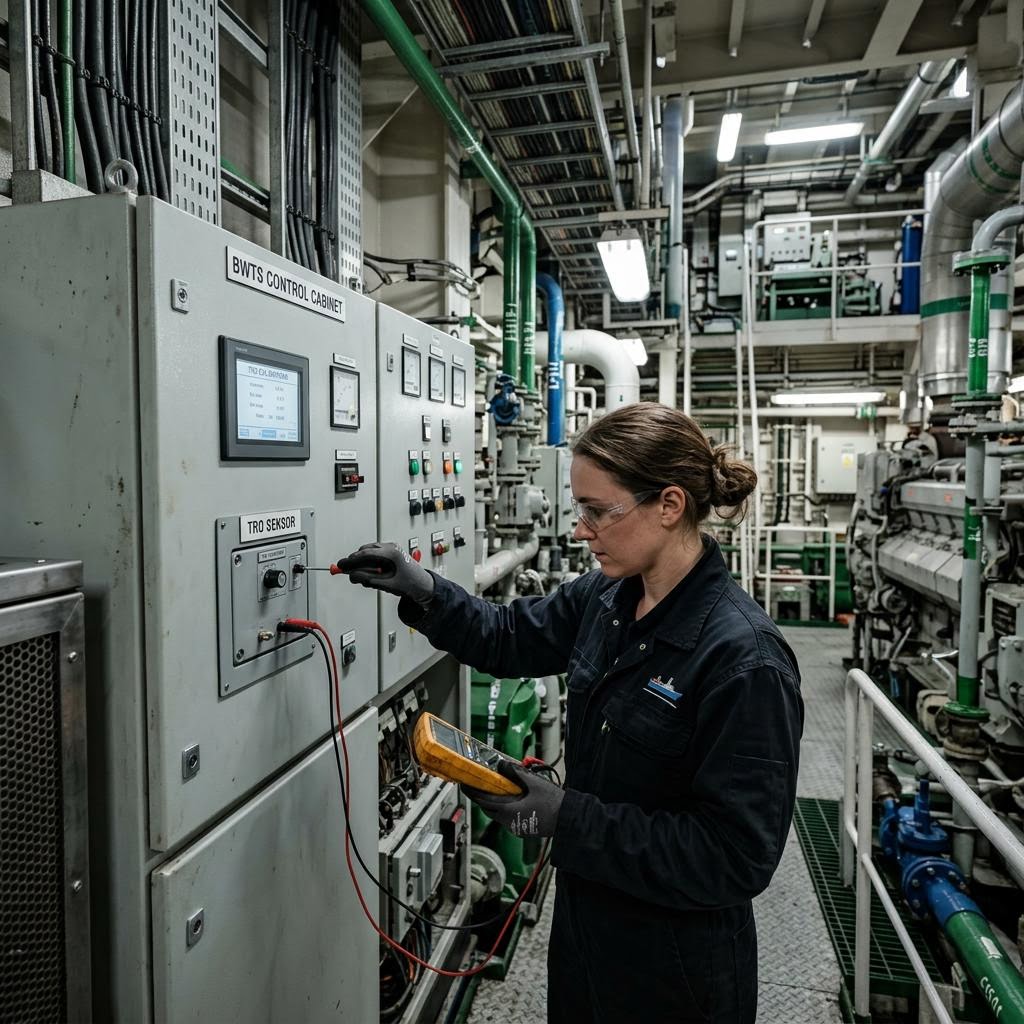
TRO alarms are frequent and are not always a treatment problem. A reading that is implausibly high or low, or that will not stabilise, often points to expired or contaminated reagent, a blocked or air-locked sample line, a dirty measuring cell or a sensor due for service, rather than to the treatment unit itself.
The diagnostic sequence is to verify the reagent is in date and correctly installed, confirm the sample line is clear and flowing, check the measuring cell and sensor condition, and only then question the treatment output. A genuinely low TRO with healthy analyser and reagent does indicate under-treatment and should be investigated at the EUT unit and flow.
Sea Clean supplies TRO sensor parts and in-date reagents and verifies the analyser against reference values during attendance, so the vessel can rely on the reading for both compliance confirmation and safe discharge.
Flow, Valve and Neutralisation Faults
Flow and valve faults underlie many OceanGuard alarms. A flow meter reading low or unstable, a control valve not stroking fully, or an actuator fault can stop the system reaching its operating window and trigger treatment or sequence alarms. These are checked by comparing commanded and actual valve positions and by confirming flow against the pumps in use.
On discharge, neutralisation faults arise when residual oxidant remains above the permitted limit and the neutraliser dosing is insufficient, empty or not commanded correctly. The checks cover neutraliser stock, the dosing pump and line, and the discharge TRO reading, since discharging above the limit is both a compliance and a safety issue.
Sea Clean supplies flow instrumentation, valves, actuators and neutralisation components, and during attendance verifies the whole uptake-treatment-discharge sequence so a fault in one stage is not masking a problem in another.
When to Escalate and Get Attendance
Some faults can be cleared by the crew with guidance, such as a blocked sample line, an expired reagent or a reset after a transient trip. Others, including electrode wear, persistent treatment-unit faults, power-supply problems and anything affecting the validity of D-2 treatment, warrant engineer attendance and genuine parts.
A BWTS fault that risks a port state control finding or a non-compliant discharge should be escalated early rather than worked around, because contingency measures and documentation are easier to arrange before arrival than during an inspection. Sea Clean can advise on whether a fault is a crew-clearable item or an attendance case.
From the Haugesund base, urgent OceanGuard attendance in Norway and the North Sea is typically within 0-24 hours subject to scheduling, and worldwide by mobilising as flights, visas and access allow. Send the alarm history, parameters, system model and IMO number to post@seaclean.no to start diagnosis.
Frequently asked questions
What causes a high filter differential pressure alarm on OceanGuard?
Usually sediment or biological loading in turbid water, a fouled or damaged element, or a backflush that is not clearing the screen. Check the actual differential against baseline and whether backflush initiates and completes; the backflush valve and actuator are common culprits when backflush fails.
Is a TRO alarm always a treatment problem?
No. Many TRO alarms stem from expired or contaminated reagent, a blocked or air-locked sample line, a dirty measuring cell or a sensor due for service. Verify the analyser and reagent first; a genuinely low TRO with a healthy analyser indicates under-treatment to investigate at the EUT unit and flow.
What does rising EUT treatment unit voltage indicate?
Needing higher voltage to reach the same output commonly indicates electrode scaling or wear. Scaling may respond to inspection and cleaning, but worn electrodes require genuine replacement. Erratic current points instead to a connection or power-supply fault, which is diagnosed separately.
When should a fault be escalated to engineer attendance?
Electrode wear, persistent treatment-unit faults, power-supply problems and anything affecting D-2 validity warrant attendance and genuine parts. Faults risking a PSC finding or non-compliant discharge should be escalated early. Urgent Norway and North Sea attendance is typically within 0-24 hours.