Troubleshooting the Sunrui BalClor BWTS
Updated
Faults on a Sunrui BalClor system usually fall into a few recurring patterns: TRO control alarms, low electrolyser output, filter high-pressure trips and neutralisation problems on discharge. This article works through these fault modes, their likely causes and practical checks, and explains how Sea Clean AS supports BalClor diagnosis and repair as an independent service provider.
Key takeaways
- Diagnose BalClor faults by subsystem: filter, electrolyser, TRO control, or neutralisation circuit.
- Check sample lines, reagent and pump cartridges before assuming a TRO sensor or dosing failure.
- Low electrolyser output is most often scaling, which acid cleaning usually reverses before cell replacement.
- Filter high-pressure trips often reflect turbid water; check backflush and consider a slower ballasting rate.
- High discharge TRO points to the neutralisation circuit: tank level, dosing pump and the discharge analyser.
- Sea Clean offers independent BalClor engineer attendance, typically 0-24h ETA for Norway and North Sea calls.
Approaching a BalClor Fault Methodically
BalClor is a side-stream electrochlorination system, so a useful first question on any fault is which subsystem is involved: the pre-treatment filter, the electrolyser and hypochlorite generation, the TRO measurement and dosing control, or the neutralisation circuit on discharge. Identifying the subsystem narrows the cause quickly and avoids changing parts at random.
The control system logs and alarm history are the most valuable diagnostic resource on board. Reading the sequence of alarms, rather than reacting to the latest one, often reveals the root event, for example a filter trip that cascaded into a dosing alarm because flow was lost.
Before suspecting hardware, confirm the operating conditions: seawater temperature and salinity, flow rate, and whether the system is being operated within the limits of its type approval. Low salinity in particular reduces electrochlorination efficiency and is a frequent cause of apparent low output that is actually an operating-envelope issue.
TRO Control and Measurement Alarms
TRO alarms during ballasting usually mean the system cannot reach or hold the required disinfectant concentration, while TRO alarms on deballasting mean the neutralised discharge is reading above the limit. The first step is to decide whether the reading is real or an analyser artefact, because the response differs entirely.
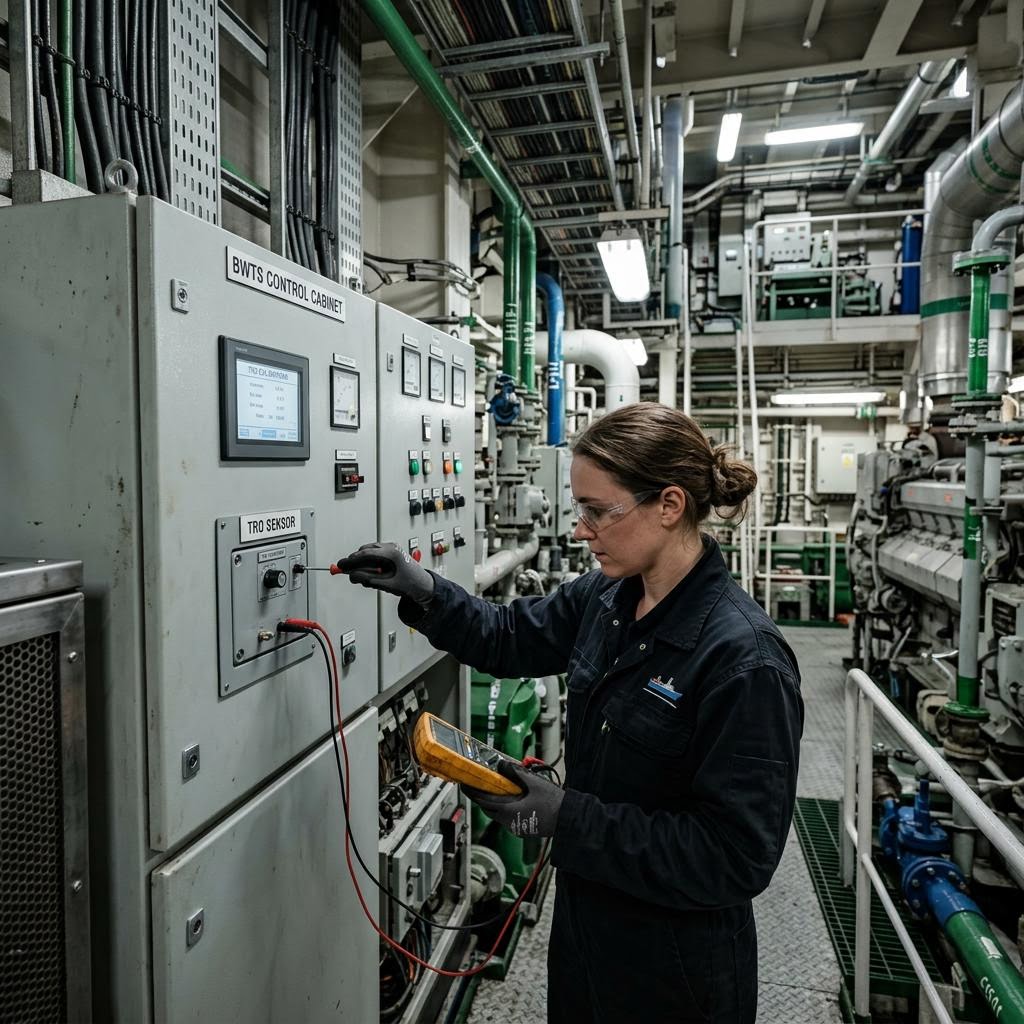
Check the analyser sample lines for blockage or air, the reagent for expiry, and the peristaltic pump cartridge for wear before concluding that dosing is genuinely off. A blocked or starved sample line commonly produces readings that do not reflect the actual line concentration and triggers nuisance alarms.
Where the reading is genuine, low ballasting TRO points back to the electrolyser, while high discharge TRO points to inadequate neutraliser dosing. Distinguishing the two early saves time and prevents an unnecessary discharge that breaches the residual oxidant limit.
Low Electrolyser Output
If hypochlorite generation is genuinely low, the electrolyser is the focus. Rising cell voltage at a given current, or current that cannot be sustained, typically indicates scaling on the electrodes from calcium and magnesium deposits, which is the most common and most reversible cause.
Acid cleaning of the cell to the manufacturer's procedure usually restores output where scaling is the issue. Confirm also that the side-stream flow and pressure are correct, because insufficient flow through the electrolyser reduces generation and can mimic a worn cell.
Where cleaning does not restore output and flow is correct, the electrode coating may be worn and the cell or electrode assembly needs replacement. This is a planned, longer-lead repair, so confirming the diagnosis before ordering avoids the cost of a wrongly specified cell.
Filter High-Pressure and Flow Trips
A rising filter differential pressure or a high-pressure trip during ballasting is one of the most common BalClor interruptions, particularly in turbid or sediment-laden water. The backflush mechanism may be struggling to keep the element clean, or the element itself may be fouled or damaged.
Check the backflush sequence, the backflush pump or motor and the associated valves, and inspect the filter element for fouling and integrity. Operating in heavy sediment may simply require a slower ballasting rate to keep within the filter's capacity rather than indicating a fault.
If the element is fouled beyond cleaning or damaged, it must be replaced with the correct part for the model. Carrying a spare element and seal kit on board allows the crew to restore the system without waiting for a port delivery.
Neutralisation and Discharge Problems
On deballasting, BalClor measures residual oxidant and doses neutraliser if needed so the discharge is below the TRO limit. A high discharge reading despite dosing points to the neutralisation circuit: an empty or low neutraliser tank, an airlocked or worn dosing pump, a blocked dosing line, or a faulty discharge TRO analyser.
Confirm neutraliser stock and dosing-pump operation first, since an empty tank or airlocked pump is a frequent and quickly corrected cause. Verify the discharge analyser with the same checks used elsewhere, because a faulty analyser can hold the discharge valve closed even when the water is actually within limits.
Because an over-limit discharge is both a compliance and an environmental issue, the system is designed to inhibit discharge until TRO is acceptable. Resolving the neutralisation fault rather than overriding the interlock is essential, and Sea Clean can advise on the correct diagnostic path.
When to Call for Engineer Support
Many BalClor faults are resolved by the crew with the alarm history, the manuals and a stock of consumables. Engineer attendance is warranted when a fault recurs, when the diagnosis is unclear, when an electrolyser or analyser repair exceeds the crew's tools, or when a PSC inspection or commissioning test is imminent.
Sea Clean provides independent service and engineer attendance for BalClor systems, mobilising with the spares and reagents likely needed for the reported fault. For Norwegian and North Sea port calls an engineer typically reaches the vessel within 0-24 hours; for worldwide calls mobilisation is as fast as flights, visas and port access allow.
Send the vessel name, IMO number, BalClor model, the alarm history and a description of the fault to post@seaclean.no so attendance and parts can be planned together. Providing the alarm log in advance lets the engineer arrive with the right parts rather than diagnosing from scratch on board.
Frequently asked questions
Why can't my BalClor system reach the TRO setpoint when ballasting?
Either the analyser is misreading or the electrolyser output is genuinely low. Check sample lines, reagent and the pump cartridge first. If the reading is real, look at electrolyser scaling, side-stream flow and whether seawater salinity is within the system's operating envelope, since low salinity reduces electrochlorination efficiency.
What causes a high TRO reading on discharge?
A high discharge reading despite dosing points to the neutralisation circuit: an empty or low neutraliser tank, an airlocked or worn dosing pump, a blocked dosing line, or a faulty discharge analyser. Resolve the fault rather than overriding the discharge interlock, since an over-limit discharge breaches the residual oxidant limit.
How do I deal with repeated filter high-pressure trips?
Check the backflush sequence, pump and valves, and inspect the element for fouling or damage. In turbid or sediment-laden water a slower ballasting rate may keep the system within the filter's capacity. If the element is fouled beyond cleaning, replace it with the correct part for the model.
When should I call Sea Clean for BalClor support?
Call for engineer attendance when a fault recurs, when diagnosis is unclear, when a repair exceeds the crew's tools, or when a PSC inspection or commissioning test is imminent. Provide the alarm history in advance so the engineer arrives with the right parts. ETA is typically 0-24h for Norway and North Sea calls.