Headway OceanGuard BWTS Service and Support
Updated
The Headway OceanGuard system treats ballast water by filtration combined with electrocatalysis (EUT) that generates disinfecting radicals without a separate chemical dosing tank. Sea Clean AS is an authorized Headway Technology agent and provides OceanGuard service attendance, genuine spare parts, consumables and commissioning testing support. This article explains how the system works, what routine and corrective service involves, and how attendance and parts supply are arranged for vessels in Norway, the North Sea and worldwide.
Key takeaways
- OceanGuard treats ballast by automatic backflushing filtration plus in-situ electrocatalysis (EUT), without a large stored-chemical dosing tank.
- Sea Clean AS is an authorized Headway Technology agent and supplies genuine OceanGuard parts and recognised service.
- Planned maintenance focuses on the filter, EUT treatment unit, TRO analyser and flow/pressure instrumentation.
- Commissioning testing under MEPC.325(75) is supported by Sea Clean, with analysis certified by an accredited or authorised party.
- Genuine parts and in-date reagents are matched to the exact unit revision and consolidated into single deliveries where possible.
- Direct attendance covers Norway and the North Sea within 0-24h for urgent calls; worldwide attendance is by mobilisation as flights and access allow.
How OceanGuard Treats Ballast Water
The Headway OceanGuard BWTS uses a two-stage process. On uptake, ballast water passes through an automatic backflushing filter, typically with a screen mesh in the tens of microns, which removes larger organisms and sediment before the water reaches the treatment unit. The filtered solids are returned to the source water during backflush so they are not carried into the tanks.
The second stage is electrocatalysis, branded EUT, in which a side-stream or full-flow passes through a treatment unit where electrodes generate hydroxyl radicals and other short-lived oxidants directly in the water. Because the active species are produced in situ and decay quickly, OceanGuard does not rely on a large stored-chemical dosing system, which changes the maintenance profile compared with electrochlorination units that hold and dose sodium hypochlorite.
Total residual oxidant (TRO) is monitored during the cycle, and on discharge the water is neutralised where residual oxidant remains above the permitted discharge limit. Understanding this uptake-treatment-discharge sequence is the basis for diagnosing faults, planning parts and supporting commissioning, because each stage has its own sensors, controls and wear items.
Sea Clean as Authorized Headway Agent
Sea Clean AS is an authorized agent for Headway Technology, which means we supply genuine OceanGuard spare parts and consumables and carry out service and engineer attendance on these systems with manufacturer-recognised standing. For OceanGuard specifically we can state this authorization directly, which matters to owners who want genuine parts and recognised service for warranty and class purposes.
Authorization gives access to Headway documentation, parts identification and technical support channels, so a part can be matched to the exact unit revision and a fault referred upstream when needed. It also means commissioning and recommissioning work is carried out in line with the manufacturer's procedures rather than improvised.
For brands other than Headway, Sea Clean provides independent service and parts support and does not claim manufacturer authorization. The distinction is deliberate: OceanGuard owners receive recognised agent service, while owners of other systems receive capable independent attendance.
Routine Service and Planned Maintenance
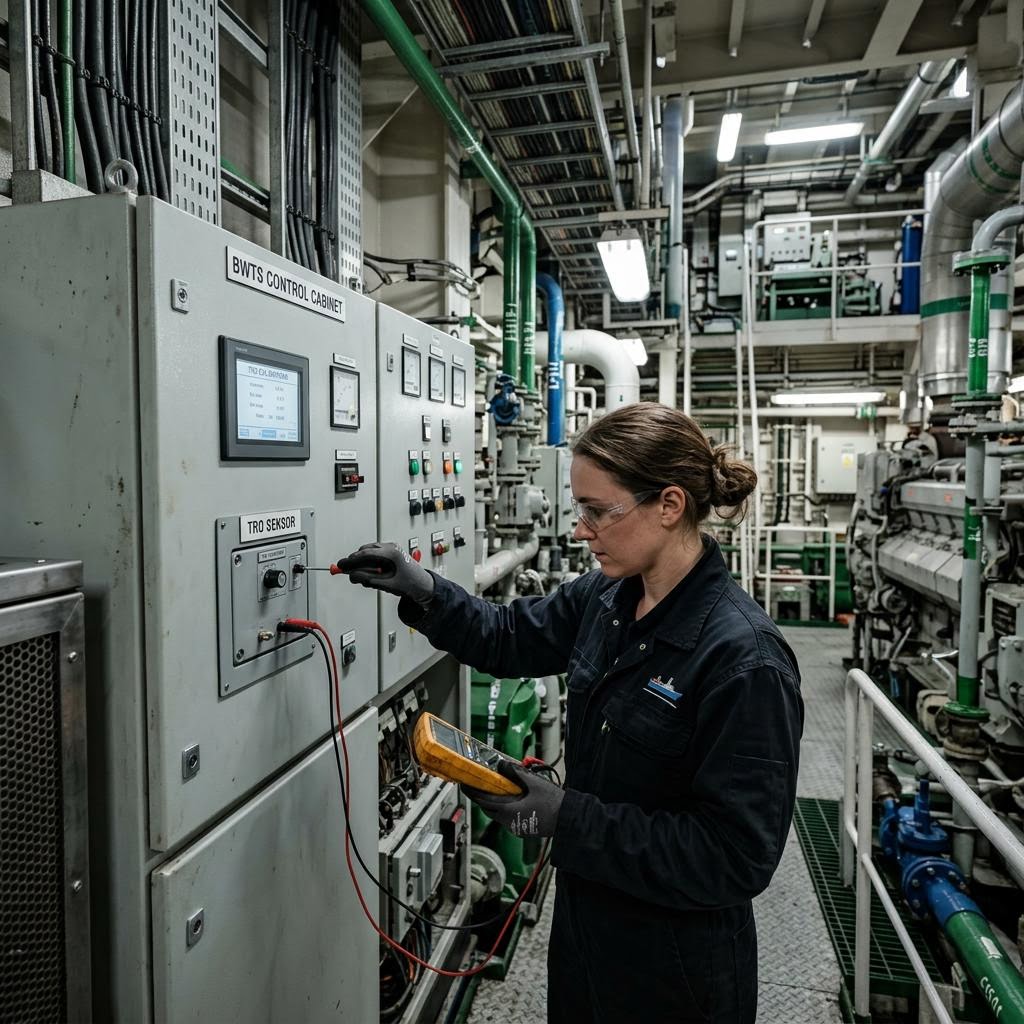
Planned OceanGuard maintenance centres on the filter, the EUT treatment unit, the sensors and the control system. Filter elements and seals are inspected for wear and fouling, backflush function is verified, and the differential pressure response is checked against expected values so that a clogging trend is caught before it forces a bypass or trips an alarm.
The treatment unit electrodes are inspected for scaling, erosion and connection integrity, and the TRO analyser is serviced and verified against reference reagents so its readings remain trustworthy. Sample lines, flow meters and valves are checked because a blocked sample line or a sticking valve commonly causes alarms that look like a treatment fault but are actually instrumentation or flow issues.
Sea Clean plans these tasks around the vessel's schedule and carries the spares and reagents likely needed for the service interval, so a planned attendance does not stall waiting for a part. Service findings are documented for the vessel's records and for class where the attendance supports survey requirements.
Commissioning and Recommissioning Testing
Commissioning testing under the IMO BWMS Code (resolution MEPC.325(75)) confirms that an installed BWTS can meet the D-2 discharge standard on the specific vessel after installation. For OceanGuard this means verifying the filter, treatment unit and neutralisation operate correctly together and that a representative discharge sample meets the standard, with the analysis carried out by an accredited laboratory or a party authorised by the flag administration or class.
Sea Clean supports OceanGuard commissioning by attending the vessel, operating and verifying the system, coordinating representative sampling and supplying TRO test kits and reagents for indicative checks. We do not certify the analysis ourselves; the accredited or authorised party performs and certifies the detailed result, and we facilitate the test and the documentation around it.
Recommissioning after a major repair, an electrode replacement or a lay-up follows similar logic: the system is brought back to known-good operation, verified, and where required re-tested so the result can be presented to the surveyor and retained on board.
Parts Supply and Consumables
As an authorized agent, Sea Clean supplies genuine Headway OceanGuard parts including filter elements and seals, EUT treatment unit components, TRO sensor parts and reagents, flow and pressure instrumentation, valves, and control and power components. Matching the part to the exact unit model and revision avoids the delay and risk of fitting an incompatible item.
Consumables such as TRO test reagents and neutraliser are supplied in date and labelled for the receiving vessel, with attention to shelf life so the engineer is not left with stock that expires before use. For vessels on tight schedules we consolidate parts and reagents into a single delivery to the agreed berth or agent.
Where a part is held in Norway it can often reach a Norwegian or North Sea port quickly; for worldwide calls, parts are routed by courier or air freight and coordinated with the local agent, so lead time depends on freight and customs rather than availability.
Attendance Coverage and Response
From the Haugesund and Karmsund base, Sea Clean attends OceanGuard vessels directly along the Norwegian west coast and into the North Sea and north-west European ports. For these calls an engineer can typically reach the vessel within 0-24 hours for urgent attendance, subject to scheduling and port access, and within a normal working window for planned jobs.
For worldwide calls, attendance is arranged by mobilising an engineer as flights, visas and port access allow, with parts and reagents forwarded ahead and local agent coordination on site. We do not promise instant global arrival; the honest position is rapid mobilisation rather than a standing presence in every port.
To begin coordination, send the vessel name, IMO number, system model, the fault or scope, ETA and port to post@seaclean.no. The more detail provided on the OceanGuard revision and the alarm history, the better an attendance and parts package can be prepared before the vessel arrives.
Frequently asked questions
Is Sea Clean an authorized Headway agent?
Yes. Sea Clean AS is an authorized agent for Headway Technology and supplies genuine OceanGuard spare parts and consumables, and carries out service and engineer attendance on these systems with manufacturer-recognised standing. This authorization applies to Headway products specifically.
Does OceanGuard use stored chemicals to treat ballast water?
No large stored-chemical dosing tank is required. OceanGuard generates disinfecting oxidants in situ by electrocatalysis (EUT) after filtration, and the active species decay quickly. Neutralisation is applied on discharge where residual oxidant remains above the permitted limit.
Can Sea Clean support OceanGuard commissioning testing?
Yes. Sea Clean attends the vessel, operates and verifies the system, coordinates representative sampling and supplies TRO test kits and reagents. The detailed analysis is performed and certified by an accredited laboratory or a party authorised by the flag administration or class, not by Sea Clean.
How quickly can an engineer attend an OceanGuard vessel?
For Norway and North Sea port calls an engineer can typically attend within 0-24 hours, subject to scheduling and port access. For worldwide calls attendance is arranged by mobilising as flights, visas and port access allow, with parts forwarded ahead and local agent coordination.