Urgent BWTS Breakdown Response
Updated
A ballast water treatment system that fails during cargo operations or before a survey can stop ballasting, threaten a port call and create a compliance problem. This article explains how to triage an urgent BWTS breakdown, what interim and contingency measures are legitimate, and how Sea Clean combines remote support, parts supply and engineer attendance to restore operation.
Key takeaways
- Record the exact alarm, fault codes and screen image before resetting, so triage is based on facts.
- If treatment is lost, use legitimate contingency measures and record them in the ballast water record book.
- Urgent faults cluster around sensors, power, treatment stages, and filter or backflush problems.
- Parts, not labour, often limit repair speed; accurate identification and fast freight are decisive.
- Restoration is complete only when the system demonstrably treats again and the work is documented.
- Understanding the cause and carrying the right spares prevents the breakdown from recurring.
First Response: Stabilise and Triage
When a BWTS alarms or trips, the first task is to stabilise the situation without making it worse. The crew should record the exact alarm text and any fault codes, note what the system was doing at the moment of failure, and avoid repeated reset attempts that can mask the underlying cause. A clear photograph of the control screen is often more useful than a verbal description.
Triage then separates the likely categories: a sensor or signal fault, a power or control failure, a treatment-stage problem such as a UV lamp or electrochlorination cell, or a flow and filtration issue. Each points to a different repair path and a different parts list. Getting this rough classification right early saves a wasted mobilisation.
Sea Clean's role at this stage is to help the crew interpret the symptoms by phone or video and decide whether the problem can be cleared on board, needs parts shipped, or needs an engineer. Honest triage avoids both panic call-outs and dangerous delay.
Interim and Contingency Measures
If the system cannot treat ballast, the vessel must not simply discharge untreated water where that breaches the rules. Legitimate contingency measures depend on the regime and the port, and may include retaining ballast on board, using a designated reception facility where available, exchanging ballast in permitted areas where that is still accepted, or arranging an alternative agreed with the port state and flag.
Any contingency action must be recorded in the ballast water record book and reported as the relevant authority requires. The aim is to keep the vessel both safe and demonstrably acting in good faith while the system is repaired, not to improvise an unrecorded workaround.
Sea Clean supports this by advising on the practical options and by supplying reagents such as sodium thiosulfate neutraliser where neutralisation of treated water is part of the contingency. The compliance decision rests with the master, owner and flag, informed by the port state's position.
Common Urgent Fault Modes
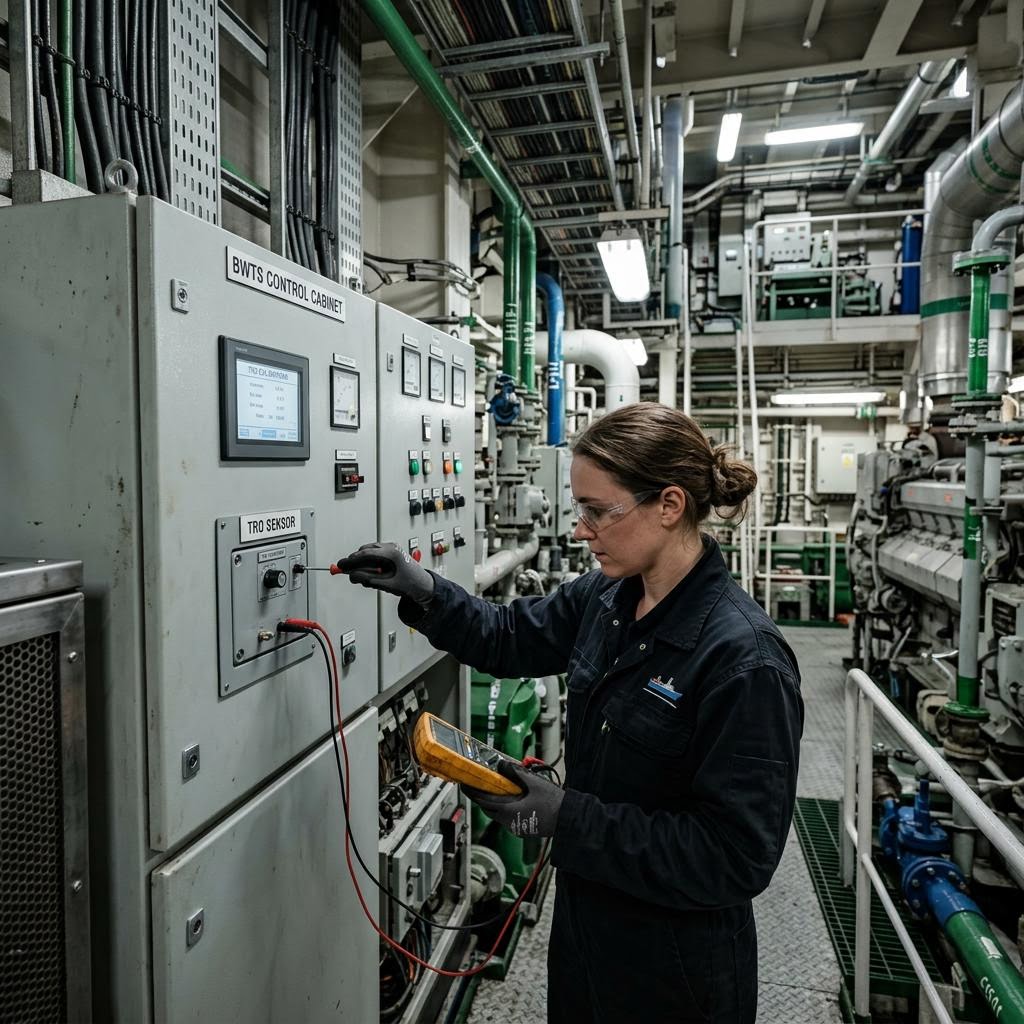
On electrochlorination systems, urgent faults often involve the electrolyser cell, the TRO sensor reading out of range, or a power supply or rectifier trip. Salinity or temperature outside the design envelope can also stop treatment, which is a process limit rather than a defect, and needs to be recognised as such before parts are changed.
On UV systems, lamp failure, quartz sleeve fouling, a wiper fault or a UV intensity sensor alarm are typical. A single failed lamp may drop treatment below the validated dose, so the fault is real even though the unit appears to run. Filter and backflush problems, such as a blocked or torn screen and differential-pressure alarms, cut across both technologies.
Because these patterns are well known, an accurate fault description lets Sea Clean carry or ship the right candidate parts straight away. Many urgent calls are resolved on the first visit precisely because the likely cause was identified before travel.
Parts Under Time Pressure
Speed of repair is often limited by parts rather than labour. Sea Clean supplies genuine Headway OceanGuard parts and multi-brand BWTS parts, and under urgent conditions ships them by the fastest courier or air freight to meet the vessel or the engineer at the port. For worldwide calls, parts are frequently sent ahead to a local agent so they are waiting on arrival.
Where an exact original part has a long lead time, a verified equivalent can sometimes restore operation faster, provided it meets the system's requirements; this is judged case by case and never at the expense of the system's validated performance. Consumables such as reagents and test kits are dispatched in date and labelled for the vessel.
Clear part identification, the system serial and any nameplate or drawing reference, prevents the classic delay of shipping the wrong item. A photograph of the failed component and its markings usually settles identification quickly.
Engineer Attendance and Restoration
When the fault needs hands on the equipment, an engineer is mobilised on the timing realistic for the location: typically within 0-24 hours for Norway and North Sea ports, and as flights, visas and port access allow elsewhere. The engineer arrives with the candidate parts and tools indicated by the triage, restores function, and verifies treatment before the system is signed back into service.
Restoration is not complete until the system demonstrably treats again, which on electrochlorination units means a TRO reading back within range and on UV units a validated dose. The engineer documents the work, the parts fitted and the verification result so the vessel has a record for class and port state.
Where attendance cannot beat the schedule, the engineer guides the crew remotely through the repair and verification, and a follow-up attendance is arranged at the next suitable port. The objective is a documented return to compliant operation, not just a cleared alarm.
After the Breakdown: Preventing a Repeat
Once the immediate fault is fixed, the cause should be understood so it does not recur on the next ballast operation. A sensor that drifted, a cell nearing the end of its life, or a filter fouled by local water all point to a planned-maintenance action rather than another emergency.
Sea Clean records the failure and the fix and, where useful, recommends spares to carry on board so the same fault can be cleared by the crew next time without a call-out. Building a small, correct onboard spares holding is one of the cheapest ways to avoid repeat downtime.
Folding the lessons into the vessel's planned maintenance schedule turns an urgent breakdown into a one-off. Linking the urgent repair to a follow-up annual service is often the most efficient way to close out the underlying condition.
Frequently asked questions
What should the crew do first when a BWTS fails?
Record the exact alarm text and fault codes, photograph the control screen, and note what the system was doing when it failed. Avoid repeated resets that can hide the cause, and contact Sea Clean with the make, model and symptom so triage can begin immediately.
Can the vessel discharge ballast if the BWTS is broken?
Not where that breaches the applicable rules. Legitimate options include retaining ballast, using a reception facility where available, or another measure agreed with the port state and flag, all recorded in the ballast water record book. The compliance decision rests with the master, owner and flag.
How fast can parts and an engineer reach the vessel?
Parts are shipped by the fastest courier or air freight, often sent ahead to a local agent for worldwide calls. An engineer is mobilised within 0-24 hours for Norway and North Sea ports, and as flights, visas and port access allow elsewhere.
How do you stop the same breakdown happening again?
Sea Clean identifies the underlying cause, records the fix, and recommends spares to carry on board so the crew can clear a recurrence without a call-out. The lessons are folded into the vessel's planned maintenance, often linked to a follow-up annual service.