Techcross ECS and HYCHLOR BWTS Service
Updated
Techcross is one of the most widely installed BWTS makers, with the in-line electrolysis ECS system and the side-stream HYCHLOR electrochlorination system in service across large fleets. Sea Clean AS provides independent service, parts sourcing, troubleshooting and engineer attendance for Techcross systems; Sea Clean is not a Techcross-authorized agent and does not claim OEM approval. This article explains how the systems work and what independent service and support involve.
Key takeaways
- Techcross ECS uses full-flow in-line electrolysis; HYCHLOR uses side-stream electrochlorination with dosing into the main flow.
- Sea Clean provides independent service and parts support for Techcross and does not claim OEM authorization (authorized for Headway only).
- Electrodes are the main wear item; rising voltage for the same output signals scaling or coating loss.
- Low-salinity operation stresses electrolysis units and can expose marginal electrode condition.
- Most TRO alarms are analyser, reagent or sample-line issues; neutralisation faults are both compliance and safety concerns.
- Urgent Norway/North Sea attendance is typically within 0-24h; worldwide attendance is by mobilisation as access allows.
Techcross ECS and HYCHLOR Explained
Techcross Electro-Cleen System (ECS) treats ballast water by full-flow in-line electrolysis: the whole ballast stream passes through an electrolysis chamber on uptake, where electrodes generate active chlorine and other oxidants directly in the seawater to inactivate organisms. There is no upstream filter in the classic ECS arrangement, which makes electrode condition and water conductivity central to its operation.
HYCHLOR is Techcross's side-stream electrochlorination design, in which a small portion of the flow is electrolysed to produce a concentrated hypochlorite solution that is dosed into the main ballast stream. This approach suits larger flow rates and lower-salinity operation differently from full-flow ECS, and it changes the maintenance focus toward the side-stream generator and dosing system.
Both designs rely on TRO monitoring to confirm dose and to control neutralisation on discharge, and both depend on adequate salinity or conductivity to generate oxidant. Knowing which Techcross variant is installed is the starting point for any service or parts work, because the wear items and fault modes differ.
Sea Clean's Independent Position on Techcross
Sea Clean provides independent service and parts support for Techcross systems. We are an authorized agent for Headway Technology only; for Techcross and all other non-Headway brands we do not claim manufacturer authorization or OEM approval, and we describe our work accordingly as independent service and parts sourcing.
Independent does not mean less capable. Sea Clean engineers attend Techcross ECS and HYCHLOR installations for fault diagnosis, electrode and component replacement, TRO and neutralisation issues and general maintenance, drawing on practical experience with electrolysis and electrochlorination systems across brands.
Where a matter genuinely requires the manufacturer, for example a proprietary software lock or a warranty-bound component, we are clear about that limit so the owner can decide how to proceed. Honesty about what independent service can and cannot do is part of how we work.
Electrolysis and Electrode Maintenance
The electrolysis chamber is the heart of both ECS and HYCHLOR and its electrodes are the principal wear item. Over time electrodes scale, erode and lose coating, which shows up as the need for higher voltage to reach the same oxidant output, reduced TRO, or power faults. Regular inspection and condition assessment catch this before it forces under-treatment.
Scaling, especially in hard or warm water, can sometimes be reduced by cleaning, but coating loss and erosion require electrode replacement. Because electrode performance depends on conductivity, low-salinity operation puts extra demand on the unit and can expose marginal electrode condition that is masked in full-strength seawater.
Sea Clean inspects and services electrolysis units, sources replacement electrodes and chamber components, and verifies output after work so the system returns to its operating window. Power-supply and rectifier faults are diagnosed separately from electrode wear because the remedies differ.
TRO Control and Neutralisation
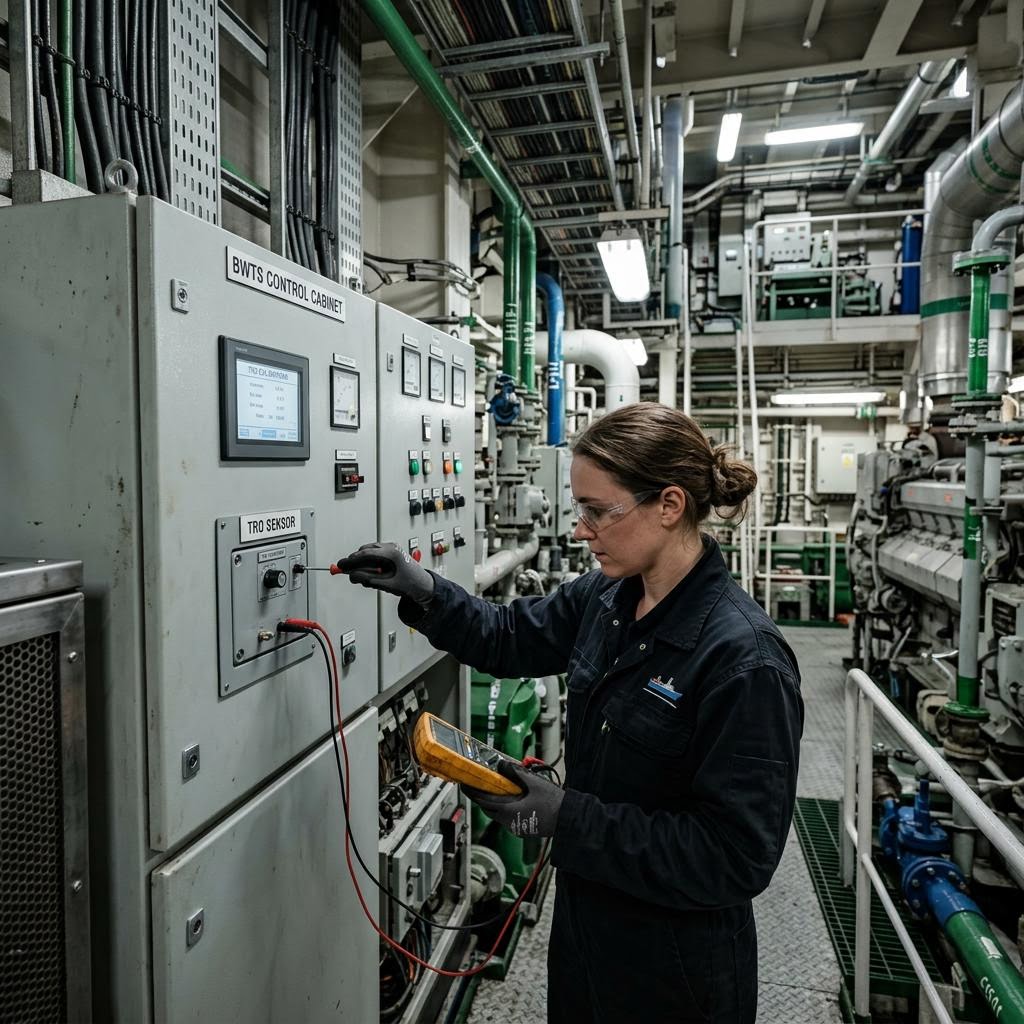
Techcross systems use TRO measurement to confirm treatment dose on uptake and to manage neutralisation on discharge. A TRO analyser that drifts, is starved of reagent or has a blocked sample line produces alarms that can look like treatment faults, so the analyser and its consumables are checked before the electrolysis unit is suspected.
On discharge, residual oxidant above the permitted limit must be neutralised, typically with sodium thiosulfate, before the water leaves the vessel. Neutralisation faults arise from empty or low neutraliser stock, a dosing pump or line problem, or an incorrect command, and they are both a compliance and a safety concern.
Sea Clean supplies TRO test kits, sensor consumables and sodium thiosulfate neutraliser, supplied in date and labelled for the vessel, and verifies the analyser and neutralisation chain during attendance so discharge readings can be relied on.
Parts Sourcing for Techcross Systems
Independent parts support for Techcross covers electrolysis electrodes and chamber components, TRO analyser parts and reagents, flow and pressure instrumentation, valves and actuators, dosing-system components for HYCHLOR, and electrical and control items. Sea Clean sources these through its supplier network and matches them to the installed variant and rating.
Accurate identification matters as much for Techcross as for any maker, so the system model, serial number and configuration should accompany an enquiry. The wrong electrode set or analyser part will not perform correctly even if it physically fits.
For Norwegian and North Sea calls, sourced parts can often reach the vessel quickly; for worldwide calls they are routed by courier or air freight and coordinated with the local agent. Consolidating parts and reagents into one delivery reduces handling during a short port stay.
Attendance and Response for Techcross
Sea Clean attends Techcross vessels for planned maintenance, fault diagnosis, electrode and component replacement, and support around commissioning or PSC issues. The engineer carries the parts and reagents likely needed for the reported scope, with access arranged through the agent and chief engineer.
From the Haugesund base, urgent Techcross attendance in Norway and the North Sea is typically within 0-24 hours subject to scheduling and port access, and planned work is scheduled to the vessel's program. For worldwide calls, an engineer is mobilised as flights, visas and port access allow, with parts forwarded ahead; we do not promise instant global arrival.
To start coordination, send the vessel name, IMO number, the Techcross model (ECS or HYCHLOR) and variant, the fault or scope, and the ETA and port to post@seaclean.no. Detail on the alarm history and electrode condition helps prepare an effective attendance.
Frequently asked questions
Is Sea Clean an authorized Techcross agent?
No. Sea Clean is an authorized agent for Headway Technology only. For Techcross we provide independent service, parts sourcing, troubleshooting and engineer attendance, and we do not claim OEM authorization or approval from Techcross.
What is the difference between Techcross ECS and HYCHLOR?
ECS treats the full ballast flow by in-line electrolysis, generating oxidants directly in the stream. HYCHLOR is a side-stream electrochlorination system that produces a concentrated hypochlorite solution and doses it into the main flow, which changes the maintenance focus toward the generator and dosing system.
What is the main wear item on a Techcross system?
The electrolysis electrodes. They scale, erode and lose coating over time, shown by needing higher voltage for the same oxidant output or by reduced TRO. Scaling may respond to cleaning, but coating loss and erosion require electrode replacement and verification of output afterward.
Can Sea Clean source Techcross spare parts?
Yes. Sea Clean sources electrolysis electrodes, chamber components, TRO analyser parts and reagents, instrumentation, valves and dosing components for Techcross systems through its supplier network, matched to the installed model and variant. Provide the model and serial number for correct identification.