What Does a CLX-XT WCAL Fault After Startup Mean?
Updated
WCAL in this CLX-XT manual means invalid water-level calibration, not automatically a wrong chlorine slope. One documented cause is starting the instrument before sample water is available. Resolve the actual water condition before relying on a cleared display.
Request BWTS spare parts, annual calibration or ballast-water testing
Key takeaways
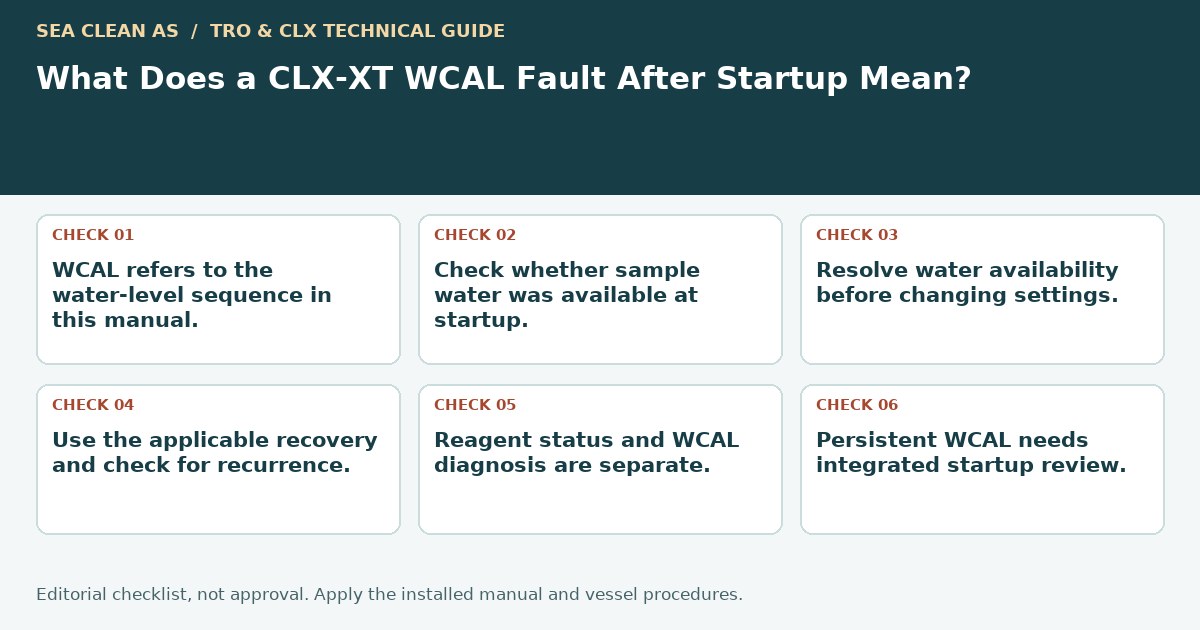
- WCAL refers to the water-level sequence in this manual.
- Check whether sample water was available at startup.
- Resolve water availability before changing settings.
- Use the applicable recovery and check for recurrence.
- Reagent status and WCAL diagnosis are separate.
- Persistent WCAL needs integrated startup review.
Read the model's fault definition
Section 10.1 identifies WCAL as water-level calibration invalid.
Record the exact message, model, serial number and other queued faults. Do not interpret every use of calibration in an instrument message as a request to adjust the displayed TRO concentration; hydraulic and optical sequences have their own checks.
Reconstruct the startup order
Compare when power was applied with when sample water became available.
The manual explicitly notes that a WCAL fault can follow power-up before a water sample is present. This matters during commissioning, valve-line-up changes or restart after maintenance, when treatment water and instrument power may be restored at different times.
Establish a usable sample path
Confirm the permitted sample source, valve position, supply and drain condition under the vessel's safe procedure.
No-water, slow-fill and drain problems should be distinguished from the initial startup condition. Do not adjust a regulator repeatedly without determining whether upstream isolation or a restriction is preventing the intended flow.
Use the documented recovery route
Section 10.3 describes ensuring sample availability and using the specified PRIME sequence to force another water calibration.
Follow the exact installed manual and chemical-handling precautions. A fault disappearing after a reset is not evidence that the underlying condition was corrected if it returns on the next cycle.
Do not mistake reagent renewal for WCAL repair
A replacement DPD set may be needed independently for commissioning or an expired bottle, but WCAL itself does not identify exhausted chemistry.
Keep the sample-path finding and the reagent status as separate job items. This avoids using repeated reagent changes to investigate a hydraulic startup problem.
If fresh chemistry is also required, identify it separately from the sample-water fault investigation. Plan the separate commissioning reagent requirement
Escalate persistent startup failure
Provide startup timing, sample observations, fault queue and the current drawing for technical review.
Instrument work should be coordinated with the BWMS commissioning sequence and protective functions. Sea Clean can support the scope; a valid water-level sequence is not evidence of biological commissioning-test acceptance or whole-system approval.
Send startup timing, queued codes and sample-path observations for the fitted analyser. Coordinate WCAL and commissioning-sequence review
Frequently asked questions
Is WCAL the same as TRO slope calibration?
No. The cited manual defines it as water-level calibration.
Can power-up without sample water trigger WCAL?
Yes. The manual specifically identifies that startup condition.
Does replacing indicator necessarily clear WCAL?
No. Establish the water and measurement sequence independently.
What if WCAL returns after recovery?
Preserve the observations and escalate the recurring instrument condition instead of treating reset as repair.
Sources
- HF scientific CLX-XT operation and maintenance manual, revision 5.0 — Sections 6.2–6.3 and 10.1–10.3 define startup WCAL and the sample-availability recovery.
- HF scientific CLX-XT engineering specification
Related articles
- Should CLX-XT FAST or SLOW Faults Be Fixed by Increasing Sample Pressure?
- What Is the Difference Between CLX PURG and NPRG Faults?
- Why Does a CLX PRIME Cycle Run Without Reagent Colour?
- What Must Be Checked Before Restarting a CLX-XT After Long Storage?
- What Is a Ballast Water Treatment System? Explained
- How Does BWTS Installation Work? Step by Step
Request spares, calibration or ballast-water testing
Include BWMS brand/model, vessel/IMO number, port/terminal, date/ETA and scope or part numbers. These links prepare an email draft; you must send it yourself.
- Request a parts quote — Sensors, TRO reagents, calibration kits and replacement parts. Confirm compatibility, availability and delivery for your installed system.
- Request a calibration booking — Annual instrument calibration with a calibration certificate for the work completed. OEM instructions, drift or applicable rules may require earlier work.
- Request testing coordination — Arrange sampling and testing with an appropriately qualified party for your IMO D-2, commissioning or other stated purpose.
Authorised Headway agent. Other-brand enquiries are independently reviewed; no OEM authorisation is claimed. Sea Clean is not an accredited laboratory or approving authority. Calibration does not demonstrate biological D-2 compliance. Attendance, testing scope and parts delivery are confirmed per enquiry.