What Is the Difference Between CLX PURG and NPRG Faults?
Updated
In the cited CLX-XT table, PURG means slow cuvette purge and NPRG means the cuvette is not purging. Both direct attention to drainage. They are not direct diagnoses of expired DPD chemistry.
Request BWTS spare parts, annual calibration or ballast-water testing
Key takeaways
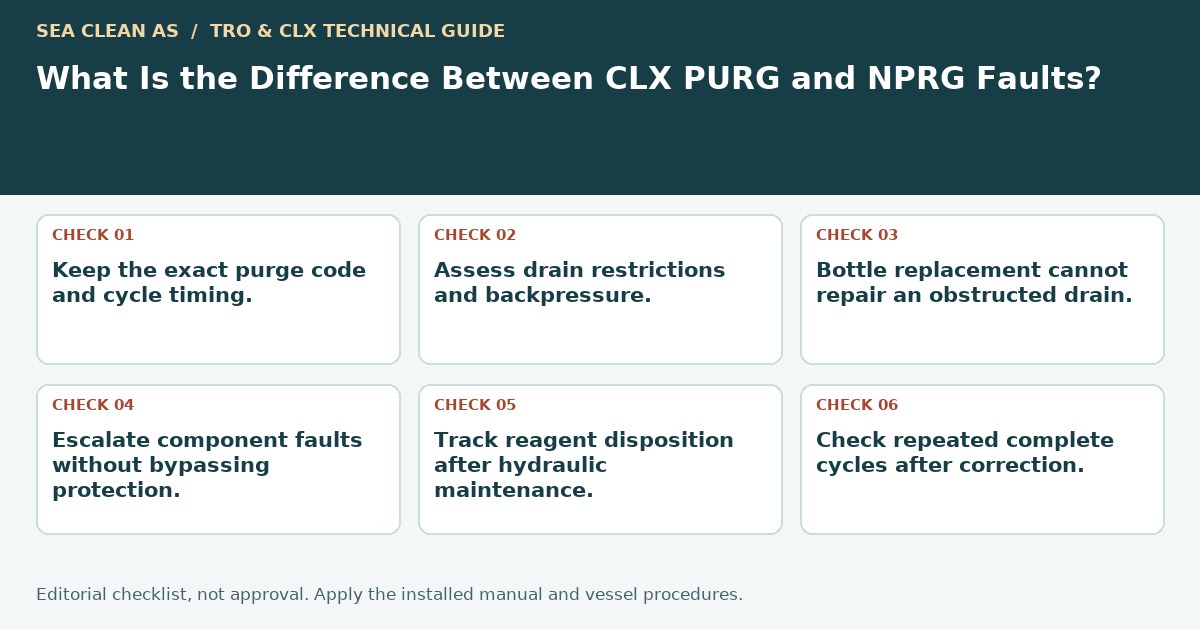
- Keep the exact purge code and cycle timing.
- Assess drain restrictions and backpressure.
- Bottle replacement cannot repair an obstructed drain.
- Escalate component faults without bypassing protection.
- Track reagent disposition after hydraulic maintenance.
- Check repeated complete cycles after correction.
Preserve the exact message
Record whether the fault is PURG or NPRG, when it occurs in the cycle and whether other faults accompany it.
The distinction between slow drainage and absent drainage helps focus the investigation. Clearing the queue without recording it loses information needed to separate intermittent restrictions from a persistent failure.
Review the installed drain route
Section 5.2 requires the main drain to remain open to atmosphere and recommends a short route.
Check for kinks, restrictions or changes to its destination under the approved vessel procedure. A downstream arrangement that introduces backpressure can affect the analyser even when incoming sample supply appears normal.
Do not confuse hydraulic and reagent functions
The measurement cycle must remove reacted sample before subsequent steps.
New indicator or buffer cannot open a restricted drain. Inspect the actual path and compare findings with the manual before purchasing bottles or adjusting chlorine calibration to account for a disturbed measurement sequence.
Recognise the limit of onboard checks
A purge-solenoid fault has its own code and potential electrical or mechanical causes.
Work involving wiring or internal components requires competent personnel and isolation. Do not apply external pressure, bridge protection or manipulate a powered valve to force a purge in an operating control loop.
Restore usable consumables after hydraulic work
Maintenance may require flushing and subsequent replacement or reinstallation of correctly prepared reagent.
Keep that requirement separate from the drain repair and record any reagent removed. The replacement reference and remaining life must still match the actual analyser, not the generic purge symptom.
If flushing removes chemistry, request the correct set independently of the hydraulic fault. Identify any reagent replacement required after drain work
Close out the whole cycle
Confirm fill, measurement and purge complete without recurrence, then document the drainage correction and required measurement check.
A single cleared code is not the close-out criterion. Sea Clean can review the work with sample plumbing and instrument condition, retaining the vessel's approved treatment and alarm basis.
Provide the route drawing, exact code and cycle observations for technical review. Coordinate CLX drain and purge-sequence diagnostics
Frequently asked questions
Does PURG mean no purge at all?
The cited XT table defines PURG as slow purge; NPRG is no purge.
Can expired reagent cause every purge warning?
Do not assume so. The table directs these faults to the drain lines.
Should the drain be pressurised?
The cited installation instruction requires it open to atmosphere; review the installed route accordingly.
Is clearing the code a complete repair?
No. Demonstrate repeated proper cycle operation and record the correction.
Sources
- HF scientific CLX-XT operation and maintenance manual, revision 5.0 — Sections 4.1, 5.2 and 10.1 define purge operation and drain-related fault meanings.
- HF scientific CLX-XT engineering specification
Related articles
- Should CLX-XT FAST or SLOW Faults Be Fixed by Increasing Sample Pressure?
- What Does a CLX-XT WCAL Fault After Startup Mean?
- Does CLX AutoPurge Remove the Need to Check After a Power Loss?
- Does a CLX-XT GLAS Fault Require New Reagent or Cuvette Work?
- What Is a Ballast Water Treatment System? Explained
- How Does BWTS Installation Work? Step by Step
Request spares, calibration or ballast-water testing
Include BWMS brand/model, vessel/IMO number, port/terminal, date/ETA and scope or part numbers. These links prepare an email draft; you must send it yourself.
- Request a parts quote — Sensors, TRO reagents, calibration kits and replacement parts. Confirm compatibility, availability and delivery for your installed system.
- Request a calibration booking — Annual instrument calibration with a calibration certificate for the work completed. OEM instructions, drift or applicable rules may require earlier work.
- Request testing coordination — Arrange sampling and testing with an appropriately qualified party for your IMO D-2, commissioning or other stated purpose.
Authorised Headway agent. Other-brand enquiries are independently reviewed; no OEM authorisation is claimed. Sea Clean is not an accredited laboratory or approving authority. Calibration does not demonstrate biological D-2 compliance. Attendance, testing scope and parts delivery are confirmed per enquiry.