Why Does a CLX PRIME Cycle Run Without Reagent Colour?
Updated
Priming activity does not by itself prove that both reagents reached the cuvette or that the indicator was correctly activated. Check the sample and chemistry, then the delivery path. Colour is only expected when the specified reaction has a suitable oxidant sample.
Request BWTS spare parts, annual calibration or ballast-water testing
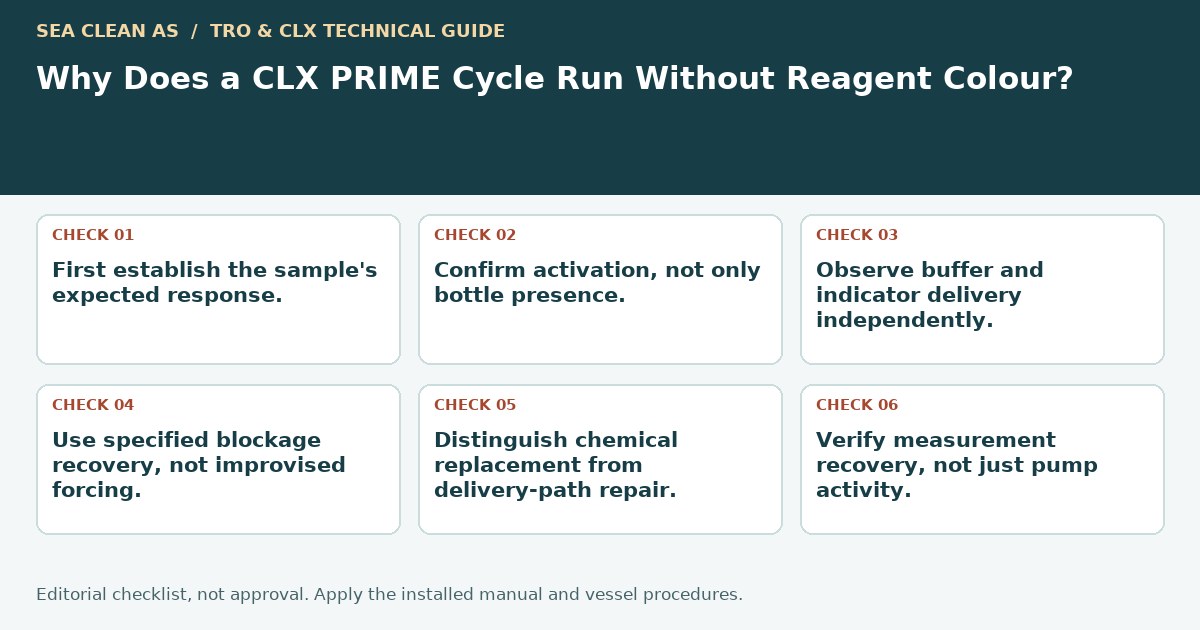
Key takeaways
- First establish the sample's expected response.
- Confirm activation, not only bottle presence.
- Observe buffer and indicator delivery independently.
- Use specified blockage recovery, not improvised forcing.
- Distinguish chemical replacement from delivery-path repair.
- Verify measurement recovery, not just pump activity.
Establish whether colour should be present
A chlorine-free sample should not produce the intended oxidant colour.
Before diagnosing a failed reagent delivery, identify the sample source and a suitable reference result. Do not judge priming success solely by appearance or introduce an improvised strong oxidant into the analyser to force a pink reaction.
Check the indicator's preparation
The liquid set described in section 11.2 requires its supplied DPD powder to activate the indicator.
Confirm the formulation, mixing record and date. A correctly labelled but unactivated liquid can make an installed bottle look complete without providing the specified measurement chemistry.
Check both channels
Trace the buffer and indicator suction paths, liquid levels and cap connections against the drawing.
Missing buffer delivery is a listed cause of low readings. An operator observing movement in one tube cannot conclude that both reagents were delivered correctly; document each side separately.
Look for delivery restrictions
Section 10.4 identifies tubing or check-valve blockage as possible causes when reagent will not flow or prime.
The manual provides a specified chlorine-free-water flushing route. Use the applicable maintenance procedure, isolation and handling precautions rather than forcing reagent with an improvised pressure source or adding aggressive cleaning chemicals.
Match replacement stock to the fault
A fresh reagent set is appropriate when the chemistry is depleted or uncertain, but it cannot repair a stuck valve or worn delivery tube.
Determine whether the replacement request needs bottles, tubing/cuvette components or technical work. Keep any removed reagent and lot details identifiable for investigation.
Where the chemistry is the issue, include the fitted reference and activation history; do not assume bottles alone resolve a delivery fault. Request the identified replacement reagent components
Verify more than the priming sound
After recovery, confirm a completed measurement cycle, absence of recurring faults and a suitable reference comparison where required.
Record the observations and any parts replaced. If priming still fails, escalate the instrument condition; repeated commands consume material and do not establish reliable dosing or measurement.
Include observations for both channels and the recovery steps already performed. Arrange CLX reagent-path fault investigation
Frequently asked questions
Should every PRIME cycle produce pink colour?
No. The expected reaction depends on a suitable oxidant sample and correctly prepared reagents.
Can pump noise prove both reagents arrived?
No. Check delivery through each channel.
Can new bottles fix a blocked check valve?
Not by themselves. The delivery restriction needs the specified maintenance response.
Should calibration be adjusted before checking priming?
No. Establish correct sample and reagent delivery first.
Sources
- HF scientific CLX-XT operation and maintenance manual, revision 5.0 — Sections 4.1, 10.4–10.5 and 11.2–11.3 cover priming, reagent clogs and activation.
- HF scientific CLX-XT engineering specification
Related articles
- Why Does a CLX Liquid Indicator Still Need DPD Activation?
- Can CLX Buffer and Indicator Bottles Be Swapped or Topped Up?
- What Does a CLX-XT WCAL Fault After Startup Mean?
- Does a TRO Reagent Pack Include Everything Needed for Calibration?
- Is CLX-XT2 Dry Reagent 09994 the Same as 09952?
- What Is a Ballast Water Treatment System? Explained
Request spares, calibration or ballast-water testing
Include BWMS brand/model, vessel/IMO number, port/terminal, date/ETA and scope or part numbers. These links prepare an email draft; you must send it yourself.
- Request a parts quote — Sensors, TRO reagents, calibration kits and replacement parts. Confirm compatibility, availability and delivery for your installed system.
- Request a calibration booking — Annual instrument calibration with a calibration certificate for the work completed. OEM instructions, drift or applicable rules may require earlier work.
- Request testing coordination — Arrange sampling and testing with an appropriately qualified party for your IMO D-2, commissioning or other stated purpose.
Authorised Headway agent. Other-brand enquiries are independently reviewed; no OEM authorisation is claimed. Sea Clean is not an accredited laboratory or approving authority. Calibration does not demonstrate biological D-2 compliance. Attendance, testing scope and parts delivery are confirmed per enquiry.