What Must Be Checked Before Restarting a CLX-XT After Long Storage?
Updated
Restart is not simply restoring power and reading the screen. Establish how the instrument was stored, whether reagents were removed and lines flushed, then prepare the sample path and current chemistry before restoring reliance on the output.
Request BWTS spare parts, annual calibration or ballast-water testing
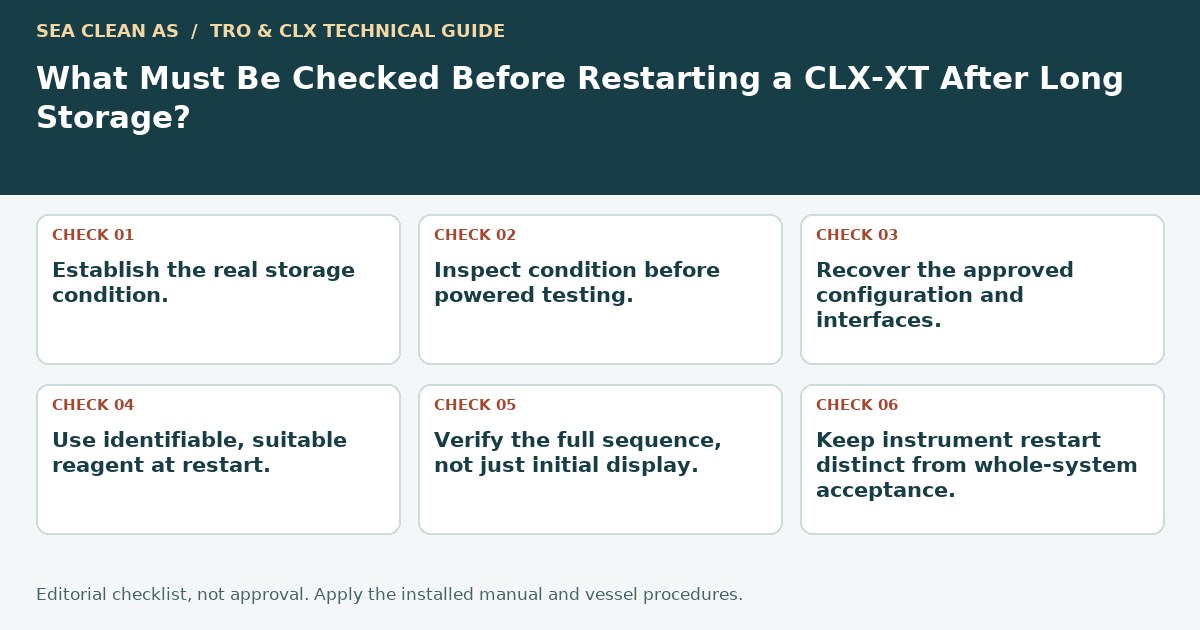
Key takeaways
- Establish the real storage condition.
- Inspect condition before powered testing.
- Recover the approved configuration and interfaces.
- Use identifiable, suitable reagent at restart.
- Verify the full sequence, not just initial display.
- Keep instrument restart distinct from whole-system acceptance.
Recover the shutdown record
Section 11.4 directs removal of reagent, flushing, drainage in service mode and disconnection for prolonged inactivity.
Determine which actions were actually completed. An instrument that was drained and cleaned has a different starting condition from one left with sample and activated indicator inside for months.
Inspect before energising
Review accessible plumbing, cuvette, connections and enclosure condition under the safe inspection procedure.
Look for residual deposits, damaged tubing or evidence of leakage. Electrical and internal checks require competent personnel; turning power on to see whether a damaged instrument still works is not an inspection method.
Review configuration and integration
Retain the as-left range, communications, alarms and standby arrangement.
Establish whether repairs or equipment changes occurred during storage. A new software setting or instrument replacement may require integration review before the controller can use the signal, even if the local analytical check is successful.
Prepare current chemistry
Check usable unopened stock and obtain the exact formulation needed.
Do not reuse an unlabelled activated bottle simply because liquid remains. Follow its preparation, activation-date and priming requirements, identifying bottle changes separately from any tubing or cuvette replacement.
Provide instrument identity and recommissioning date when replacing aged or untraceable stock. Plan suitable 09991 chemistry for the restart
Coordinate sample and startup readiness
Ensure the permitted sample source and drain are available at the required startup stages.
Capture any WCAL or fill/purge message instead of suppressing it. Verify completed measurement cycles and an appropriate comparison before returning the channel to operational reliance; an initial number alone is insufficient.
Define the recommissioning boundary
The restart work package should list inspection, components, chemistry, analytical checks, output verification and unresolved findings.
Sea Clean can coordinate instrument support across EC systems. These tasks do not replace any separately required biological commissioning test, survey or authority acceptance following the vessel's work.
Include storage actions, current configuration and the required operating window. Coordinate CLX restart inspection and verification
Frequently asked questions
Can old liquid left inside be used at restart?
Do not assume suitability; establish identity, activation age and storage history.
Should storage shutdown records be recovered?
Yes. Flushed/drained storage and uncontrolled shutdown create different conditions.
Does a first displayed number prove readiness?
No. Verify the measurement sequence, appropriate check and required output.
Is analyser restart a biological commissioning test?
No. They are separate technical and acceptance scopes.
Sources
- HF scientific CLX-XT operation and maintenance manual, revision 5.0 — Sections 11.4, 11.1–11.3 and 6 describe storage, reagent preparation and startup.
- HF scientific CLX-XT engineering specification
Related articles
- Should CLX-XT Cooling Stay Powered Between Ballast Operations?
- What Does a CLX-XT WCAL Fault After Startup Mean?
- Does CLX AutoPurge Remove the Need to Check After a Power Loss?
- Why Does a CLX PRIME Cycle Run Without Reagent Colour?
- What Should Be Checked Before Discharging Long-Stored Ballast?
- What Is a Ballast Water Treatment System? Explained
Request spares, calibration or ballast-water testing
Include BWMS brand/model, vessel/IMO number, port/terminal, date/ETA and scope or part numbers. These links prepare an email draft; you must send it yourself.
- Request a parts quote — Sensors, TRO reagents, calibration kits and replacement parts. Confirm compatibility, availability and delivery for your installed system.
- Request a calibration booking — Annual instrument calibration with a calibration certificate for the work completed. OEM instructions, drift or applicable rules may require earlier work.
- Request testing coordination — Arrange sampling and testing with an appropriately qualified party for your IMO D-2, commissioning or other stated purpose.
Authorised Headway agent. Other-brand enquiries are independently reviewed; no OEM authorisation is claimed. Sea Clean is not an accredited laboratory or approving authority. Calibration does not demonstrate biological D-2 compliance. Attendance, testing scope and parts delivery are confirmed per enquiry.