Should CLX-XT FAST or SLOW Faults Be Fixed by Increasing Sample Pressure?
Updated
Not as a general response. FAST indicates intake flow too fast, while SLOW indicates slow cuvette filling in this manual. Establish supply and restrictions, then use the specified flow assessment instead of treating both messages as low pressure.
Request BWTS spare parts, annual calibration or ballast-water testing
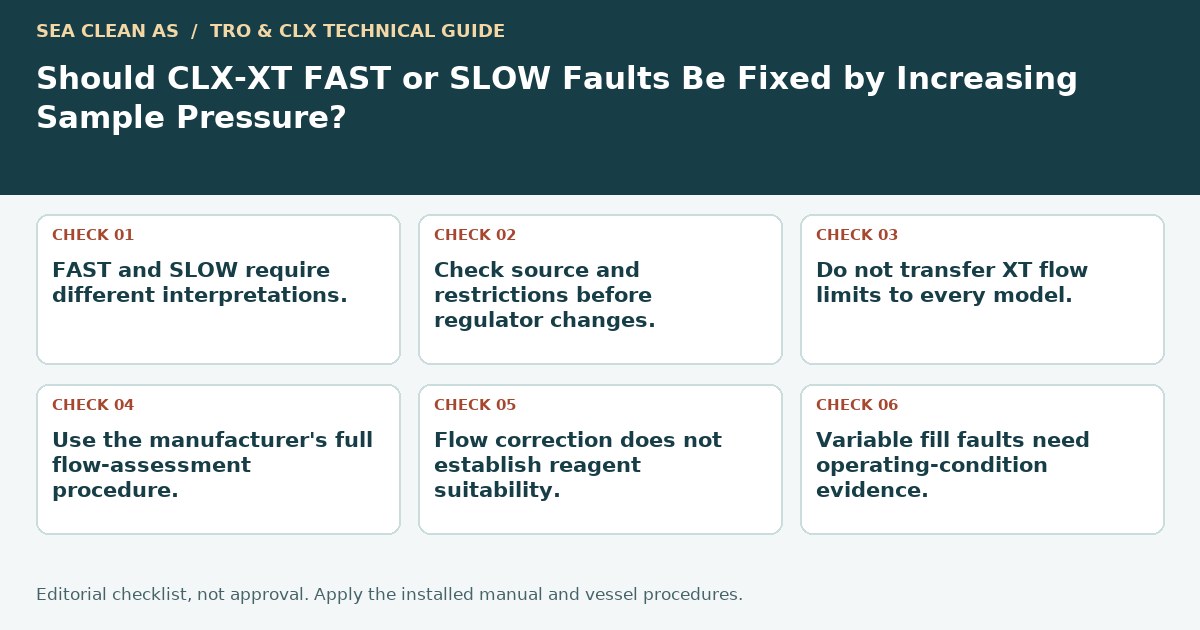
Key takeaways
- FAST and SLOW require different interpretations.
- Check source and restrictions before regulator changes.
- Do not transfer XT flow limits to every model.
- Use the manufacturer's full flow-assessment procedure.
- Flow correction does not establish reagent suitability.
- Variable fill faults need operating-condition evidence.
Distinguish the direction of the fault
Record FAST or SLOW exactly.
Increasing flow in response to FAST moves in the wrong direction; changing pressure for SLOW may conceal a restriction. The diagnostic aim is correct instrument filling, not maximum available sample pressure or an arbitrarily vigorous visible stream.
Check the upstream condition
Review source-water availability, isolation valves, strainer condition and tubing before adjustment.
A partially blocked screen or closed valve may limit the sample independently of the regulator setting. Observe the actual operating condition because a check made with the ballast pump stopped may not represent the next measurement sequence.
Use model-specific operating limits
The XT sheet states a sample pressure envelope and flow-to-waste range, but those values are not universal CLX-family settings.
Confirm the nameplate and current instructions before applying them. Process pressure at the sample take-off is also not necessarily the regulated condition inside the analyser.
Follow the specified flow test
Section 10.2 describes a flow routine reporting HI, LO or Good and incremental regulator adjustment where needed.
Qualified personnel should follow that full procedure and tighten/restore the relevant parts. This article is a diagnostic interpretation, not a replacement for the installed manual's adjustment sequence.
Keep reagent availability distinct
A correct fill routine still needs the specified buffer and activated indicator for measurement.
Review reagent stock if maintenance uses or removes it, but do not order a different formulation as a remedy for a sample filling fault. Chemistry and hydraulic acceptance remain separate check items.
Where chemistry needs renewal as well, identify that supply separately from flow correction. Plan correct reagent stock for the post-maintenance check
Escalate persistent or variable fill
If fault direction changes with operating conditions, capture pump state, supply observations, drain behaviour and the queued messages.
Technical review can assess the regulator, valves and sample path together. Do not mask the fault through longer averaging, calibration compensation or an unapproved change to control response.
Share the operating state, fault direction and sample-path observations. Review recurring FAST or SLOW conditions
Frequently asked questions
Does FAST mean low sample pressure?
No. The cited manual defines it as intake water flow too fast.
Does SLOW always mean the regulator needs adjustment?
No. Establish water supply and restrictions first.
Can I use one pressure setting for all CLX models?
Use the actual model's limits and flow procedure.
Will new DPD reagent correct sample filling?
Not by itself. Hydraulic function and reagent suitability are separate.
Sources
- HF scientific CLX-XT operation and maintenance manual, revision 5.0 — Sections 5.2 and 10.1–10.2 define FAST/SLOW, supply limits and the flow routine.
- HF scientific CLX-XT engineering specification
Related articles
- What Does a CLX-XT WCAL Fault After Startup Mean?
- What Is the Difference Between CLX PURG and NPRG Faults?
- How Can CLX Averaging Affect a BWTS Commissioning Response Check?
- Why Does a CLX PRIME Cycle Run Without Reagent Colour?
- What Is a Ballast Water Treatment System? Explained
- How Does BWTS Installation Work? Step by Step
Request spares, calibration or ballast-water testing
Include BWMS brand/model, vessel/IMO number, port/terminal, date/ETA and scope or part numbers. These links prepare an email draft; you must send it yourself.
- Request a parts quote — Sensors, TRO reagents, calibration kits and replacement parts. Confirm compatibility, availability and delivery for your installed system.
- Request a calibration booking — Annual instrument calibration with a calibration certificate for the work completed. OEM instructions, drift or applicable rules may require earlier work.
- Request testing coordination — Arrange sampling and testing with an appropriately qualified party for your IMO D-2, commissioning or other stated purpose.
Authorised Headway agent. Other-brand enquiries are independently reviewed; no OEM authorisation is claimed. Sea Clean is not an accredited laboratory or approving authority. Calibration does not demonstrate biological D-2 compliance. Attendance, testing scope and parts delivery are confirmed per enquiry.