Does CLX AutoPurge Remove the Need to Check After a Power Loss?
Updated
No. AutoPurge is an optional hardware function intended to drain the cuvette after unexpected loss of power. It is not proof that a particular unit has drained, that reagents remain suitable or that the connected control system is ready.
Request BWTS spare parts, annual calibration or ballast-water testing
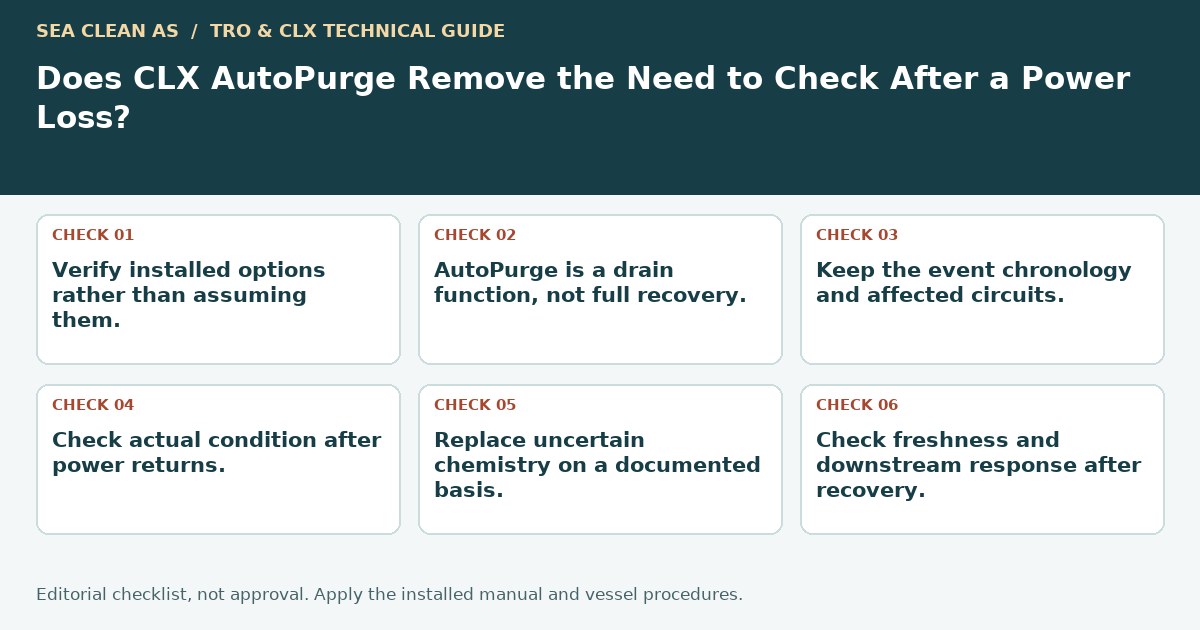
Key takeaways
- Verify installed options rather than assuming them.
- AutoPurge is a drain function, not full recovery.
- Keep the event chronology and affected circuits.
- Check actual condition after power returns.
- Replace uncertain chemistry on a documented basis.
- Check freshness and downstream response after recovery.
Confirm that the option is fitted
Section 9.6 describes factory-installed AutoPurge option 25279.
Check the actual instrument records before assuming its presence. Similar enclosures or a fleet's standard purchasing specification do not establish that every delivered analyser has the same shutdown feature.
Understand its limited function
The manual describes stored electrical charge opening the purge solenoid after unexpected power removal.
This addresses sample/reagent left in the optics, which can stain the cuvette. It does not document continued cooling, sample supply, chemistry stability or automatic acceptance of the next measurement.
Record the event and affected supplies
Document the interruption period, affected instrument and cooling circuits, operating mode and last valid measurement.
A power event can also interrupt optional standby purge timing. Distinguish a confirmed outage from a controller communications loss so subsequent checks address the actual event.
Inspect optical and reagent condition
Review whether the cuvette drained and whether staining, leakage or uncertain activated-reagent exposure is present.
Power restoration cannot erase prior warm storage or guarantee that liquid remaining in the optics had no effect. Follow the applicable recovery procedure and obtain advice where condition cannot be established.
Restore suitable chemistry if required
Where bottle condition or exposure cannot be accepted, specify the correct replacement reagent and activation records.
Treat tubing/cuvette work separately. Repeated priming with uncertain chemistry uses material without demonstrating that the analytical channel has recovered.
Include the installed reference and bottle/exposure history when suitable stock must be restored. Request replacement chemistry for an affected power event
Verify both measurement and controller response
Confirm startup, valid cycles, fault status and the required downstream signal.
A restarted display may not be a valid fresh process value in every control mode. Coordinate unresolved power or integration issues with technical support before relying on the channel in treatment or neutralisation decisions.
Provide the outage chronology, fitted options and controller state for the restart scope. Review CLX power-event recovery and integration
Frequently asked questions
Does every CLX-XT include AutoPurge?
No. The cited manual describes it as an optional factory-installed feature.
Does AutoPurge maintain indicator cooling?
It is described as a cuvette-drain function, not a substitute for cooling power.
Can restored power prove reagent suitability?
No. Assess the actual exposure and reagent history separately.
What should be checked beyond the front display?
Valid fresh cycles, faults and the required controller signal and response.
Sources
- HF scientific CLX-XT operation and maintenance manual, revision 5.0 — Sections 9.4–9.6 explain powered standby purge, reset behaviour and optional AutoPurge.
- HF scientific CLX-XT engineering specification
Related articles
- Should CLX-XT Cooling Stay Powered Between Ballast Operations?
- What Is the Difference Between CLX PURG and NPRG Faults?
- Does Zero TRO in CLX Remote Standby Mean the Water Is Oxidant-Free?
- What Must Be Checked Before Restarting a CLX-XT After Long Storage?
- What Should You Preserve After a BWMS Power Loss?
- What Is a Ballast Water Treatment System? Explained
Request spares, calibration or ballast-water testing
Include BWMS brand/model, vessel/IMO number, port/terminal, date/ETA and scope or part numbers. These links prepare an email draft; you must send it yourself.
- Request a parts quote — Sensors, TRO reagents, calibration kits and replacement parts. Confirm compatibility, availability and delivery for your installed system.
- Request a calibration booking — Annual instrument calibration with a calibration certificate for the work completed. OEM instructions, drift or applicable rules may require earlier work.
- Request testing coordination — Arrange sampling and testing with an appropriately qualified party for your IMO D-2, commissioning or other stated purpose.
Authorised Headway agent. Other-brand enquiries are independently reviewed; no OEM authorisation is claimed. Sea Clean is not an accredited laboratory or approving authority. Calibration does not demonstrate biological D-2 compliance. Attendance, testing scope and parts delivery are confirmed per enquiry.