What Should Be Checked Before Discharging Long-Stored Ballast?
Updated
Long storage changes the operational context, but it is not a universal trigger for either automatic failure or automatic retesting. Use the approved system’s requirements and the actual tank history to assess the planned discharge.
Request BWTS spare parts, annual calibration or ballast-water testing
Key takeaways
- Review the complete tank history.
- Treat sediment observations as evidence.
- Apply required discharge-stage controls.
- Avoid a universal retest interval.
- Disclose missing treatment history.
- Record the actual operation afterward.
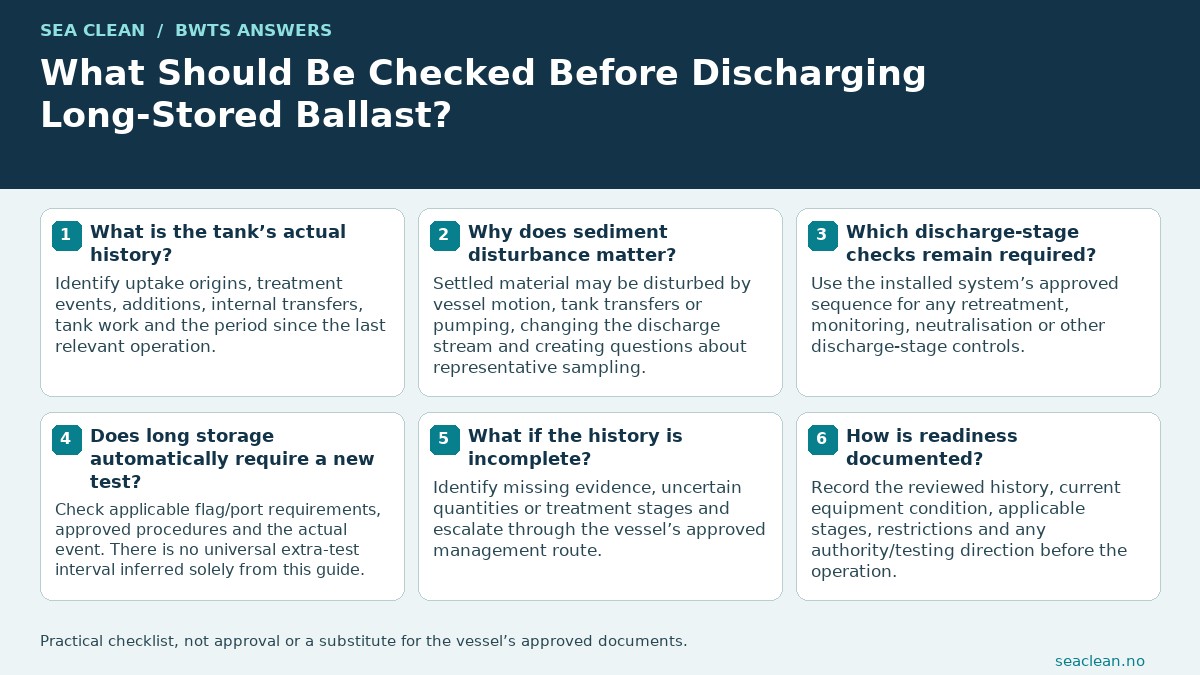
What is the tank’s actual history?
Identify uptake origins, treatment events, additions, internal transfers, tank work and the period since the last relevant operation.
A calendar age alone cannot describe mixed contents or interrupted treatment. Reconcile the record book and tank log first.
Why does sediment disturbance matter?
Settled material may be disturbed by vessel motion, tank transfers or pumping, changing the discharge stream and creating questions about representative sampling.
Do not infer a quantified biological result from visible sediment alone. Treat observations as operational evidence requiring appropriate assessment.
Related guidance: BWMS Management Plan Change Control: When Does a Revision Need Approval?
Which discharge-stage checks remain required?
Use the installed system’s approved sequence for any retreatment, monitoring, neutralisation or other discharge-stage controls.
Do not assume treatment during uptake means no action is required at discharge, or that every technology requires the same second stage.
Does long storage automatically require a new test?
Check applicable flag/port requirements, approved procedures and the actual event. There is no universal extra-test interval inferred solely from this guide.
Sampling should have a defined purpose and suitable method. A quick onboard reading does not resolve every question about stored-water biological condition.
What if the history is incomplete?
Identify missing evidence, uncertain quantities or treatment stages and escalate through the vessel’s approved management route.
Do not manufacture an earlier treatment entry or assume a sister tank’s record covers the uncertain one.
Related guidance: Can a Leaking Valve Undermine a Correct BWMS Reading?
How is readiness documented?
Record the reviewed history, current equipment condition, applicable stages, restrictions and any authority/testing direction before the operation.
Retain actual discharge evidence afterward. A pre-operation checklist cannot substitute for truthful entries of what was ultimately carried out.
Frequently asked questions
Does old ballast always fail D-2?
No such automatic conclusion follows from age alone; assess the actual evidence and applicable requirements.
Does clear water prove biological compliance?
No. Visual appearance is not a biological compliance test.
Can a historic uptake record remove discharge checks?
No. Follow the approved system’s actual discharge requirements.
Should uncertain history be reconstructed as a clean entry?
No. Use reliable evidence, state gaps and follow transparent correction/escalation procedures.
Sources
- IMO — BWMS Code, MEPC.300(72) — Approval framework, monitoring, system design limitations and biological performance; not a universal maker procedure.
- IMO — BWM.2/Circ.80/Rev.1: record-keeping and reporting — The linked PDF is the revised circular dated 24 October 2024, despite its shorter filename.
- IMO — BWM Convention and implementation guidelines
Related articles
- How Does a Tank Refill Affect BWMS Holding-Time Requirements?
- Can a Leaking Valve Undermine a Correct BWMS Reading?
- BWMS Management Plan Change Control: When Does a Revision Need Approval?
- BWTS Contingency Notification Pack: What to Send Flag and Port
- How Can Reagent Lot, Expiry and Storage Affect TRO Results?
- What Is a Ballast Water Treatment System? Explained
Request spares, calibration or ballast-water testing
Include BWMS brand/model, vessel/IMO number, port/terminal, date/ETA and scope or part numbers. These links prepare an email draft; you must send it yourself.
- Request a parts quote — Sensors, TRO reagents, calibration kits and replacement parts. Confirm compatibility, availability and delivery for your installed system.
- Request a calibration booking — Plan instrument-specific calibration and service evidence. OEM instructions, drift or applicable rules may require work sooner than annually.
- Request testing coordination — Arrange sampling and testing with an appropriately qualified party for your IMO D-2, commissioning or other stated purpose.
Authorised Headway agent. Other-brand enquiries are independently reviewed; no OEM authorisation is claimed. Sea Clean is not an accredited laboratory or approving authority. Calibration does not demonstrate biological D-2 compliance. Attendance, testing scope and parts delivery are confirmed per enquiry.