How Does CLX Cycle Time Change Reagent Purchase Quantities?
Updated
More measurement cycles normally mean more reagent use, while activated indicator life still runs by calendar time. Purchase planning needs both limits; slowing a measurement cycle is not an acceptable shortcut around a vessel's control requirements.
Request BWTS spare parts, annual calibration or ballast-water testing
Key takeaways
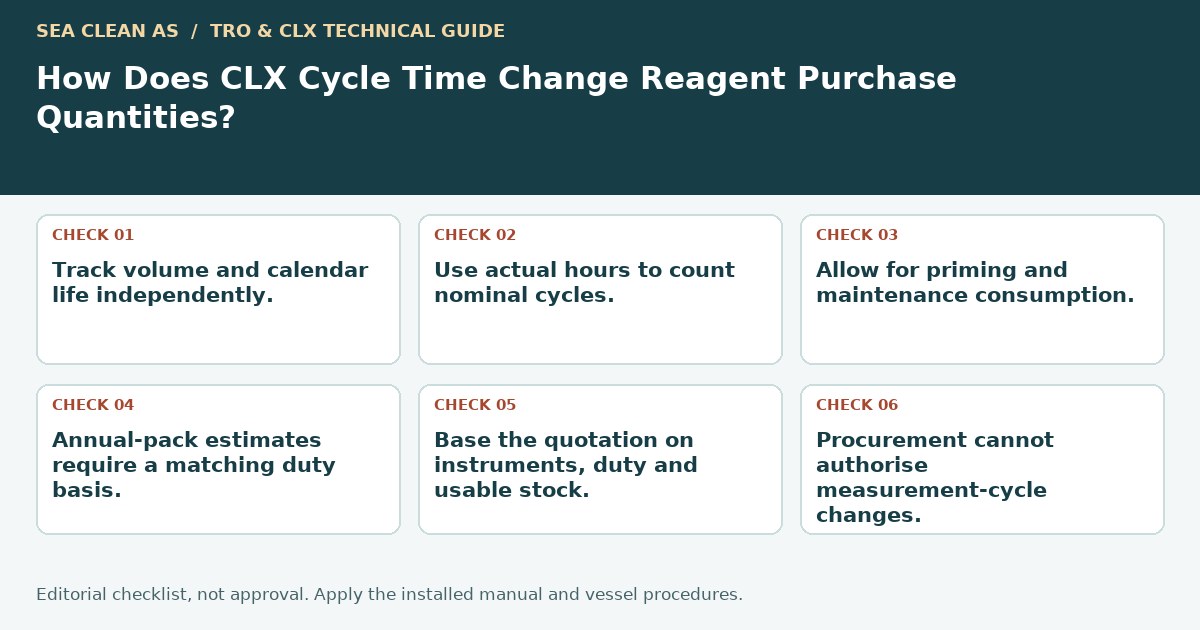
- Track volume and calendar life independently.
- Use actual hours to count nominal cycles.
- Allow for priming and maintenance consumption.
- Annual-pack estimates require a matching duty basis.
- Base the quotation on instruments, duty and usable stock.
- Procurement cannot authorise measurement-cycle changes.
Separate consumption from degradation
A bottle may be replaced because it is empty or because its allowed in-use period has elapsed.
Those are different triggers. Section 8.11 warns that changing cycle time directly affects consumed volume, while retaining the mixed indicator's defined life in the powered cooling chamber. A longer cycle does not preserve activated chemistry indefinitely.
Count actual measurement opportunities
Build an operating profile from recorded ballasting, discharge and test hours for each instrument.
An illustrative 24 hours at one cycle per minute gives 1,440 nominal cycles; at one cycle per five minutes it gives 288. These arithmetic examples count cycles only, not validated bottle quantities or approved control settings.
Include non-routine use
Priming, maintenance checks, commissioning work and any fitted standby purge feature can consume reagent outside the planned measurement profile.
Record them rather than treating every millilitre as ballast throughput. Unexpected consumption can indicate leakage or repeated interventions and should not automatically be solved by increasing the ship's stock.
Check the annual-pack assumptions
The XT manual's annual supply basis is intermittent ballast service with a default 60-second cycle and stated monthly operating hours.
Compare those assumptions with the vessel's records before using the annual label as a reorder quantity. Parallel analysers need separate counts even when installed on one BWMS.
Convert the profile into an enquiry
Provide instrument count, current cycle setting, expected operating hours, stock by activation/expiry status and the next feasible resupply window.
Ask for a defined number of compatible packs and a stated handling basis. Reserve stock should address uncertainty without creating quantities that will expire before use.
Include analyser count and duty hours rather than assuming one annual pack covers every operating pattern. Quote 09991 supply against the vessel's operating profile
Do not tune controls for stock savings
Cycle time affects when the treatment controller receives a new measurement.
Any change requires the applicable instrument, BWMS and vessel procedures, not a purchasing decision alone. If supply is running short, obtain technical advice and use the approved contingency route rather than increasing the interval or suppressing protective functions.
Unexpected use or a proposed cycle change needs instrument and BWMS review together. Review consumption without changing protective controls
Frequently asked questions
Does a slower cycle extend the indicator's calendar life?
No. Consumption and activated life remain separate limits.
Does the cycle calculation give exact bottle demand?
Not by itself. Use the actual instrument's reagent delivery and operating information.
Should commissioning hours be counted?
Yes. Testing and priming contribute to demand alongside ballast operations.
Can the purchaser change cycle time to save reagent?
No. Measurement and control requirements must be reviewed through the applicable technical procedure.
Sources
- HF scientific CLX-XT operation and maintenance manual, revision 5.0 — Sections 8.11, 9.4 and 11.1 define cycle-related demand and intermittent ballast supply assumptions.
- HF scientific CLX-XT engineering specification
Related articles
- Does a CLX 09991 Annual Pack Mean One Bottle Lasts a Year?
- Should CLX-XT Cooling Stay Powered Between Ballast Operations?
- Why Should TRO Reagent Orders Identify the Analyser, Not Just the BWTS Brand?
- How Can CLX Averaging Affect a BWTS Commissioning Response Check?
- What Is a Ballast Water Treatment System? Explained
- How Does BWTS Installation Work? Step by Step
Request spares, calibration or ballast-water testing
Include BWMS brand/model, vessel/IMO number, port/terminal, date/ETA and scope or part numbers. These links prepare an email draft; you must send it yourself.
- Request a parts quote — Sensors, TRO reagents, calibration kits and replacement parts. Confirm compatibility, availability and delivery for your installed system.
- Request a calibration booking — Annual instrument calibration with a calibration certificate for the work completed. OEM instructions, drift or applicable rules may require earlier work.
- Request testing coordination — Arrange sampling and testing with an appropriately qualified party for your IMO D-2, commissioning or other stated purpose.
Authorised Headway agent. Other-brand enquiries are independently reviewed; no OEM authorisation is claimed. Sea Clean is not an accredited laboratory or approving authority. Calibration does not demonstrate biological D-2 compliance. Attendance, testing scope and parts delivery are confirmed per enquiry.