How Can CLX Averaging Affect a BWTS Commissioning Response Check?
Updated
Averaging and filtering can change how quickly a displayed or transmitted reading follows a real concentration change. A commissioning response check must distinguish analytical performance, sample transport, cycle time and configured smoothing.
Request BWTS spare parts, annual calibration or ballast-water testing
Key takeaways
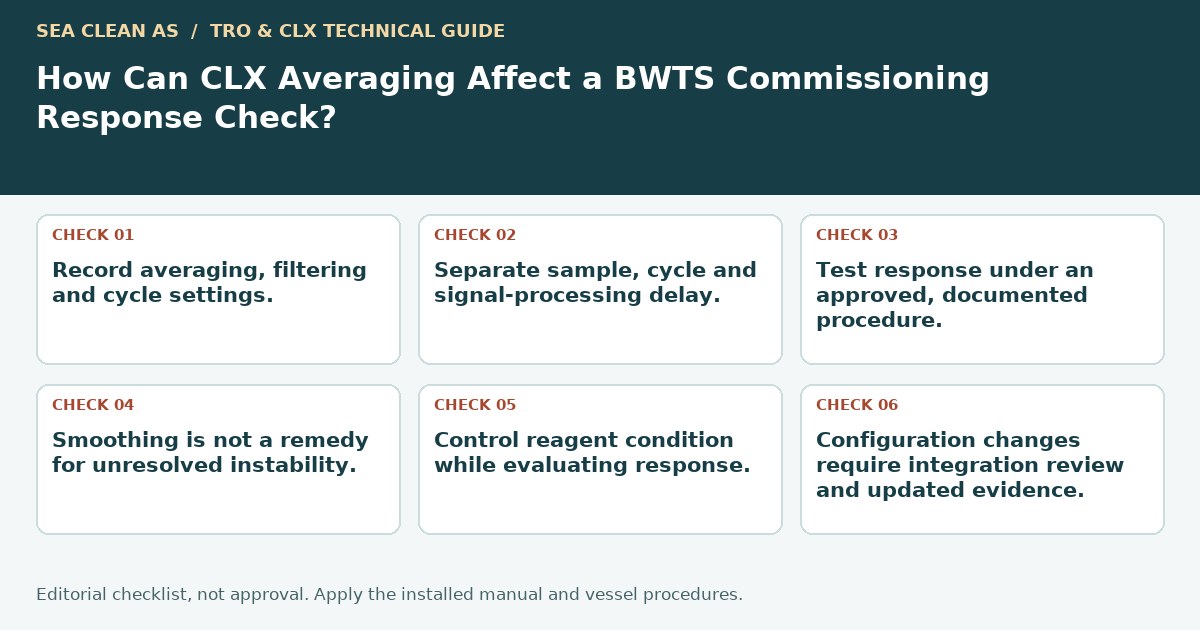
- Record averaging, filtering and cycle settings.
- Separate sample, cycle and signal-processing delay.
- Test response under an approved, documented procedure.
- Smoothing is not a remedy for unresolved instability.
- Control reagent condition while evaluating response.
- Configuration changes require integration review and updated evidence.
Recover the actual settings
Section 8.8 describes configurable averaging and a software filter; section 8.11 describes cycle time.
Record what the delivered unit uses instead of assuming factory defaults. Configuration is part of the measurement-chain evidence, particularly when a controller receives a smoothed value rather than an individual cycle result.
Distinguish several sources of delay
Sample transport to the analyser, the measurement cycle, averaging and receiver processing can each contribute to apparent response.
A single stopwatch value taken from a process change to the controller screen combines them. Define the start and end events before attributing the entire delay to the chemistry or sensor.
Use a defined response test
Specify sample condition, reference method, stable periods, timestamps and control state for the check.
The intended change must be suitable for the approved commissioning procedure. Do not introduce unapproved oxidant concentrations or override dosing controls merely to create a clearer response graph.
Interpret filtering rather than conceal it
The cited XT manual describes limiting consecutive displayed changes under its filtering behaviour, with particular conditions for subsequent changes and averaging selection.
Use that model-specific description to interpret results. Increasing smoothing to hide instability may also conceal faults or delay a response that the BWMS requires.
Keep reagent condition controlled
Use appropriate identifiable chemistry and record activation and preparation when assessing response.
A comparison made with uncertain or expired indicator cannot isolate the effect of filtering. If new reagent is needed, treat its installation as a documented test condition rather than changing several variables without a record.
Where fresh chemistry is needed, record its identity and activation as part of the response-test conditions. Specify suitable reagent for the commissioning comparison
Agree any change with integration requirements
Averaging changes can affect outputs used for treatment and neutralisation.
Review proposed settings through the vessel's approved technical process and repeat only the checks invalidated by the change. Sea Clean can coordinate commissioning readiness and signal verification; instrument response evidence remains separate from biological test acceptance.
Provide the test definition, settings and required BWMS response before changing smoothing. Coordinate CLX response and commissioning-readiness review
Frequently asked questions
Does a delayed reading always indicate reagent degradation?
No. Transport, cycle timing and configured smoothing can contribute.
Should factory settings be assumed during testing?
No. Record the actual installed settings.
Can more averaging be used to hide unstable readings?
It should not conceal unresolved faults or compromise required response.
Does a response check prove biological commissioning acceptance?
No. Instrument response and biological testing are distinct.
Sources
- HF scientific CLX-XT operation and maintenance manual, revision 5.0 — Sections 8.8 and 8.11 describe model-specific averaging/filtering and measurement cycles.
- HF scientific CLX-XT engineering specification
Related articles
- How Does CLX Cycle Time Change Reagent Purchase Quantities?
- Can a Standard 0–10 mg/L CLX Monitor Be Treated as a 15 mg/L Instrument?
- Why Can the CLX Display and BWTS PLC Show Different TRO Values?
- Should CLX-XT FAST or SLOW Faults Be Fixed by Increasing Sample Pressure?
- What Is a Ballast Water Treatment System? Explained
- How Does BWTS Installation Work? Step by Step
Request spares, calibration or ballast-water testing
Include BWMS brand/model, vessel/IMO number, port/terminal, date/ETA and scope or part numbers. These links prepare an email draft; you must send it yourself.
- Request a parts quote — Sensors, TRO reagents, calibration kits and replacement parts. Confirm compatibility, availability and delivery for your installed system.
- Request a calibration booking — Annual instrument calibration with a calibration certificate for the work completed. OEM instructions, drift or applicable rules may require earlier work.
- Request testing coordination — Arrange sampling and testing with an appropriately qualified party for your IMO D-2, commissioning or other stated purpose.
Authorised Headway agent. Other-brand enquiries are independently reviewed; no OEM authorisation is claimed. Sea Clean is not an accredited laboratory or approving authority. Calibration does not demonstrate biological D-2 compliance. Attendance, testing scope and parts delivery are confirmed per enquiry.