Can a Standard 0–10 mg/L CLX Monitor Be Treated as a 15 mg/L Instrument?
Updated
No. The cited XT and XT2 documents distinguish the standard range from an optional higher range. A displayed number above the standard limit is not proof that the instrument has the high-range option or meets its accuracy specification.
Request BWTS spare parts, annual calibration or ballast-water testing
Key takeaways
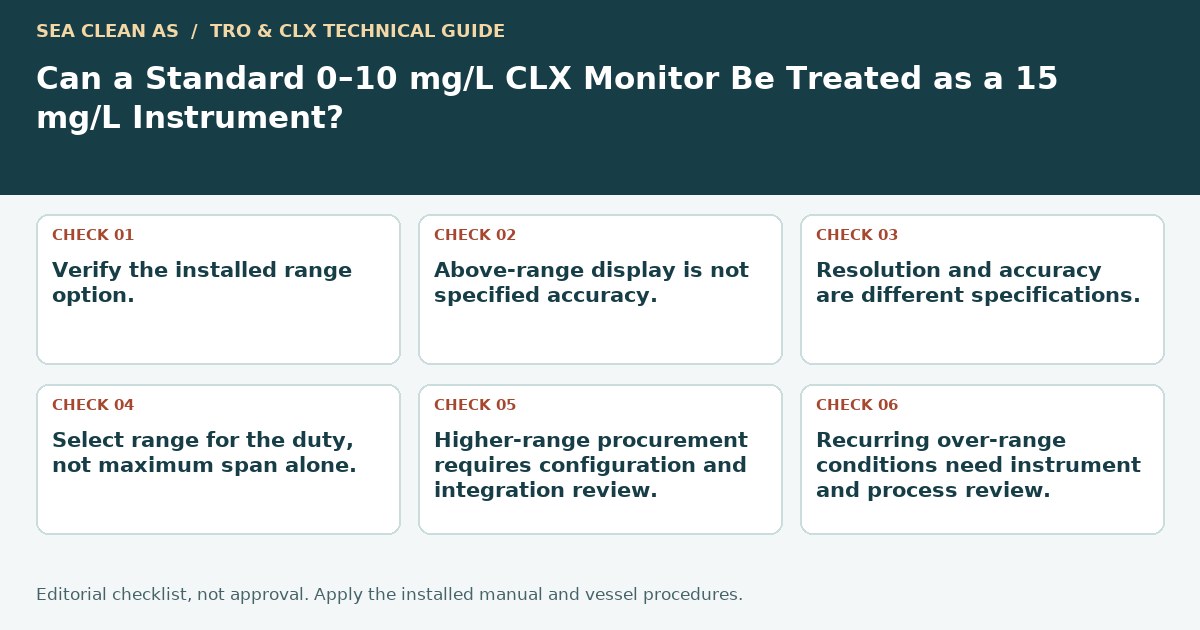
- Verify the installed range option.
- Above-range display is not specified accuracy.
- Resolution and accuracy are different specifications.
- Select range for the duty, not maximum span alone.
- Higher-range procurement requires configuration and integration review.
- Recurring over-range conditions need instrument and process review.
Identify the delivered range
Use the instrument records, nameplate information and supplier configuration evidence to establish whether the optional 0–15 mg/L range is fitted.
Do not infer range from a controller scale or a generic sales description. Standard and optional variants share family names while having different measurement specifications.
Distinguish display from specified performance
Section 6 warns that the XT may display values above 10 mg/L without those readings being within its stated accuracy.
A numeric display alone does not validate operation outside the specified range. Capture over-range messages and process conditions rather than accepting a plausible-looking value.
Read the range-specific accuracy
The XT2 sheet gives different accuracy expressions for standard and optional ranges, including a fixed minimum term.
Resolution is separately stated. An order describing only 0.01 mg/L resolution does not establish suitability at low residuals or throughout the optional high range.
Review the process requirement
Identify treatment and discharge measurement duties, expected concentration range and applicable operating documents.
A higher maximum range does not automatically improve low-level measurement or establish a new permitted discharge criterion. Assess the actual measurement requirement rather than selecting the largest number available.
Scope the replacement completely
A proposed high-range replacement needs signal scaling, control logic, installation, compatible reagents and accessories reviewed together.
The XT2 sheet describes its high-range option as factory installed. Do not assume a menu change converts every delivered standard unit into an approved higher-range variant.
Include delivered configuration, analytical duty and interfaces instead of requesting a generic high-range unit. Specify the required range in a CLX monitor enquiry
Escalate recurring over-range operation
Provide maximum observed values, fitted range, reagent status and system operating mode.
Technical review should distinguish genuine process conditions, measurement faults and unsuitable range selection. Sea Clean can coordinate the instrument and EC service scope without changing treatment limits or implying that range selection proves D-2 compliance.
Share the instrument option and operating data before any proposed range or control change. Review over-range TRO and monitor suitability
Frequently asked questions
Does a reading above 10 prove a high-range option is fitted?
No. Establish the delivered configuration independently.
Is resolution the same as accuracy?
No. Read both, including the applicable range-specific accuracy expression.
Does a 15 mg/L option change discharge limits?
No. Measurement range and permitted operating/discharge criteria are distinct.
Can any standard CLX be upgraded through settings alone?
Do not assume so; the cited XT2 sheet identifies its high-range option as factory installed.
Sources
- HF scientific CLX-XT operation and maintenance manual, revision 5.0 — Sections 2 and 6 distinguish standard/optional range and warn about above-range accuracy.
- HF scientific CLX-XT2 engineering specification
Related articles
- Why Can the CLX Display and BWTS PLC Show Different TRO Values?
- When Do CLX-XT POST and FAIL Codes Need Manufacturer-Level Service?
- How Can CLX Averaging Affect a BWTS Commissioning Response Check?
- Can Free-Chlorine DPD Reagent Replace a Total-Chlorine CLX Set?
- What Is a Ballast Water Treatment System? Explained
- How Does BWTS Installation Work? Step by Step
Request spares, calibration or ballast-water testing
Include BWMS brand/model, vessel/IMO number, port/terminal, date/ETA and scope or part numbers. These links prepare an email draft; you must send it yourself.
- Request a parts quote — Sensors, TRO reagents, calibration kits and replacement parts. Confirm compatibility, availability and delivery for your installed system.
- Request a calibration booking — Annual instrument calibration with a calibration certificate for the work completed. OEM instructions, drift or applicable rules may require earlier work.
- Request testing coordination — Arrange sampling and testing with an appropriately qualified party for your IMO D-2, commissioning or other stated purpose.
Authorised Headway agent. Other-brand enquiries are independently reviewed; no OEM authorisation is claimed. Sea Clean is not an accredited laboratory or approving authority. Calibration does not demonstrate biological D-2 compliance. Attendance, testing scope and parts delivery are confirmed per enquiry.