Why Can the CLX Display and BWTS PLC Show Different TRO Values?
Updated
A mismatch may arise from the signal path rather than the DPD measurement. Compare configured analogue endpoints, actual transmitted current and receiver scaling before changing the analytical calibration to make the screens agree.
Request BWTS spare parts, annual calibration or ballast-water testing
Key takeaways
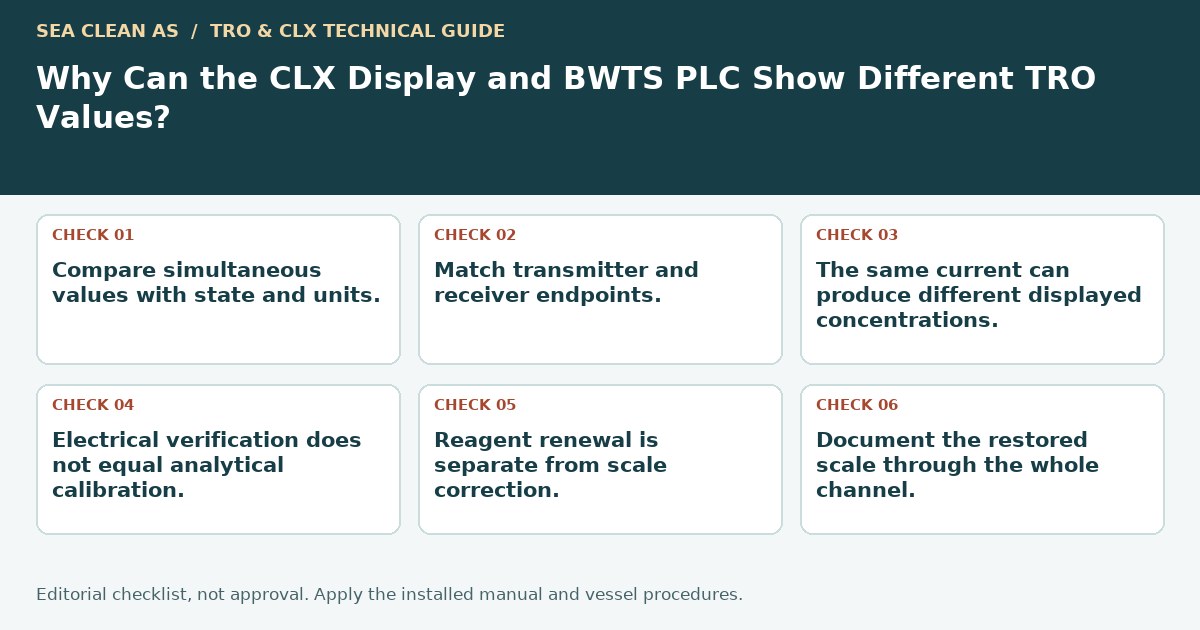
- Compare simultaneous values with state and units.
- Match transmitter and receiver endpoints.
- The same current can produce different displayed concentrations.
- Electrical verification does not equal analytical calibration.
- Reagent renewal is separate from scale correction.
- Document the restored scale through the whole channel.
Capture simultaneous readings
Record local value, controller value, instrument mode, fault queue and timestamps during a stable period.
A controller may show a previous, filtered or fault-associated value rather than the current local result. Establish the connected channel and units before treating the difference as chemical measurement error.
Read both endpoint configurations
Section 8.1 permits concentration values to be assigned to 4 mA and 20 mA, including an inverted assignment.
The receiver must interpret the same endpoints. A default assumption of 0–10 mg/L is not sufficient if the installed channel is configured differently.
Check the scale mathematically
For an illustrative linear 4–20 mA mapping of 0–10 mg/L, 12 mA corresponds to 5 mg/L.
If a receiver interprets 0–15 mg/L, it displays 7.5 mg/L for the same current. This example explains a scaling mismatch; it is not a prescribed range or instruction to change a vessel's settings.
Test transmission separately from chemistry
The manual describes fixed-current output checks in sections 8.13–8.14.
Competent personnel can use the applicable procedure to establish output and receiver response while managing connected controls safely. Do not tune chlorine slope to compensate for incorrect receiver scaling or unintended loop loading.
Keep measurement supplies correctly scoped
If a parallel analytical comparison is required, ensure suitable reagent and method status independently.
A fresh DPD set does not correct a numerical scaling error. Record chemical checks and signal checks separately so the investigation identifies which part of the channel was actually corrected.
Use the reagent path only where the measurement check also needs appropriate consumables; it does not replace scale diagnostics. Specify chemistry for a separate analytical comparison
Restore and document the approved channel
Any configuration correction must follow the vessel's control-change procedure.
Record endpoints, output checks, receiver settings and final paired readings, including fault behaviour where required. Sea Clean can coordinate analyser/PLC review; control integration remains distinct from an instrument calibration certificate or biological compliance evidence.
Include both endpoint settings, the wiring/channel identity and simultaneous readings. Coordinate CLX-to-PLC scaling verification
Frequently asked questions
Does screen disagreement always mean DPD drift?
No. Scaling, output state and controller handling can cause it.
Must 4 mA always represent zero?
The cited manual allows assigned endpoints; check the installed configuration.
Can chlorine slope correct receiver scaling?
It should not be used to conceal a signal-scaling error.
Who should perform fixed-current tests?
Competent personnel following the installed procedure and safe control/isolation arrangements.
Sources
- HF scientific CLX-XT operation and maintenance manual, revision 5.0 — Sections 8.1 and 8.13–8.14 describe configurable endpoints and fixed-current checks.
- HF scientific CLX-XT engineering specification
Related articles
- Why Does a CLX-XT Show MA While the TRO Display Still Works?
- Can a CLX Fault Current Be Mistaken for Zero TRO?
- Can a Standard 0–10 mg/L CLX Monitor Be Treated as a 15 mg/L Instrument?
- Does Zero TRO in CLX Remote Standby Mean the Water Is Oxidant-Free?
- What Is a Ballast Water Treatment System? Explained
- How Does BWTS Installation Work? Step by Step
Request spares, calibration or ballast-water testing
Include BWMS brand/model, vessel/IMO number, port/terminal, date/ETA and scope or part numbers. These links prepare an email draft; you must send it yourself.
- Request a parts quote — Sensors, TRO reagents, calibration kits and replacement parts. Confirm compatibility, availability and delivery for your installed system.
- Request a calibration booking — Annual instrument calibration with a calibration certificate for the work completed. OEM instructions, drift or applicable rules may require earlier work.
- Request testing coordination — Arrange sampling and testing with an appropriately qualified party for your IMO D-2, commissioning or other stated purpose.
Authorised Headway agent. Other-brand enquiries are independently reviewed; no OEM authorisation is claimed. Sea Clean is not an accredited laboratory or approving authority. Calibration does not demonstrate biological D-2 compliance. Attendance, testing scope and parts delivery are confirmed per enquiry.