When Do CLX-XT POST and FAIL Codes Need Manufacturer-Level Service?
Updated
The XT manual classifies POST as a severe condition normally requiring technical assistance and FAIL as an internal system failure not correctable by the operator. These codes should not be treated as routine reagent replacement reminders.
Request BWTS spare parts, annual calibration or ballast-water testing
Key takeaways
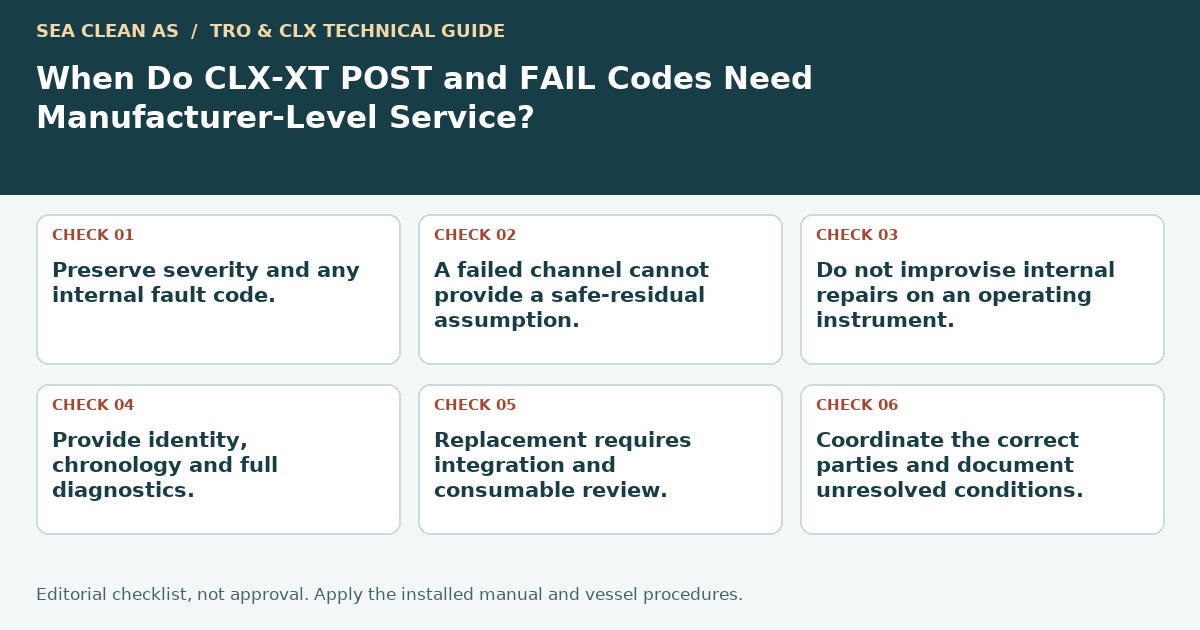
- Preserve severity and any internal fault code.
- A failed channel cannot provide a safe-residual assumption.
- Do not improvise internal repairs on an operating instrument.
- Provide identity, chronology and full diagnostics.
- Replacement requires integration and consumable review.
- Coordinate the correct parties and document unresolved conditions.
Use the severity classification
Section 10.1 distinguishes four fault levels.
POST is level 2; FAIL is level 1 and the instrument will not operate. Record the exact displayed internal code as well as the word FAIL. The classification is specific to this manual and must be checked against the actual instrument version.
Protect operational decisions
An unavailable or unreliable TRO channel must be handled under the vessel's BWMS procedures and applicable contingency requirements.
Do not infer a safe residual from a last value, a zero current or a frozen controller display. Instrument failure does not authorise continuation with disabled protection.
Avoid unsupported board-level intervention
The manual directs internal level 1 failures to factory service, rather than operator correction.
Repeated resets or opening live equipment can erase evidence or create hazards without repairing the fault. Observe electrical safety, preserve the configuration records and obtain the required qualified technical advice.
Build the service evidence package
Include model, serial number, software/version information where available, queued messages, numeric code, startup sequence and any recent maintenance or power event.
A service enquiry should also identify the vessel's operational state and required window. This information is more useful than a generic request for TRO repair.
Treat replacement equipment as a project
A replacement analyser needs appropriate range, outputs, enclosure/site suitability and integration review.
A shared CLX family name does not establish drop-in equivalence. Include compatible reagents and accessories in the procurement scope, but do not assume that new bottles can repair an internal electronic failure.
Provide the failed instrument and interface requirements; product family alone does not establish a drop-in replacement. Start an identified CLX replacement-monitor enquiry
Keep responsibilities explicit
Sea Clean can coordinate fault assessment, manufacturer input and instrument supply/service requirements across EC systems.
Headway authorisation is separate from independent work for other makes. Factory work, attendance, parts and operational acceptance should be allocated explicitly, with findings retained rather than implying a whole-system compliance certificate.
Include the full code, vessel operation status and any required manufacturer involvement. Coordinate POST or FAIL escalation and service responsibilities
Frequently asked questions
Is FAIL an operator-correctable reagent fault?
The cited manual classifies it as an internal failure requiring factory service.
Does POST have the same severity as a concentration alarm?
No. POST is a severe level 2 condition in this XT manual.
Can the last displayed TRO value be relied on after failure?
Do not assume it remains a valid current measurement.
Can another CLX monitor be fitted without integration review?
No. Confirm its range, interfaces, installation requirements and applicable system basis.
Sources
- HF scientific CLX-XT operation and maintenance manual, revision 5.0 — Sections 10.1 and 10.5 define POST/FAIL severity and the limits of operator correction.
- HF scientific CLX-XT engineering specification
Related articles
- Can a CLX Fault Current Be Mistaken for Zero TRO?
- Why Does a CLX-XT Show MA While the TRO Display Still Works?
- Can a Standard 0–10 mg/L CLX Monitor Be Treated as a 15 mg/L Instrument?
- Does CLX AutoPurge Remove the Need to Check After a Power Loss?
- What Is a Ballast Water Treatment System? Explained
- How Does BWTS Installation Work? Step by Step
Request spares, calibration or ballast-water testing
Include BWMS brand/model, vessel/IMO number, port/terminal, date/ETA and scope or part numbers. These links prepare an email draft; you must send it yourself.
- Request a parts quote — Sensors, TRO reagents, calibration kits and replacement parts. Confirm compatibility, availability and delivery for your installed system.
- Request a calibration booking — Annual instrument calibration with a calibration certificate for the work completed. OEM instructions, drift or applicable rules may require earlier work.
- Request testing coordination — Arrange sampling and testing with an appropriately qualified party for your IMO D-2, commissioning or other stated purpose.
Authorised Headway agent. Other-brand enquiries are independently reviewed; no OEM authorisation is claimed. Sea Clean is not an accredited laboratory or approving authority. Calibration does not demonstrate biological D-2 compliance. Attendance, testing scope and parts delivery are confirmed per enquiry.