Can Free-Chlorine DPD Reagent Replace a Total-Chlorine CLX Set?
Updated
Not simply because both use DPD. The cited CLX-XT specification describes total-chlorine measurement with its specified reagents. A free-chlorine reagent or handheld result is not automatically the same measurand as the installed TRO channel.
Request BWTS spare parts, annual calibration or ballast-water testing
Key takeaways
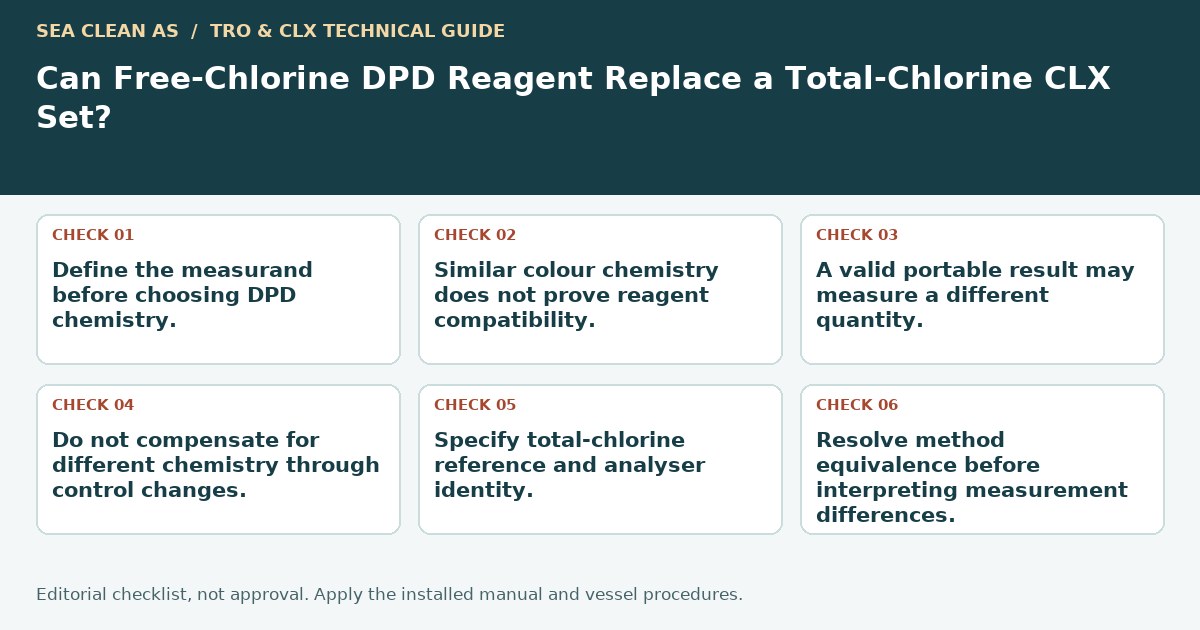
- Define the measurand before choosing DPD chemistry.
- Similar colour chemistry does not prove reagent compatibility.
- A valid portable result may measure a different quantity.
- Do not compensate for different chemistry through control changes.
- Specify total-chlorine reference and analyser identity.
- Resolve method equivalence before interpreting measurement differences.
Name the measurement before choosing reagent
The instrument specification, reagent label and BWMS documentation should identify the measurement basis together.
Free chlorine and total chlorine are not interchangeable purchasing descriptions. For ballast TRO work, record how the analyser reports oxidant concentration, including its stated units and any matrix-specific interpretation in the maker's documents.
DPD is a method family
A shared colour-forming indicator does not make every DPD procedure identical.
The specified buffer, indicator formulation, reaction conditions and instrument cycle are part of the method. Generic pool-test tablets or another instrument's sachets should not be loaded into the online reagent channels on the assumption that all pink reactions are equivalent.
Check handheld comparisons carefully
When an online reading differs from a portable result, check whether the portable test measured free or total chlorine before calling the difference drift.
Record the portable procedure, range, reagent reference, sample point and timing. A correct free-chlorine result may still be an unsuitable comparison for the specified total-chlorine channel.
Avoid changing the control meaning
The TRO signal can inform dosing and neutralisation logic.
Substituting a different measurement procedure changes what that signal represents even if the numeric display looks plausible. Do not change treatment settings, discharge criteria or alarm functions to make an unsuitable reagent's result look acceptable.
Specify the correct consumable request
Use the exact analyser model and required total-chlorine reagent reference on the order.
If an alternative is proposed, request documentary evidence for that model and measurement basis. Supplier wording such as chlorine reagent or DPD compatible is too broad to resolve the analytical distinction.
Use the instrument and reagent identifiers to distinguish the required set from generic free-chlorine products. Specify the total-chlorine TRO reagent set
Escalate a method mismatch
Preserve both test records and the reagent packaging rather than repeatedly recalibrating against unlike results.
A technical review can establish a suitable comparison method and investigate the sample path. TRO evidence remains instrument/process evidence; it is not a substitute for the biological limits or testing requirements associated with IMO D-2.
Provide both measurement procedures and results so the comparison is assessed before adjustment. Review differing DPD and online TRO methods
Frequently asked questions
Does a pink DPD reaction prove the reagent is suitable?
No. The formulation and method must match the installed analyser and intended measurement.
Can a free-chlorine handheld test validate every TRO reading?
Not automatically; first establish a suitable and equivalent measurement basis.
Is generic chlorine reagent a sufficient purchasing description?
No. Identify the total-chlorine reference, instrument and required formulation.
Does a total-chlorine result prove D-2 biological compliance?
No. Oxidant measurement and biological compliance evidence are different.
Sources
- HF scientific CLX-XT operation and maintenance manual, revision 5.0 — Sections 3.0 and 4.1 describe the CLX-XT DPD method and its buffer/indicator measurement cycle.
- HF scientific CLX-XT engineering specification
Related articles
- Can CLX Buffer and Indicator Bottles Be Swapped or Topped Up?
- Why Does a CLX Liquid Indicator Still Need DPD Activation?
- Why Should TRO Reagent Orders Identify the Analyser, Not Just the BWTS Brand?
- TRO Measurement: The DPD Method Explained
- What Is a Ballast Water Treatment System? Explained
- How Does BWTS Installation Work? Step by Step
Request spares, calibration or ballast-water testing
Include BWMS brand/model, vessel/IMO number, port/terminal, date/ETA and scope or part numbers. These links prepare an email draft; you must send it yourself.
- Request a parts quote — Sensors, TRO reagents, calibration kits and replacement parts. Confirm compatibility, availability and delivery for your installed system.
- Request a calibration booking — Annual instrument calibration with a calibration certificate for the work completed. OEM instructions, drift or applicable rules may require earlier work.
- Request testing coordination — Arrange sampling and testing with an appropriately qualified party for your IMO D-2, commissioning or other stated purpose.
Authorised Headway agent. Other-brand enquiries are independently reviewed; no OEM authorisation is claimed. Sea Clean is not an accredited laboratory or approving authority. Calibration does not demonstrate biological D-2 compliance. Attendance, testing scope and parts delivery are confirmed per enquiry.