Does a CLX-XT GLAS Fault Require New Reagent or Cuvette Work?
Updated
The CLX-XT fault table identifies GLAS as a dirty cuvette. Reagent replacement does not clean the optical path. Inspect the glass and associated sample condition under the applicable maintenance procedure before considering calibration.
Request BWTS spare parts, annual calibration or ballast-water testing
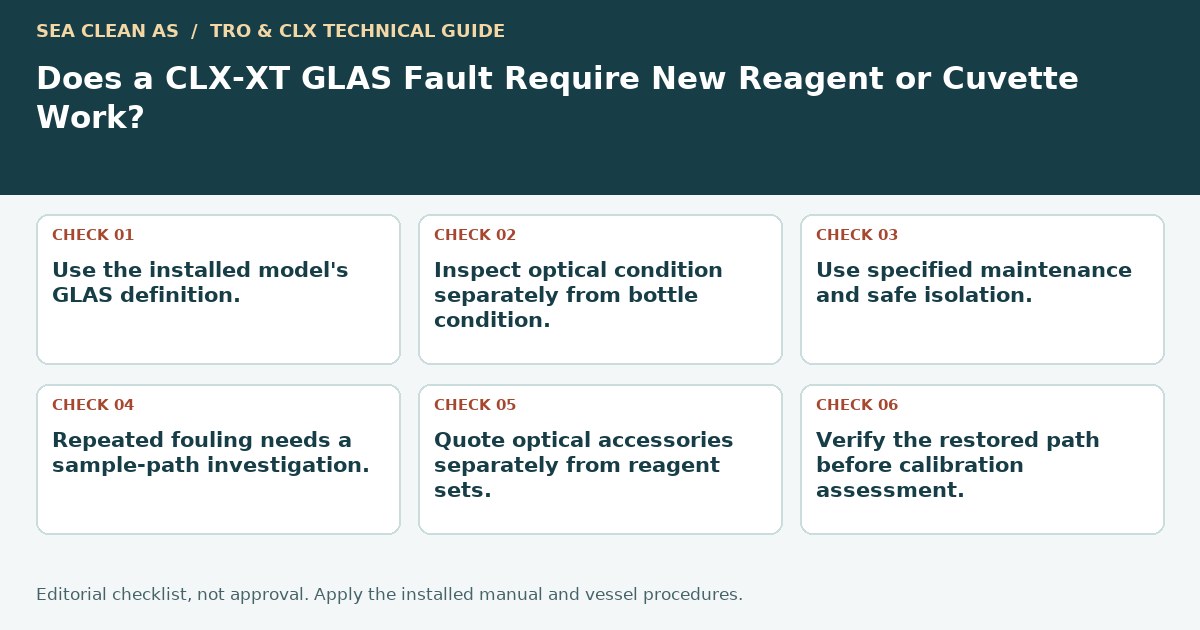
Key takeaways
- Use the installed model's GLAS definition.
- Inspect optical condition separately from bottle condition.
- Use specified maintenance and safe isolation.
- Repeated fouling needs a sample-path investigation.
- Quote optical accessories separately from reagent sets.
- Verify the restored path before calibration assessment.
Identify the warning accurately
Record GLAS and any accompanying codes before intervention.
The revision 5.0 table gives clean or replace cuvette as the corrective route. This is a model-specific definition: do not infer identical fault meanings for another CLX generation solely from a similar display.
Assess the optical path
Deposits, staining, damage or leakage can affect the measurement path independently of reagent age.
Check the cuvette condition against the manual rather than judging only the colour visible through the cabinet. Keep observations before cleaning so the cause of a recurring fault is not lost.
Prepare for safe maintenance
Section 11.1 describes instrument service mode and cuvette work.
Apply the vessel's isolation and handling requirements, use appropriate components and prevent contact with reagents. Cleaning the instrument is not a reason to improvise solvents or dismantle powered electrical equipment.
Investigate recurring fouling
Inspect the sample strainer and incoming water condition if the cleaned glass rapidly becomes dirty again.
A replacement cuvette can restore the path temporarily without solving repeated debris ingress. Record the interval to recurrence and the operating water conditions to support a useful service investigation.
Specify chemistry and glass separately
The XT engineering sheet lists tubing/cuvette kit 09950XT separately from reagent 09991.
Request the actual accessory reference for the installed model. Add reagent renewal only when its own date, preparation or condition requires it, rather than treating every optical warning as a consumable-bottle failure.
Use the identified chemistry reference only if bottle condition or dates also require replacement. Plan reagent renewal alongside—not instead of—optical work
Demonstrate measurement recovery
After reassembly, check for leaks, completed cycles and recurrence, then make any required suitable comparison.
Record as-found condition, components and results. Do not change slope to compensate for a dirty optical path; a successful optical repair is also not evidence of biological D-2 compliance.
Include photographs, recurrence timing and the sample condition rather than only the GLAS code. Request cuvette and recurring-fouling investigation
Frequently asked questions
What does GLAS mean in this XT manual?
It identifies a dirty measurement cuvette.
Will fresh reagent clean the cuvette?
No. Reagent condition and the optical path require separate checks.
Should I change slope to remove the warning?
No. Resolve the optical condition before assessing calibration.
What does repeated GLAS after cleaning suggest?
Investigate sample debris, staining and other recurring optical conditions rather than replacing bottles repeatedly.
Sources
- HF scientific CLX-XT operation and maintenance manual, revision 5.0 — Sections 10.1, 10.5 and 11.1 describe GLAS, low-reading causes and cuvette maintenance.
- HF scientific CLX-XT engineering specification
Related articles
- Does a TRO Reagent Pack Include Everything Needed for Calibration?
- What Is the Difference Between CLX PURG and NPRG Faults?
- Why Does a CLX PRIME Cycle Run Without Reagent Colour?
- What Does a CLX-XT WCAL Fault After Startup Mean?
- What Is a Ballast Water Treatment System? Explained
- How Does BWTS Installation Work? Step by Step
Request spares, calibration or ballast-water testing
Include BWMS brand/model, vessel/IMO number, port/terminal, date/ETA and scope or part numbers. These links prepare an email draft; you must send it yourself.
- Request a parts quote — Sensors, TRO reagents, calibration kits and replacement parts. Confirm compatibility, availability and delivery for your installed system.
- Request a calibration booking — Annual instrument calibration with a calibration certificate for the work completed. OEM instructions, drift or applicable rules may require earlier work.
- Request testing coordination — Arrange sampling and testing with an appropriately qualified party for your IMO D-2, commissioning or other stated purpose.
Authorised Headway agent. Other-brand enquiries are independently reviewed; no OEM authorisation is claimed. Sea Clean is not an accredited laboratory or approving authority. Calibration does not demonstrate biological D-2 compliance. Attendance, testing scope and parts delivery are confirmed per enquiry.