Does Zero TRO in CLX Remote Standby Mean the Water Is Oxidant-Free?
Updated
Not necessarily. The CLX-XT manual describes model/software-dependent standby and reset behaviour that can affect displayed values, analogue output and alarms. Establish whether a measurement cycle has completed and which control option is fitted before interpreting a zero.
Request BWTS spare parts, annual calibration or ballast-water testing
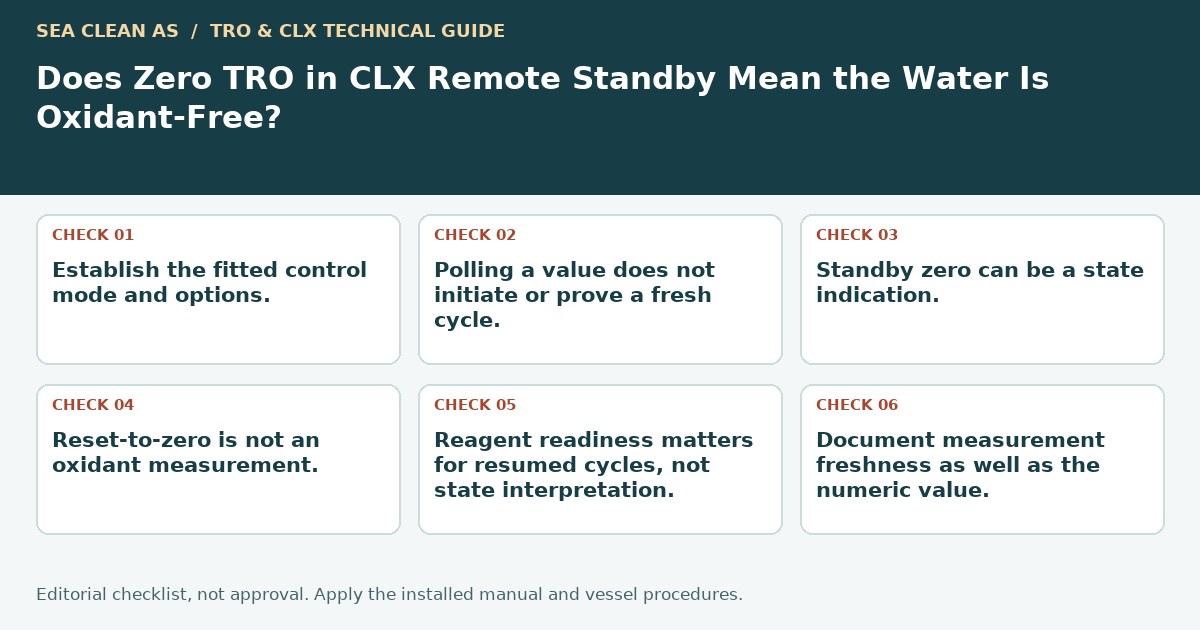
Key takeaways
- Establish the fitted control mode and options.
- Polling a value does not initiate or prove a fresh cycle.
- Standby zero can be a state indication.
- Reset-to-zero is not an oxidant measurement.
- Reagent readiness matters for resumed cycles, not state interpretation.
- Document measurement freshness as well as the numeric value.
Identify the actual control option
Sections 6.2 and 6.3 distinguish Modbus control from hardware remote standby.
The implemented sequence and software options matter. Record the option and current mode rather than treating every instrument marked AUTO as continuously producing new measurements.
Separate requests from completed cycles
A commanded measurement needs its full sequence before a fresh result is available.
The cited Modbus option performs one cycle on a prompt and then awaits another. A poll of a numeric register alone cannot show that another sample has been measured; status and timing need to be considered.
Understand the remote-standby zero
The hardware-standby description states that, after the first reading, standby can present 0.00 with corresponding analogue and alarm behaviour.
Read that instruction for the installed version before interpreting zero as a chemical result. It is a defined operating state, not a universal finding of no residual oxidant.
Review explicit reset behaviour
Section 9.5 describes a software reset-to-zero function affecting the reading, output and alarms.
Do not operate such controls merely to obtain a reassuring display or clear a process concern. The approved BWMS integration must account for the difference between a reset value and a completed analytical measurement.
Check chemistry when measurement actually resumes
When a genuine cycle is requested, both correct reagents and the sample path must be ready.
Reagent stock review belongs to that measurement readiness, not to explaining every standby zero. Specify the fitted reference if fresh chemistry is required before restored operation.
If restart requires fresh 09991 stock, state that separately from the control-state investigation. Plan identified chemistry for resumed CLX measurement
Verify freshness through the controller
An integration check should record prompt, busy/standby state, completed-cycle time and resulting local/controller values.
Sea Clean can coordinate this alongside instrument work. Records should identify when valid fresh measurements exist; neither a software zero nor a stale value proves neutralisation or biological compliance.
Include the fitted option and controller sequence so a zero is interpreted correctly. Review CLX standby state and measurement freshness
Frequently asked questions
Does a standby value of 0.00 prove no TRO?
Not automatically. It may be the configured remote-standby behaviour.
Does reading a Modbus register make a new measurement?
Not by itself. The installed control sequence determines cycle initiation.
Can reset-to-zero affect analogue output?
The cited XT manual describes an option that affects reading, output and alarms.
What should a freshness check record?
Control request, instrument state, completed-cycle timing and corresponding local/controller values.
Sources
- HF scientific CLX-XT operation and maintenance manual, revision 5.0 — Sections 6.2–6.3 and 9.5 describe prompted cycles, hardware standby and reset-to-zero.
- HF scientific CLX-XT engineering specification
Related articles
- Can a CLX Fault Current Be Mistaken for Zero TRO?
- Does CLX AutoPurge Remove the Need to Check After a Power Loss?
- Why Can the CLX Display and BWTS PLC Show Different TRO Values?
- Should CLX-XT Cooling Stay Powered Between Ballast Operations?
- What Is a Ballast Water Treatment System? Explained
- How Does BWTS Installation Work? Step by Step
Request spares, calibration or ballast-water testing
Include BWMS brand/model, vessel/IMO number, port/terminal, date/ETA and scope or part numbers. These links prepare an email draft; you must send it yourself.
- Request a parts quote — Sensors, TRO reagents, calibration kits and replacement parts. Confirm compatibility, availability and delivery for your installed system.
- Request a calibration booking — Annual instrument calibration with a calibration certificate for the work completed. OEM instructions, drift or applicable rules may require earlier work.
- Request testing coordination — Arrange sampling and testing with an appropriately qualified party for your IMO D-2, commissioning or other stated purpose.
Authorised Headway agent. Other-brand enquiries are independently reviewed; no OEM authorisation is claimed. Sea Clean is not an accredited laboratory or approving authority. Calibration does not demonstrate biological D-2 compliance. Attendance, testing scope and parts delivery are confirmed per enquiry.