What Should You Preserve After a BWMS Power Loss?
Updated
A controller reboot can restore a healthy screen while removing the context needed to assess the interrupted operation. Capture both the electrical event and the actual water route before declaring the system ready.
Request BWTS spare parts, annual calibration or ballast-water testing
Key takeaways
- Capture the actual outage interval.
- Check log and counter retention.
- Verify real valve fail-safe states.
- Use the approved restart sequence.
- Separate restart from treatment validity.
- Retain clock discrepancies openly.
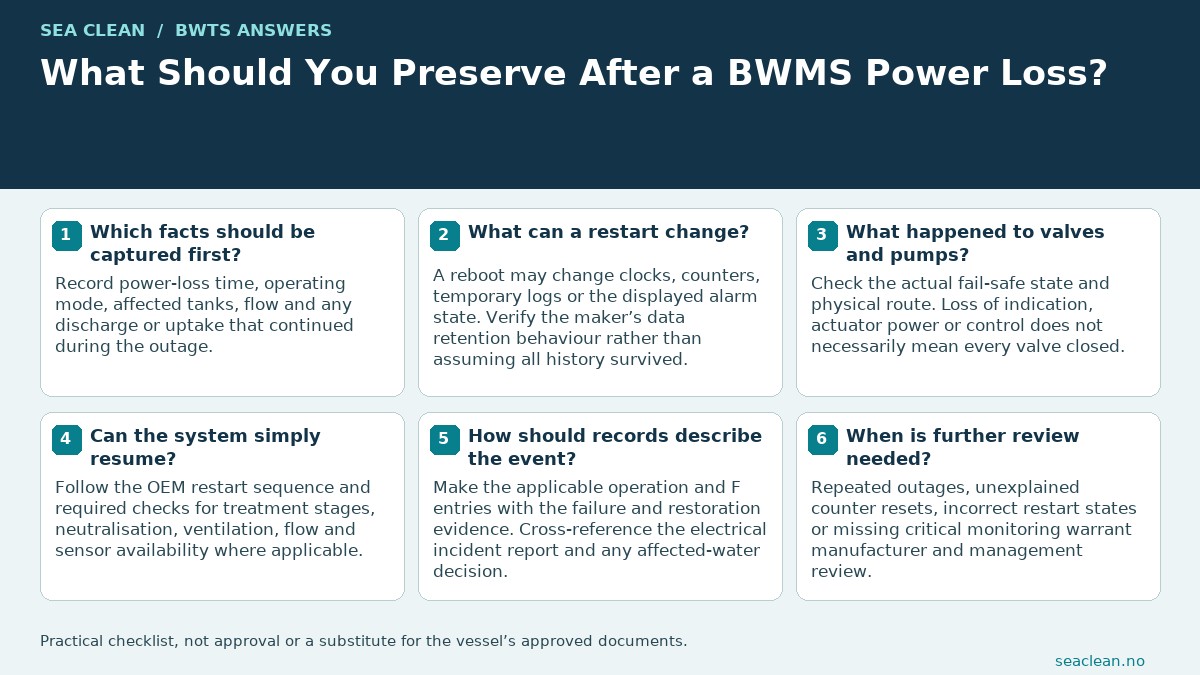
Which facts should be captured first?
Record power-loss time, operating mode, affected tanks, flow and any discharge or uptake that continued during the outage.
Keep safety actions first. Capture displays or export history when safe, but do not delay isolation of electrical or chemical hazards.
What can a restart change?
A reboot may change clocks, counters, temporary logs or the displayed alarm state. Verify the maker’s data retention behaviour rather than assuming all history survived.
Compare retained BWMS data with independent bridge, engine and power-system records. Keep source versions and identify gaps in the reconstruction.
Related guidance: BWTS Record Book Entries After an Alarm, Repair or Failed Operation
What happened to valves and pumps?
Check the actual fail-safe state and physical route. Loss of indication, actuator power or control does not necessarily mean every valve closed.
Use approved drawings and safe verification methods. A restored command signal is different from confirmation that the commanded route is established.
Can the system simply resume?
Follow the OEM restart sequence and required checks for treatment stages, neutralisation, ventilation, flow and sensor availability where applicable.
Determine whether the interruption affects already transferred or retained water. Restart readiness does not automatically validate treatment completed before the outage.
How should records describe the event?
Make the applicable operation and F entries with the failure and restoration evidence. Cross-reference the electrical incident report and any affected-water decision.
Do not replace the actual outage interval with the later acknowledgment time. Note clock discrepancies separately so the physical sequence remains understandable.
Related guidance: How Should a BWMS Bypass Be Described in the Record Book?
When is further review needed?
Repeated outages, unexplained counter resets, incorrect restart states or missing critical monitoring warrant manufacturer and management review.
Record the return-to-service basis and unresolved restrictions. Never change logic or disable an alarm solely to prevent another visible interruption.
Frequently asked questions
Does a normal screen mean treatment was valid?
No. It only describes the restored displayed state, not the interrupted operation’s history.
Can I use the reboot time as failure time?
Only if evidence establishes that as the failure time; otherwise distinguish outage, reboot and acknowledgment.
Must every valve fail closed?
Do not assume that. Verify the installed arrangement’s documented fail-safe behaviour.
Should missing data be recreated from memory?
Use reliable independent evidence and state uncertainty; do not invent controller values or timestamps.
Sources
- IMO — BWM.2/Circ.80/Rev.1: record-keeping and reporting — The linked PDF is the revised circular dated 24 October 2024, despite its shorter filename.
- IMO — MEPC.369(80): revised record-book form
- IMO — BWMS Code, MEPC.300(72) — Approval framework, monitoring, system design limitations and biological performance; not a universal maker procedure.
Related articles
- What Is a Tank’s Status After BWMS Failure During Uptake?
- How Should a BWMS Bypass Be Described in the Record Book?
- BWTS Record Book Entries After an Alarm, Repair or Failed Operation
- BWMS Logs and Record Books: Building a PSC Evidence Pack
- What Is a Ballast Water Treatment System? Explained
- How Does BWTS Installation Work? Step by Step
Request spares, calibration or ballast-water testing
Include BWMS brand/model, vessel/IMO number, port/terminal, date/ETA and scope or part numbers. These links prepare an email draft; you must send it yourself.
- Request a parts quote — Sensors, TRO reagents, calibration kits and replacement parts. Confirm compatibility, availability and delivery for your installed system.
- Request a calibration booking — Annual instrument calibration with a calibration certificate for the work completed. OEM instructions, drift or applicable rules may require earlier work.
- Request testing coordination — Arrange sampling and testing with an appropriately qualified party for your IMO D-2, commissioning or other stated purpose.
Authorised Headway agent. Other-brand enquiries are independently reviewed; no OEM authorisation is claimed. Sea Clean is not an accredited laboratory or approving authority. Calibration does not demonstrate biological D-2 compliance. Attendance, testing scope and parts delivery are confirmed per enquiry.