Can a CLX Fault Current Be Mistaken for Zero TRO?
Updated
Yes, if the receiver does not correctly distinguish signal state from concentration. The CLX-XT manual allows configured fault currents, including values that can be misinterpreted by downstream scaling. Fault handling must be tested as part of the installed control arrangement.
Request BWTS spare parts, annual calibration or ballast-water testing
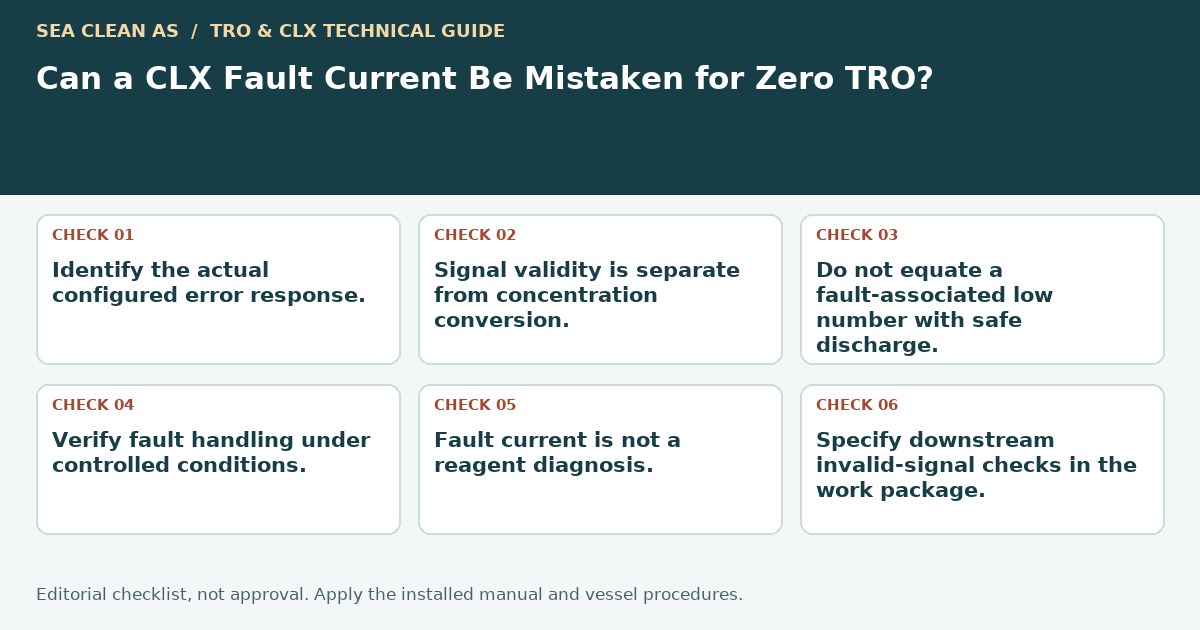
Key takeaways
- Identify the actual configured error response.
- Signal validity is separate from concentration conversion.
- Do not equate a fault-associated low number with safe discharge.
- Verify fault handling under controlled conditions.
- Fault current is not a reagent diagnosis.
- Specify downstream invalid-signal checks in the work package.
Read the error-level setting
Section 8.2 describes an error response selectable as 4, 2 or 0 mA, with OFF as its stated factory default.
Do not assume which option is installed. Preserve the setting and the associated alarm configuration before diagnosing a low controller value during an analyser fault.
Separate value from validity
An analogue current can represent a concentration under normal operation or an error state under a configured failure response.
A receiver that converts every current directly into a concentration may label a fault as low TRO. The validity decision belongs to the documented channel and control logic, not to reagent chemistry.
Review the installed safety response
Trace how the BWMS responds to instrument faults, communications loss and implausible input.
Use the applicable design and vessel procedure; do not implement a new trip, discharge permission or clamp value from a general article. A low number without a valid measurement state is not reliable residual evidence.
Test using an approved method
A controlled verification should establish fault annunciation and the required receiver response without creating an unplanned operating hazard.
Qualified personnel must coordinate the test with treatment controls and operation status. Record which simulated or actual condition was applied and what each system displayed.
Do not misdiagnose bottles from current alone
Reagent issues may create a measurement problem, but a fault current by itself does not identify the bottle or formulation at fault.
Review the queued code and instrument condition. Order chemistry only when its identity, preparation, age or supply is part of the diagnosed problem.
Define the close-out evidence
Record normal scaling, error setting, alarm logic, test observations and any remaining limitation.
Sea Clean can coordinate instrument and integration diagnostics alongside EC work. A calibration certificate alone may not demonstrate that the controller rejects invalid values; include that check explicitly when it is required.
Provide error settings and receiver logic so the service scope includes validity handling, not only concentration. Request fault-current and invalid-signal verification
Frequently asked questions
Does 0 mA always mean zero oxidant?
No. It may indicate a configured fault response or another signal problem.
Is the factory error setting necessarily still installed?
No. Read the actual configuration.
Can low TRO be accepted without checking signal validity?
Do not assume a fault-associated value is a valid current measurement.
Does instrument calibration prove fault logic works?
Not by itself. Downstream invalid-signal handling needs its own specified verification.
Sources
- HF scientific CLX-XT operation and maintenance manual, revision 5.0 — Sections 8.2, 8.4 and 10.1 explain error current, fault alarms and severity.
- HF scientific CLX-XT engineering specification
Related articles
- Why Can the CLX Display and BWTS PLC Show Different TRO Values?
- Why Does a CLX-XT Show MA While the TRO Display Still Works?
- When Do CLX-XT POST and FAIL Codes Need Manufacturer-Level Service?
- Does Zero TRO in CLX Remote Standby Mean the Water Is Oxidant-Free?
- Why Does CLX-XT Show nOnE When Calibration Is Attempted?
- What Is a Ballast Water Treatment System? Explained
Request spares, calibration or ballast-water testing
Include BWMS brand/model, vessel/IMO number, port/terminal, date/ETA and scope or part numbers. These links prepare an email draft; you must send it yourself.
- Request a parts quote — Sensors, TRO reagents, calibration kits and replacement parts. Confirm compatibility, availability and delivery for your installed system.
- Request a calibration booking — Annual instrument calibration with a calibration certificate for the work completed. OEM instructions, drift or applicable rules may require earlier work.
- Request testing coordination — Arrange sampling and testing with an appropriately qualified party for your IMO D-2, commissioning or other stated purpose.
Authorised Headway agent. Other-brand enquiries are independently reviewed; no OEM authorisation is claimed. Sea Clean is not an accredited laboratory or approving authority. Calibration does not demonstrate biological D-2 compliance. Attendance, testing scope and parts delivery are confirmed per enquiry.