Can CLX Buffer and Indicator Bottles Be Swapped or Topped Up?
Updated
The buffer and indicator are distinct reagents with distinct channels and functions. Do not swap them or improvise topping-up of old reagent with new stock to extend life. Resolve a suspected mix-up before relying on the measurement.
Request BWTS spare parts, annual calibration or ballast-water testing
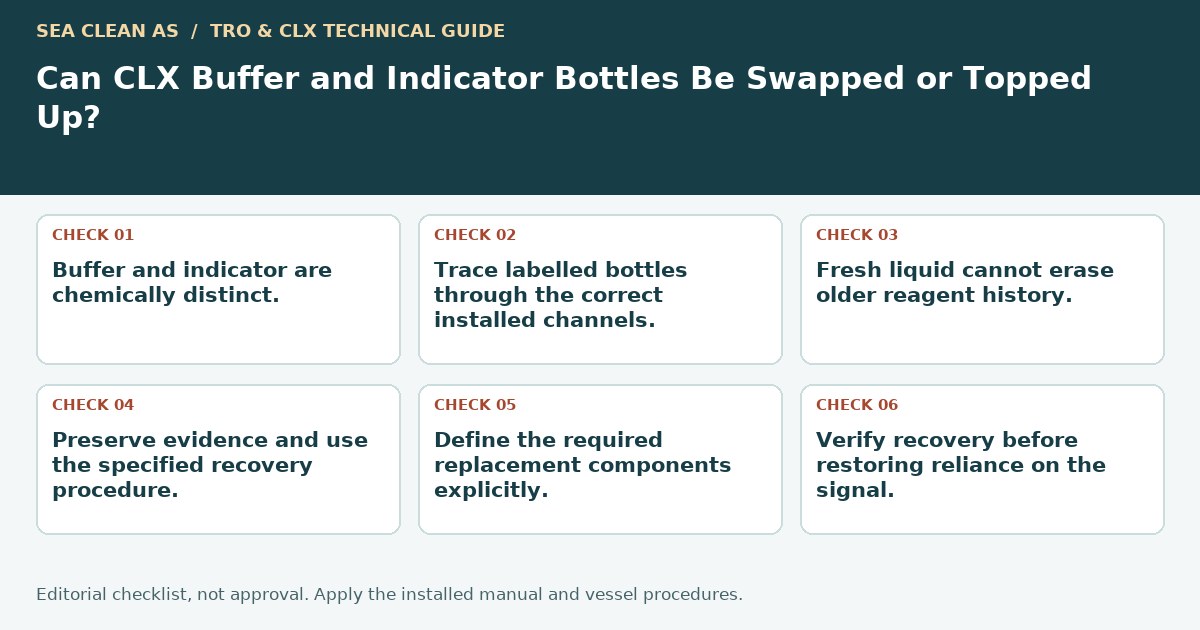
Key takeaways
- Buffer and indicator are chemically distinct.
- Trace labelled bottles through the correct installed channels.
- Fresh liquid cannot erase older reagent history.
- Preserve evidence and use the specified recovery procedure.
- Define the required replacement components explicitly.
- Verify recovery before restoring reliance on the signal.
Two bottles have different functions
Section 4.1 describes buffer for sample pH control and indicator containing DPD for colour development.
A missing buffer can cause low readings according to the diagnostic chart. Bottle appearance or remaining volume is therefore not a basis for using one reagent to keep the other channel operating.
Trace each channel rather than guessing
Identify the bottle labels, cap assemblies and tubing routing against the instrument drawing.
The XT manual places the indicator in the cooling chamber and the buffer separately. Do not rely only on a cap colour remembered from another model or maintenance visit; the physical configuration and current instructions control.
Topping up does not reset an age limit
Adding fresh indicator to an older activated bottle obscures the mixing date and retains the older liquid's history.
The cited manual describes replacement and priming, not extending the indicator clock by topping up. Keep replacement dates and lot identity clear, and follow any specific supplier instruction for the actual formulation.
Treat a mix-up as a contamination event
If bottles or channels were swapped, stop relying on the result and follow the ship's safe maintenance procedure.
Retain evidence of what was fitted and when. Use the applicable flushing and replacement instructions rather than returning displaced liquid to a stock bottle or attempting to neutralise it with another chemical.
Order complete, identifiable replacements
When the history cannot be established, obtain the correct replacement components with their documented preparation and handling requirements.
An order should distinguish a complete set from a buffer-only or indicator-only refill. Reagent replacement supplies should not be assumed to include tubing, cuvettes or calibration standards.
State whether a complete 09991 set or particular component is required, with the installed model. Request identifiable buffer and indicator replacement supply
Verify recovery at the instrument
After the correct channels are restored and primed, check for leaks, valid measurement cycles and a suitable reference comparison as required.
Calibration should not conceal a chemical handling error. Sea Clean can review the recovery scope and any additional service needs; the findings should identify affected operation periods and unresolved limitations.
Share the timing, fitted bottles and affected operation records for an appropriate technical work package. Coordinate recovery after a reagent channel mix-up
Frequently asked questions
Can buffer serve as spare indicator?
No. Buffer controls pH; indicator provides the specified DPD colour reaction.
Does topping up restart the indicator's life?
No. It does not remove the age or handling history of the existing liquid.
Should mixed-up liquid be returned to spare stock?
No. Avoid contaminating stock and follow the applicable recovery and disposal instructions.
Is channel recovery the same as calibration?
No. Correct reagent delivery and chemistry must be established before any calibration assessment.
Sources
- HF scientific CLX-XT operation and maintenance manual, revision 5.0 — Sections 4.1, 10.5 and 11.1–11.2 distinguish bottle roles, low-reading causes and replacement procedures.
- HF scientific CLX-XT engineering specification
Related articles
- Why Does a CLX Liquid Indicator Still Need DPD Activation?
- Why Does a CLX PRIME Cycle Run Without Reagent Colour?
- Does a CLX 09991 Annual Pack Mean One Bottle Lasts a Year?
- Does a TRO Reagent Pack Include Everything Needed for Calibration?
- What Is a Ballast Water Treatment System? Explained
- How Does BWTS Installation Work? Step by Step
Request spares, calibration or ballast-water testing
Include BWMS brand/model, vessel/IMO number, port/terminal, date/ETA and scope or part numbers. These links prepare an email draft; you must send it yourself.
- Request a parts quote — Sensors, TRO reagents, calibration kits and replacement parts. Confirm compatibility, availability and delivery for your installed system.
- Request a calibration booking — Annual instrument calibration with a calibration certificate for the work completed. OEM instructions, drift or applicable rules may require earlier work.
- Request testing coordination — Arrange sampling and testing with an appropriately qualified party for your IMO D-2, commissioning or other stated purpose.
Authorised Headway agent. Other-brand enquiries are independently reviewed; no OEM authorisation is claimed. Sea Clean is not an accredited laboratory or approving authority. Calibration does not demonstrate biological D-2 compliance. Attendance, testing scope and parts delivery are confirmed per enquiry.