Why Does CLX-XT Show nOnE When Calibration Is Attempted?
Updated
The cited diagnostic chart associates nOnE during calibration with no current reading posted. It is not a certificate result or proof of an empty reagent bottle. Establish valid measurement and a suitable stable comparison before any adjustment.
Request BWTS spare parts, annual calibration or ballast-water testing
Key takeaways
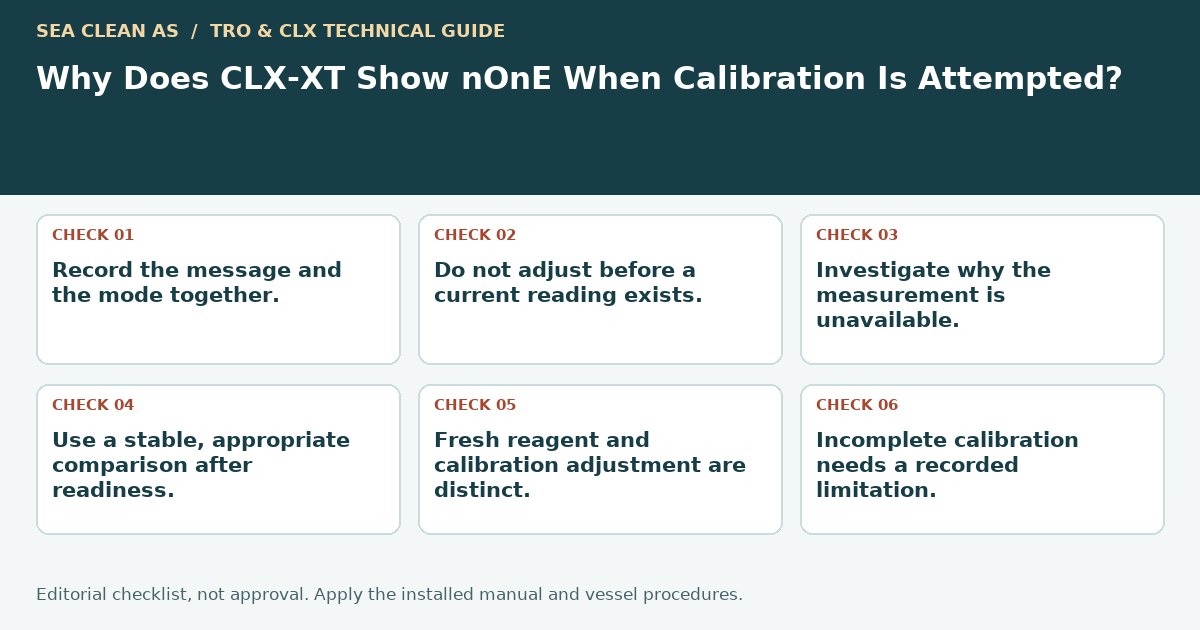
- Record the message and the mode together.
- Do not adjust before a current reading exists.
- Investigate why the measurement is unavailable.
- Use a stable, appropriate comparison after readiness.
- Fresh reagent and calibration adjustment are distinct.
- Incomplete calibration needs a recorded limitation.
Record the context of nOnE
Capture whether the message appeared while entering calibration, after startup or during another mode.
Section 10.5 specifically describes nOnE while attempting calibration. The code's context matters because a photograph without operating mode may lead to an incorrect service diagnosis.
Wait for a valid measurement
The slope procedure requires a reading to be posted.
A unit just returned from service or started before sample availability may not yet have a usable value. Check its cycle state and fault queue rather than entering an invented concentration to force the calibration sequence forward.
Resolve the underlying readiness issue
If a reading does not appear, investigate sample availability, fill/purge function and both reagent channels under the model's procedure.
The absence of a posted value is a symptom, not a diagnosis of one particular failed part. Keep startup and maintenance timing with the instrument record.
Prepare an appropriate comparison
Section 7.1 requires a stable chlorine level and a trusted comparison measurement.
A portable sample collected at another point or after a process change may not be suitable. Record sample timing, method and result so any accepted adjustment has a documented basis instead of simply clearing a message.
Separate replacement from adjustment
Expired or incorrectly prepared reagent may need renewal before the check, but delivery of fresh bottles does not itself establish calibration readiness.
Specify the matching set and record activation. Any final adjustment remains a distinct action with its own before/after evidence.
If bottle status is unresolved, establish the correct chemistry before proceeding with instrument adjustment. Identify reagent renewal needed before the comparison
Escalate persistent absence of readings
Send the model, mode, fault queue, sample condition and attempted preparation for technical review.
Annual calibration work should identify checks that could not be completed rather than produce a normal certificate for an instrument with no usable measurement. Record the limitation and planned corrective work explicitly.
Provide the instrument state and required reporting deadline, including checks that remain incomplete. Arrange calibration-readiness and no-reading investigation
Frequently asked questions
Does nOnE prove the reagent is empty?
No. During calibration, the cited chart associates it with no current reading posted.
Should I type a value to bypass readiness?
No. Establish valid measurement first.
Can a changing ballast sample support slope adjustment?
The cited procedure requires a stable level and suitable comparison.
Should unfinished checks be included in service reporting?
Yes. Identify the limitation and corrective action rather than implying completed calibration.
Sources
- HF scientific CLX-XT operation and maintenance manual, revision 5.0 — Sections 7.1 and 10.5 state the need for a posted reading and explain nOnE during calibration.
- HF scientific CLX-XT engineering specification
Related articles
- What Does a CLX-XT WCAL Fault After Startup Mean?
- Why Does a CLX PRIME Cycle Run Without Reagent Colour?
- Does a TRO Reagent Pack Include Everything Needed for Calibration?
- When Do CLX-XT POST and FAIL Codes Need Manufacturer-Level Service?
- What Is a Ballast Water Treatment System? Explained
- How Does BWTS Installation Work? Step by Step
Request spares, calibration or ballast-water testing
Include BWMS brand/model, vessel/IMO number, port/terminal, date/ETA and scope or part numbers. These links prepare an email draft; you must send it yourself.
- Request a parts quote — Sensors, TRO reagents, calibration kits and replacement parts. Confirm compatibility, availability and delivery for your installed system.
- Request a calibration booking — Annual instrument calibration with a calibration certificate for the work completed. OEM instructions, drift or applicable rules may require earlier work.
- Request testing coordination — Arrange sampling and testing with an appropriately qualified party for your IMO D-2, commissioning or other stated purpose.
Authorised Headway agent. Other-brand enquiries are independently reviewed; no OEM authorisation is claimed. Sea Clean is not an accredited laboratory or approving authority. Calibration does not demonstrate biological D-2 compliance. Attendance, testing scope and parts delivery are confirmed per enquiry.