BWTS TRO Sensor Calibration and Verification
Updated
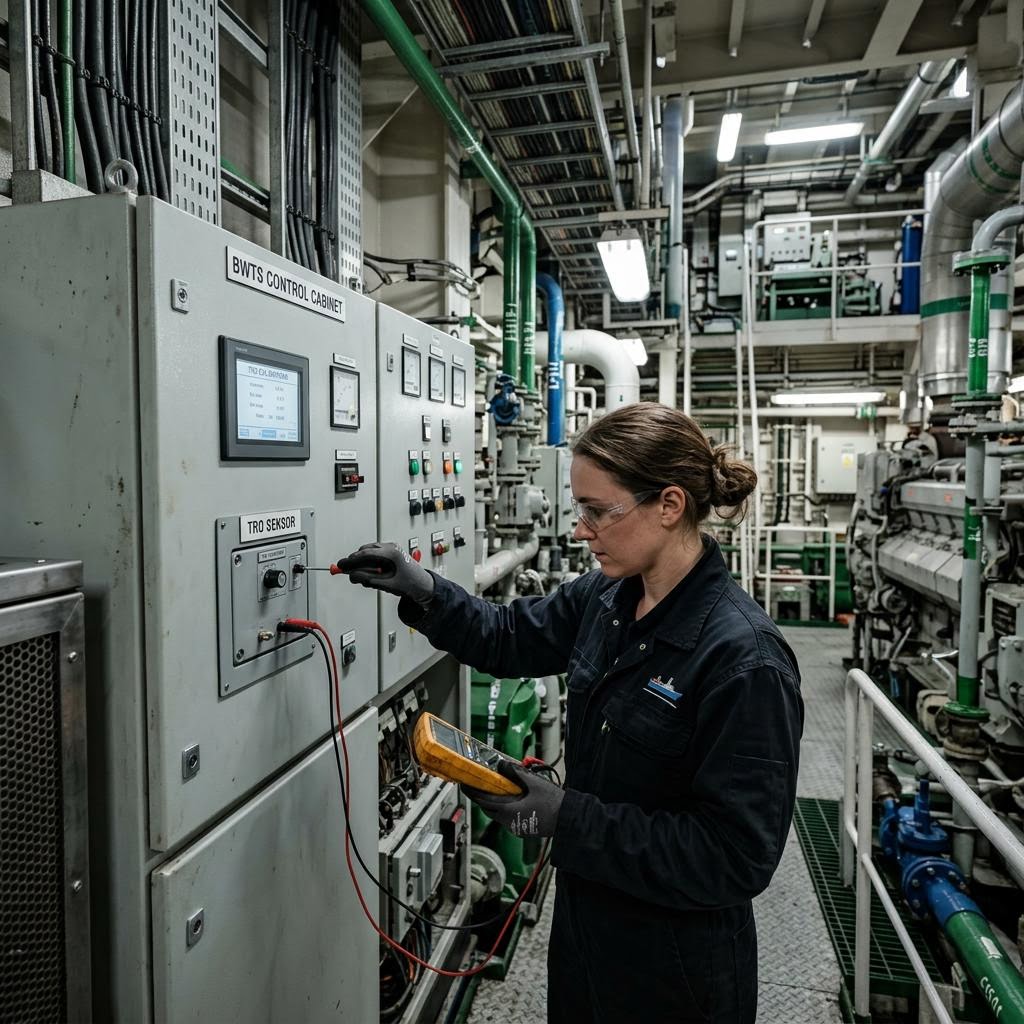
On electrochlorination ballast water systems the total residual oxidant sensor governs both treatment and neutralisation, so an inaccurate reading can mean under-treatment or an illegal discharge. This article explains why TRO sensors drift, how calibration and verification are done against reagent standards, and how Sea Clean documents the result.
Key takeaways
- The TRO sensor controls both treatment and neutralisation, so its accuracy has compliance consequences both ways.
- Sensors drift as components age, reagents deplete and deposits build, usually invisibly until they cause a problem.
- Verification checks the reading against a standard; calibration adjusts it, followed by re-verification.
- Neutralisation dosing and reagent stock are confirmed alongside the sensor, since the sensor governs discharge.
- Recorded calibrations build a drift history that signals when a sensor needs replacement rather than adjustment.
- Headway TRO calibration uses authorized agency; other electrochlorination makes are served as independent service.
Why the TRO Sensor Is Critical
Total residual oxidant is the measure of active disinfectant in the water on an electrochlorination BWTS. The TRO sensor, or analyser, tells the system whether enough disinfectant has been generated to treat the ballast on uptake, and whether the residual has been neutralised to a safe level before discharge. It sits at the centre of both functions.
Because the sensor controls both treatment and neutralisation, its accuracy has compliance consequences in both directions. A sensor reading low can drive over-dosing and waste, while a sensor reading high can lead the system to believe water is safe to discharge when residual oxidant is still present, which is a discharge violation. Neither error is acceptable.
This dual role is why TRO calibration is not a minor adjustment but a core compliance task. The whole electrochlorination process is judged through this one measurement.
Why Sensors Drift
Analytical sensors drift over time as their components age, as reagents within the analyser deplete, and as deposits or fouling build on the measuring cell. Temperature, the water matrix and the duty cycle all contribute, so a sensor that was accurate at commissioning gradually departs from the true value if left unchecked.
Drift is usually gradual and invisible in normal running, which is exactly why scheduled verification matters: by the time a drifting sensor causes an obvious problem, the system may already have treated or discharged on the strength of a wrong number. Catching drift on a schedule prevents that.
Reagent-based analysers also depend on in-date, correct reagents to measure properly, so reagent condition is part of keeping the sensor honest. A sensor fed depleted or wrong reagents cannot read correctly however well it is calibrated.
Calibration Versus Verification
Verification checks whether the sensor's reading matches a known reference, while calibration adjusts the sensor so its reading agrees with that reference. The two go together: the sensor is verified against a standard, and if it is outside tolerance it is calibrated and then re-verified to confirm the adjustment worked.
The reference is provided by reagent standards or a known sample whose oxidant value is established by an independent method, following the maker's procedure for the specific analyser. Using the correct, in-date standards and the maker's method is essential, because a calibration against a faulty reference simply moves the error.
Routine crew verification at intervals, with a full calibration at service or when verification shows drift, is the usual pattern. Sea Clean carries out the calibration to the maker's method and confirms the result by re-verification rather than assuming the adjustment is correct.
Checking Neutralisation
Because the TRO sensor governs neutralisation, calibrating it is only half the task; the neutralisation function itself must be confirmed. On discharge, treated water is dosed with sodium thiosulfate or an equivalent neutraliser to bring residual oxidant below the limit, and the sensor confirms the residual is low enough before the water leaves the ship.
Service checks that the neutraliser dosing operates correctly and that the reagent stock is in date and sufficient, since an empty or depleted neutraliser stock can cause a compliance gap at a critical discharge. The interplay between the calibrated sensor and the dosing is what keeps the discharge legal.
Sea Clean supplies sodium thiosulfate neutraliser and the analyser reagents in date and labelled for the vessel, and confirms the neutralisation loop functions as part of TRO service. The sensor and the neutralisation it controls are verified together.
Documentation and Records
A calibration is only useful if it is recorded. Sea Clean documents the pre-calibration reading, the standard used, the adjustment made, and the post-calibration verification result, so the vessel holds evidence the TRO measurement is accurate. This record supports class and port state and builds a history that shows how fast the sensor drifts between services.
That history is practically useful: a sensor that drifts quickly may be approaching the end of its life or have a fouling problem worth addressing, turning a recurring calibration into a planned replacement. The record turns isolated calibrations into a maintenance signal.
Reagent stock and expiry are noted at the same time so the vessel does not run out between services. Keeping these records current is part of demonstrating the system is operated and maintained correctly.
Parts, Reagents and Brand Scope
Sea Clean supplies TRO analyser reagents, calibration standards, sensor spares and sodium thiosulfate neutraliser, dispatched against the system make, model and serial and in date on delivery. A sensible onboard holding of reagents and standards lets the crew verify between services and avoid a compliance gap from depleted stock.
For Headway OceanGuard systems the TRO sensor calibration and parts are provided under authorized Headway Technology agency. For other electrochlorination makes such as Techcross, Erma First, Sunrui, De Nora and others, Sea Clean provides the same calibration and verification as independent service and parts support, without claiming OEM authorisation by those brands.
Note that Sea Clean supplies sampling support, test kits and reagents and attends to facilitate work, but accredited analysis and certification, where required, are performed by accredited laboratories or parties authorised by the flag or class. To arrange TRO calibration or order reagents, contact post@seaclean.no with the system details.
Frequently asked questions
Why is the TRO sensor so important?
On an electrochlorination BWTS the TRO sensor tells the system whether enough disinfectant was generated to treat the ballast and whether the residual is neutralised before discharge. An inaccurate reading can cause under-treatment or an illegal discharge, so its accuracy is a core compliance matter.
What is the difference between calibration and verification?
Verification checks whether the sensor agrees with a known reference, while calibration adjusts the sensor so it agrees. The sensor is verified against a standard, calibrated if it is outside tolerance, then re-verified to confirm the adjustment worked, all to the maker's method.
How often should the TRO sensor be calibrated?
The usual pattern is routine crew verification at intervals with a full calibration at service or whenever verification shows drift, following the maker's instructions. A recorded drift history helps set the right interval and flags when a sensor is nearing the end of its life.
Does Sea Clean perform accredited TRO analysis?
Sea Clean calibrates and verifies the onboard TRO sensor and supplies reagents, test kits and neutraliser, and attends to facilitate the work. Where accredited analysis and certification are required, these are performed by accredited laboratories or parties authorised by the flag or class, not by Sea Clean.