BWTS Installation and Commissioning Support for Retrofits
Updated
Installing a ballast water treatment system is only half the job; the system must then be integrated with the ship's power, control and piping, started up correctly, and validated through MEPC.325(75) commissioning testing that its treatment processes work as intended. Errors made during installation and first commissioning are the ones that surface later as nuisance alarms, under-treatment and failed inspections. This article explains how Sea Clean supports BWTS installation and commissioning — from integration checks and riding-crew work through first ballast setup to commissioning-test coordination.
Key takeaways
- Installation support bridges mechanically installed to operationally proven — integration, control sequencing, sensor setup and first-ballast tuning.
- Incorrect bypass logic, mis-plumbed sample lines or untuned dosing pass a superficial start-up but show up in MEPC.325(75) commissioning testing.
- First live ballast is where the installation proves itself: design dose at rated flow, TRO neutralised within limits, stable filter behaviour.
- Sea Clean can join as a riding crew to complete integration and tuning underway, keeping the vessel trading rather than idle.
- Engineering commissioning leads into MEPC.325(75) commissioning testing — an installation validation by indicative analysis — coordinated through accredited ISO 17025 labs.
- Headway installs are supported as an authorized agent; other brands receive independent, non-authorized installation and commissioning support.
Where Installation Support Fits
A BWTS retrofit is a substantial engineering project: a filter, a disinfection stage, dosing or power equipment, a control system and new pipework must be integrated into an existing ballast system without compromising ballast capacity or safety. Whether the physical installation is done at a yard or by a riding crew during trading, the interfaces between the new system and the ship are where problems concentrate.
Installation support covers the transition from mechanically installed to operationally proven: confirming the electrical supply and control integration, verifying that valves and interlocks sequence correctly, checking the filter and treatment stage are plumbed to design, and setting up the sensors and control parameters. This is engineering commissioning, distinct from the MEPC.325(75) commissioning testing that follows and validates the treatment processes.
Getting this stage right matters because the type approval and the ship's compliance depend on the installation matching the approved configuration. A system installed with an incorrect bypass, a mis-plumbed sample line or an untuned dosing set-point can pass a superficial start-up yet be flagged during commissioning testing — the expensive way to discover an installation error.
Integration and Control Checks
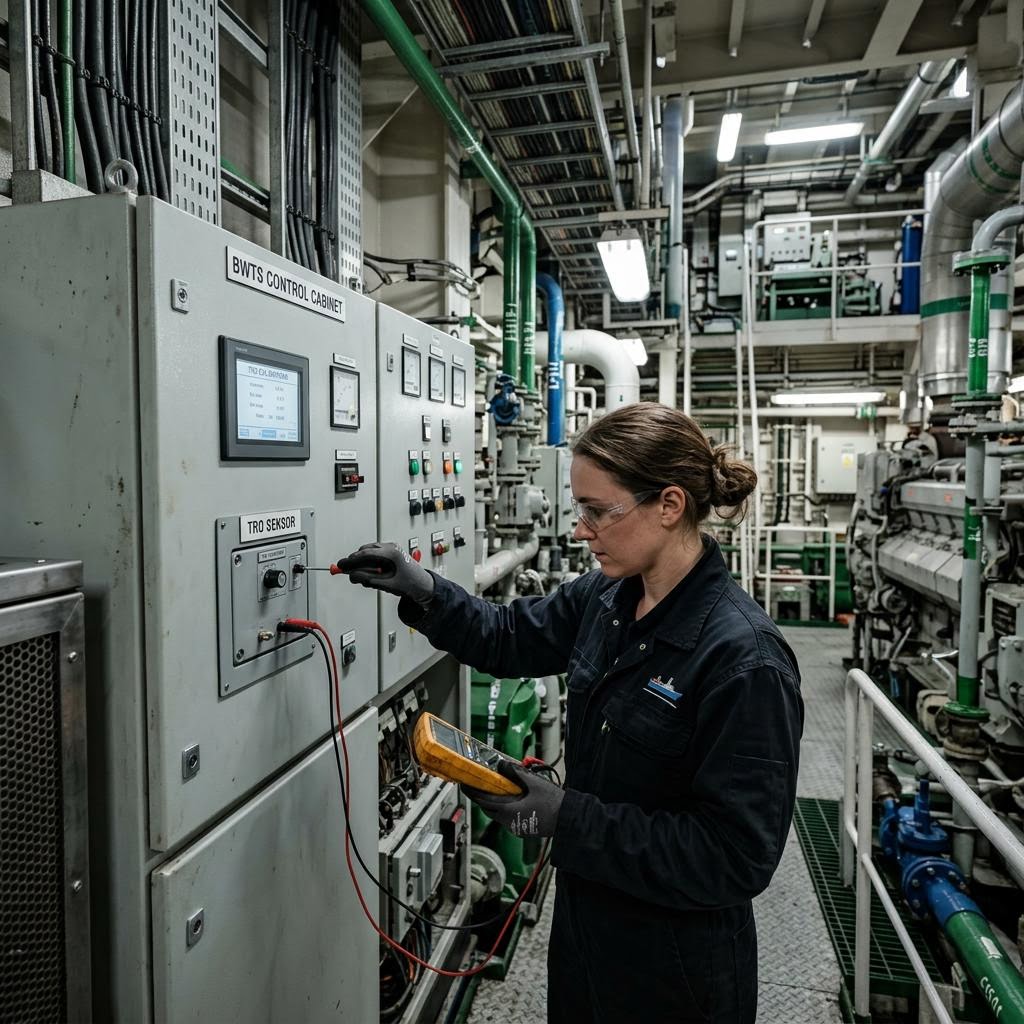
The engineer confirms the power supply matches the system's requirement and that the electrochlorination or UV load is correctly fed and protected, because power faults are a leading cause of early-life BWTS trips. Control integration is checked so the system starts, treats and stops in step with the ship's ballast operation and hands the correct signals to and from the ballast control system.
Valve and actuator sequencing is exercised through a dry run so interlocks, bypass logic and alarms behave as designed before any real ballast passes through. Incorrect sequencing — a treatment stage that starts after flow, or a bypass that opens at the wrong point — lets untreated or partially treated water through and defeats the installation regardless of how good the treatment hardware is.
Sensors are configured and their sample paths proved: the TRO or oxidant analyser, UV-intensity sensor, flow meter and pressure transmitters must read true from day one, or the control system dose is wrong from the first ballast. Setting these up correctly at commissioning, and documenting the baseline, gives every later health check and calibration a reference to measure drift against.
First Ballast Setup and Tuning
The first live ballast operation is where the installation proves itself. The engineer supervises the initial treated ballast, confirms the treatment stage delivers the design dose at rated flow, checks TRO builds and neutralises within limits, and observes filter differential-pressure behaviour under real sediment loading. Parameters are tuned so the system runs stably rather than tripping on nuisance alarms.
Neutralisation is verified on the deballast side for oxidant-based systems: the discharge must be neutralised within the permitted residual before it goes overboard, and the neutralisation set-point and reagent supply must be proven under a real discharge, not just assumed. A system that treats correctly but discharges above the residual limit is non-compliant in a different way.
The crew is walked through normal operation, the alarm responses, the routine checks and the record-book entries specific to the installed system during this setup. A commissioning that leaves the crew confident in day-to-day operation prevents the pattern where a correctly installed system is later mis-operated into alarms or non-compliance.
Riding-Crew and Sailing Support
Where the installation or the tuning cannot be completed in a single port call, Sea Clean's engineers can join the vessel as a riding crew and complete the work while the ship trades between ports. This keeps the ship earning rather than idle and lets integration checks, first-ballast tuning and crew familiarisation happen across a voyage instead of compressing them into a berth window.
Riding-crew support is particularly useful for retrofits fitted during trading, where the physical installation and the commissioning must fit around cargo operations. The engineer sails with the ship, completes the outstanding scope underway, and disembarks at a convenient port, leaving a proven, documented system behind.
Sailing support also suits situations where the first compliant ballast operation only occurs some voyages after installation, so the tuning and biological commissioning naturally fall on a later leg. Planning the riding-crew scope around the ship's actual ballast pattern is more effective than forcing commissioning into a call where no genuine ballast operation is available.
Coordinating the Commissioning Test
Engineering commissioning leads directly into the commissioning testing required under MEPC.325(75), which validates that the installation's treatment processes work as intended using indicative analysis of a treated-water sample — not a definitive determination of D-2 compliance. The two steps are best planned together, so that once the installation is tuned, Sea Clean coordinates the sampling and the accredited laboratory analysis on a system already engineered to validate cleanly rather than on an untested installation.
Sea Clean is not an accredited test laboratory; it coordinates the sampling logistics and engages accredited ISO 17025 laboratories and flag- or class-authorised parties for the analysis, and liaises with class where attendance is required. Sequencing the engineering readiness check immediately before the sampling means configuration faults are corrected first, avoiding an unsatisfactory commissioning result and a costly repeat.
For Headway OceanGuard installations this support is provided with manufacturer backing as an authorized Headway agent. For Techcross, Erma First, Sunrui, Alfa Laval, Optimarin, Wärtsilä, JFE, Panasia, De Nora and other brands, Sea Clean provides independent installation and commissioning support and does not claim manufacturer authorization for those systems.
Planning and Booking Installation Support
The most efficient projects define the scope early: what the yard or riding crew will do, what the engineer must integrate and tune, and when the commissioning test will occur against a real ballast operation. Provide the vessel name and IMO number, BWTS make and model, installation method and timeline, and the intended ports and ETAs to post@seaclean.no.
Sea Clean's engineers attend vessels across Norway and the North Sea, commonly within 24 hours for planned work, and support worldwide installations by arrangement as flights, visas and port access allow. Bringing integration, first-ballast tuning, crew familiarisation and commissioning coordination under one contact reduces the interfaces the superintendent has to manage across a retrofit.
Because installation errors are the source of so many later service calls, investing in proper commissioning support pays back over the system's life in fewer alarms, fewer breakdowns and a clean compliance record. A documented, correctly commissioned installation is the foundation every subsequent annual health check builds on.
Frequently asked questions
What is the difference between engineering and MEPC.325(75) commissioning?
Engineering commissioning confirms the installation is integrated, sequenced, tuned and dosing correctly; MEPC.325(75) commissioning testing validates that the treatment processes work as intended using indicative analysis of a treated-water sample. The latter is an installation validation, not a definitive D-2 laboratory determination. Sea Clean handles the engineering readiness and coordinates the sampling together.
Can Sea Clean commission a system installed by the yard?
Yes. Sea Clean can pick up after a yard or riding-crew installation to verify integration, tune the first ballast operation, familiarise the crew and coordinate the commissioning test. Confirming the installation matches the approved configuration before the sampling avoids an unsatisfactory commissioning result.
What is riding-crew commissioning support?
It is completing integration checks, first-ballast tuning and crew familiarisation while the vessel trades between ports, with the engineer sailing on board. It suits retrofits fitted during trading and situations where the first genuine ballast operation only occurs on a later voyage.
How do I arrange installation and commissioning support?
Send the vessel name and IMO number, BWTS make and model, installation method and timeline, and the intended ports and ETAs to post@seaclean.no. Sea Clean attends across Norway and the North Sea, usually within 24 hours for planned work, and supports worldwide installations by arrangement.