BWTS Service Reports and Class Documentation
Updated
A clear service report is what turns BWTS work into usable evidence for class surveys and port state control. This article explains what a service report should contain, how it relates to the ballast water record book and survey cycle, and how Sea Clean AS documents its attendance to support a vessel's compliance records.
Key takeaways
- Documentation is the bridge between BWTS work and the vessel's compliance position for class and PSC.
- A service report should state vessel and system details, scope, parts fitted with numbers, function tests and results, and any open items.
- The service report supports, and must be consistent with, the crew-kept ballast water record book.
- Sea Clean coordinates commissioning documentation with accredited parties; it does not itself certify analysis.
- Keeping certificate, plan, record book and reports together lets a survey or inspection confirm compliance quickly.
- Sea Clean issues Headway reports as authorized agent and other-brand reports on a clearly stated independent basis.
Why Documentation Matters as Much as the Repair
A treatment system can be repaired correctly, but if the work is not documented the vessel cannot demonstrate it to a surveyor or a port state control officer. Documentation is the bridge between the physical work and the vessel's compliance position, and a poorly recorded repair is, for inspection purposes, almost as weak as no repair at all.
Class surveys, the renewal cycle of the Ballast Water Management Certificate, and PSC inspections all rely on records to confirm that the system has been maintained and operates. A service report that names parts, tests and results gives the surveyor an objective basis to accept the system's condition rather than relying on assertion.
Good documentation also protects the operator over time, providing a maintenance history that supports warranty positions, informs future service, and demonstrates due diligence if a discharge or compliance question ever arises.
What a Service Report Should Contain
A useful report identifies the vessel, IMO number, the system make, model and serial number, and the date and place of attendance. It states the scope of work and the reason for the visit, whether planned maintenance, fault rectification, calibration or commissioning support, so the reader understands what was and was not addressed.
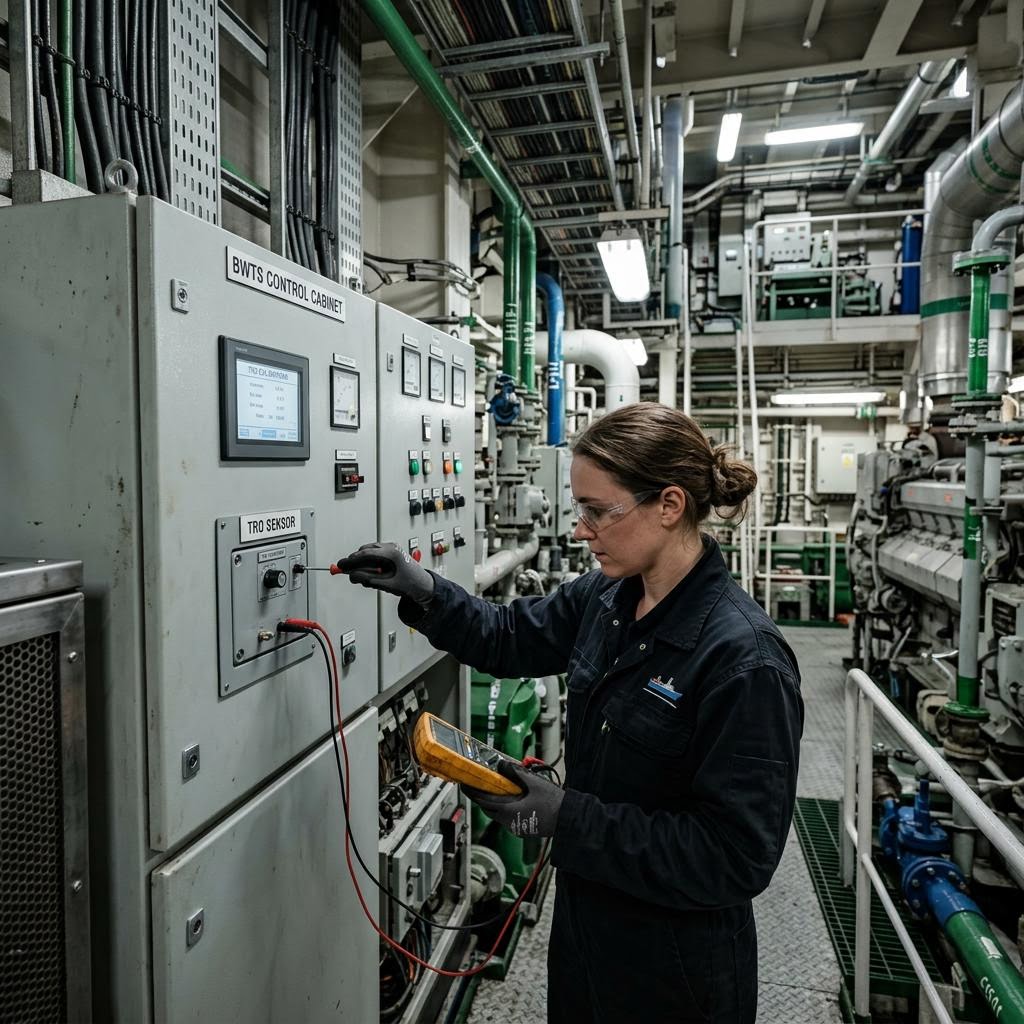
It lists the components inspected and replaced, with part numbers, and records the function tests carried out with their results: pressures, flows, UV intensity or TRO readings, alarm tests and any sampling. Photographs of key items and the control screen add evidence. Open items, recommendations and any parts to be supplied later should be stated explicitly rather than left implied.
The report should be signed by the attending engineer and dated, and ideally acknowledged by the chief engineer. A report that ties its findings to specific deficiencies or survey items, where relevant, is far more useful to the surveyor than a general note.
Relationship to the Ballast Water Record Book
The ballast water record book is the vessel's own running record of ballast operations, maintenance and any contingency measures, kept by the crew. A service report from an attending engineer is supporting evidence that sits alongside it, not a replacement for it. The two should be consistent: maintenance recorded in the report should be reflected in the record book entries.
Where a service addresses a fault that affected compliance, the record book should note the issue, the contingency applied during the period, and the rectification, with the service report providing the technical detail. An inspector reading both should see a coherent account of what happened and how it was resolved.
Sea Clean's service reports are written to slot into this picture, giving the crew clear information to make accurate record-book entries and to retain as evidence of the work performed on board.
Documentation for Commissioning and Surveys
Commissioning testing under MEPC.325(75) generates its own documentation: the function test, the sampling record, and the analysis result from the accredited party. Sea Clean is not an accredited testing laboratory and does not hold testing accreditation; it coordinates and supports the test with accredited laboratories and authorised parties, supplies sampling support and reagents, and attends to facilitate the test, while the accredited party certifies the analysis.
For class surveys the relevant documentation includes the Ballast Water Management Certificate, the approved management plan, the maintenance records and any service reports. Keeping these organised and current means a survey or PSC check confirms compliance quickly rather than turning into a search for missing paperwork.
Sea Clean's service report explains its part of this documentation clearly, distinguishing the maintenance and function-test work it performs from the certified analysis that an accredited party provides, so the record is honest about who did what.
Organising Records on Board
Records are only useful if they can be found. Keeping the certificate, management plan, record book, service reports and commissioning documentation together, in a known location and ideally backed up electronically, means the crew can present a complete picture on demand. Scattered or lost reports undermine an otherwise well-maintained system at the moment of inspection.
A simple index of service attendances, with dates, scope and the engineer, lets the chief engineer and superintendent track the maintenance history at a glance. This is also the basis for planning the next service and for ordering consumables before they run out.
Sea Clean issues reports in a consistent format that is straightforward to file and reference, supporting the vessel in maintaining an orderly compliance record over the system's life.
How Sea Clean Documents Its Work
For every attendance, Sea Clean records the scope, the parts fitted with their numbers, the tests performed and their results, and any open recommendations, signed by the engineer. For Headway systems this is issued as the authorized Headway agent; for other makers it is issued on an independent service basis, which the report states so there is no implication of OEM authorization.
Where parts or reagents are supplied separately from attendance, the supply is documented with the vessel name, IMO number and the items provided, so the consumables and their shelf life can be tracked on board. This matters particularly for reagents used in compliance verification.
Contact post@seaclean.no with the vessel name, IMO number and the documentation required to ensure attendance and supply are recorded in a form that supports the vessel's class and PSC position.
Frequently asked questions
What should a BWTS service report include?
It should identify the vessel, IMO number and the system make, model and serial number, the date and place, and the scope and reason for the visit. It should list components inspected and replaced with part numbers, the function tests and their results such as flows, UV intensity or TRO readings, photographs, and any open items, signed by the engineer.
Does a service report replace the ballast water record book?
No. The record book is the crew's own running record of ballast operations and maintenance. A service report is supporting evidence that sits alongside it. The two should be consistent, with maintenance in the report reflected in the record-book entries so an inspector sees a coherent account.
Who documents commissioning test analysis?
The accredited laboratory or authorised party that performs the analysis certifies the result. Sea Clean is not an accredited testing laboratory; it coordinates and supports the test, supplies sampling support and reagents and attends to facilitate it, while the accredited party certifies the analysis. The service report distinguishes these roles.
How are non-Headway service reports handled?
Sea Clean issues reports for Headway systems as the authorized Headway agent, and reports for Techcross, Erma First, Sunrui and other makers on an independent service basis. The report states the independent basis so there is no implication of OEM authorization by those brands.