BWTS Riding Crew and Sailing Service
Updated
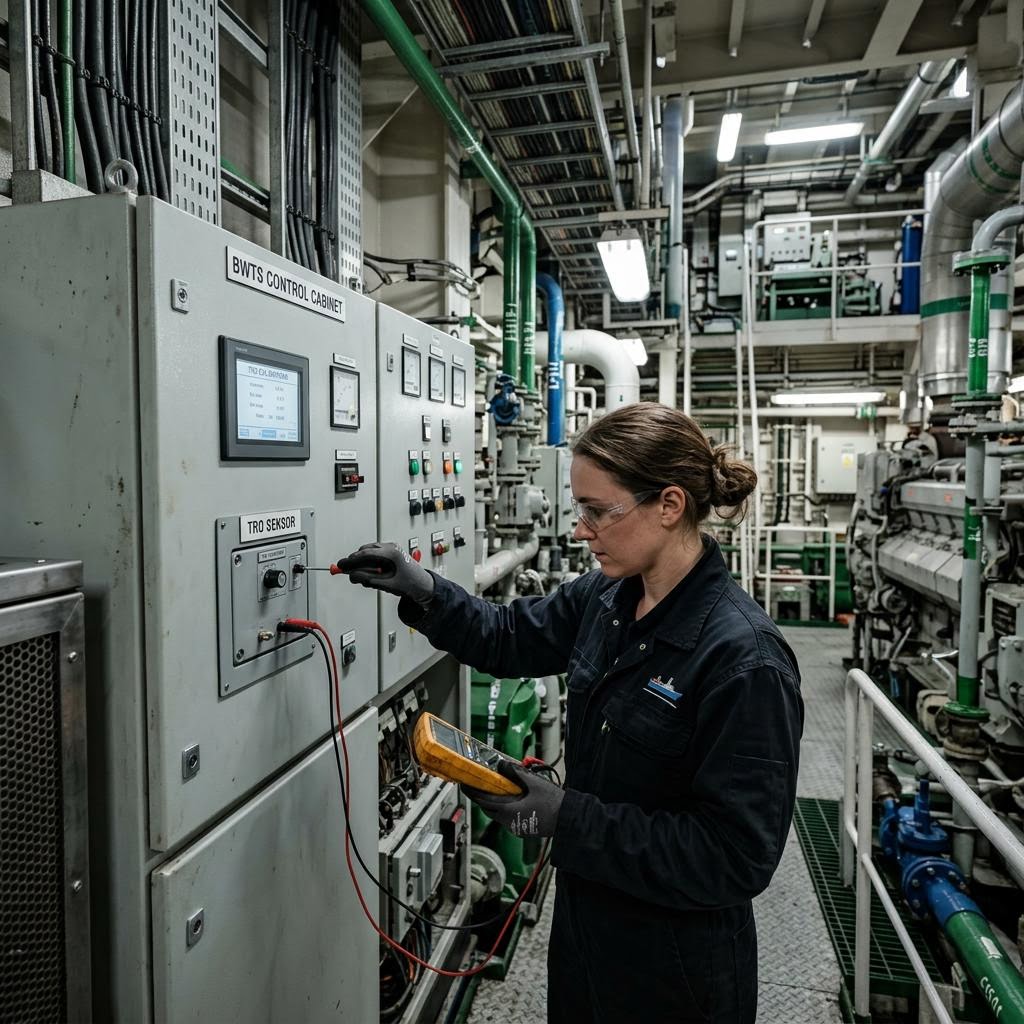
Some BWTS work cannot be finished in a short port call, particularly larger overhauls or repairs that need a treatment cycle to verify. A riding or sailing service places an engineer on board to continue the work under way between ports. This article explains when sailing service makes sense, how it is arranged, and what it achieves.
Key takeaways
- A sailing service places an engineer on board to complete BWTS work under way when a port call is too short.
- Sailing allows verification against a real ballast cycle, which dockside work cannot always provide.
- Join and leave ports, crew documents, accommodation and a full parts load must be planned in advance.
- Work under way follows the vessel's safety management system and is coordinated with the chief engineer.
- Sailing service pays when it avoids vessel delay or replaces several separate short attendances.
- Headway is covered under authorized agency; other brands are served as independent service under way.
When a Port Call Is Not Enough
A typical attendance assumes the work fits inside the vessel's time alongside. Many BWTS jobs do, but some do not: a full electrolyser cell overhaul, a multi-lamp UV refit, an extensive sensor recalibration, or a repair that can only be proven by running a real ballast operation. Forcing such work into a few hours alongside risks an incomplete job or a missed sailing.
A riding or sailing service solves this by putting the engineer on board to sail with the vessel, continuing the work under way and disembarking at a later port. The vessel keeps its schedule while the repair is completed in the time it genuinely needs.
This approach suits situations where the cost of delaying the vessel exceeds the cost of carrying an engineer for a leg, or where verification simply cannot be done at the quay.
What Sailing Service Allows
Sailing with the vessel gives the engineer access to live operating conditions. A treatment cycle can be run during a normal ballast or deballast operation, so a repair is verified against real flow, salinity and water quality rather than a dockside simulation. For systems where performance is only visible in operation, this is the most reliable way to confirm a fix.
It also allows methodical work on larger tasks: stripping and overhauling a cell, replacing a full set of lamps and sleeves, recalibrating sensors across their range, and tuning the control system, all without the clock of a port window. The engineer can address related wear discovered during the job rather than leaving it for another call.
The result is a system returned to service with verification done under way and the work fully documented, often covering more than a single short attendance could.
Planning and Logistics
Arranging a sailing service involves more than a normal attendance. The engineer joins at one port and leaves at another, so the voyage plan, the join and leave ports, and the spares and tools required for the whole job must be settled in advance. The parts should be loaded at the join port so nothing is missing once the vessel sails.
Crew formalities matter: the riding engineer needs the correct documents for joining and leaving in the relevant countries, accommodation and a safety induction on board, and the agreement of the master regarding work scope and safety. These are arranged with the owner, the agent and the vessel before joining.
Sea Clean coordinates the join and leave logistics, the parts loading and the documentation so the engineer boards ready to work. Early planning is essential because the join port effectively fixes what can be carried for the entire leg.
Safety and Working Under Way
Work under way is governed by the vessel's safety management system. The riding engineer follows the ship's permit-to-work, isolation and risk-assessment procedures, and coordinates with the chief engineer on any work affecting ballast operations, electrical supplies or confined spaces. Electrochlorination work in particular requires care around hydrogen and electrical hazards.
Scheduling the verification ballast cycle is agreed with the bridge and engine room so it fits the voyage and the cargo plan. The engineer works to the same standard as a shore attendance, with the added discipline of operating within a live, moving vessel's routines.
Documentation continues throughout: the work done, parts fitted, readings taken and verification results are recorded so the vessel disembarks the engineer with a complete service record for class and port state.
Cost and When It Pays
Sailing service carries the cost of an engineer's time across a voyage leg plus join and leave travel, so it is not the default choice for small jobs. It pays when the alternative is a vessel delay, a missed berth, or a repair that cannot be verified in port and would otherwise need several separate attendances.
For a large overhaul, doing the whole job in one continuous leg can be cheaper and more reliable than splitting it across multiple short calls, each with its own mobilisation. The verification under way also avoids the risk of signing a system back into service without proving it treats.
Sea Clean advises honestly on whether a sailing service or a series of port attendances is the better value for a given job, based on the scope, the schedule and the cost of vessel time.
Brand Scope for Sailing Service
As with all Sea Clean attendance, the brand position is clear. Sailing service on Headway OceanGuard systems is delivered under authorized Headway Technology agency with genuine parts. For other makes the same sailing service is provided as independent service and parts support.
That covers systems such as Techcross, Erma First, Sunrui and others under way, without any claim of OEM authorisation by those brands. The decision to ride along is driven by the scope and schedule, not the make of the system.
To explore a sailing service, contact post@seaclean.no with the system details, the work scope, and the proposed join and leave ports so the leg and parts can be planned.
Frequently asked questions
What is a BWTS riding or sailing service?
It is an attendance where the engineer sails with the vessel to continue BWTS work under way between ports, disembarking at a later port. It suits larger overhauls or repairs that need a real ballast cycle to verify, which a short port call cannot accommodate.
Why not just do the work in port?
Some jobs are too large for the time alongside, and some repairs can only be proven by running a treatment cycle at sea. Sailing service lets the vessel keep its schedule while the work is completed and verified in the time it genuinely needs.
What has to be arranged before the engineer joins?
The join and leave ports, the engineer's joining and leaving documents, accommodation and safety induction, the master's agreement on scope, and a full load of spares and tools at the join port. Sea Clean coordinates these so the engineer boards ready to work.
Is sailing service available for non-Headway systems?
Yes. Sea Clean is an authorized Headway agent and provides sailing service for Headway with genuine parts, and the same service for other makes such as Techcross, Erma First and Sunrui as independent service and parts support, without claiming OEM authorisation.