BWTS Annual Health Check: Full System Condition Survey
Updated
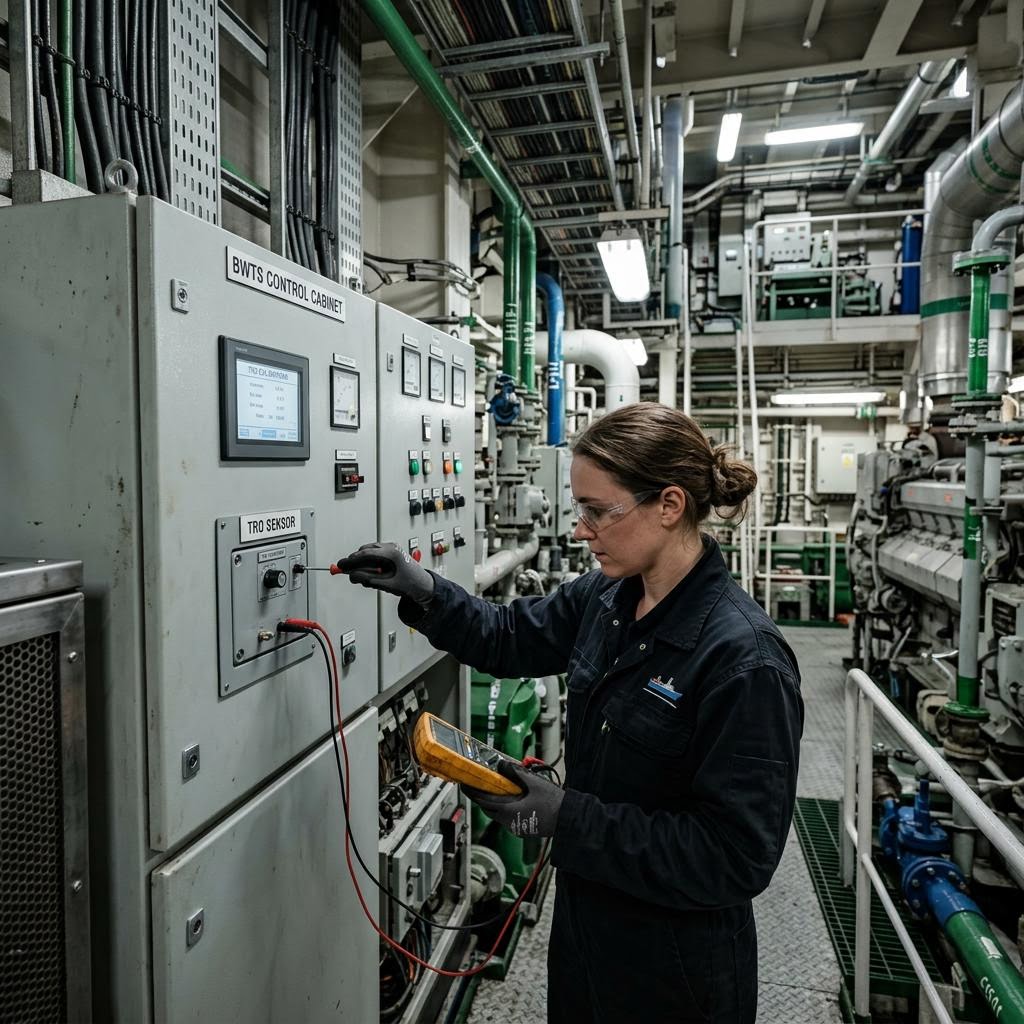
Routine operational checks keep a ballast water treatment system running, but they do not confirm it is running well. An annual health check is a structured, end-to-end survey of the whole system — treatment stage, sensors, filters, valves, control software and wear parts — carried out against the manufacturer's schedule and the type-approval conditions. This article sets out what a thorough annual health check includes, why it protects both compliance and equipment life, and how Sea Clean coordinates the work across brands and ports.
Key takeaways
- An annual health check surveys the whole BWTS end-to-end and finds the gradual faults that daily operational checks cannot detect.
- The check closes OEM-scheduled tasks in one structured visit and produces a record demonstrating the system is maintained to its approval basis.
- Treatment performance is measured against baseline — cell output, lamp dose or dosing accuracy — to expose under-treatment before a failed discharge.
- Sensors, filters, valves and control software are verified so delivered treatment matches what the control system believes it delivered.
- Time-based renewals of lamps, filters, membranes and cell parts are pre-staged so survey and renewal happen in one attendance.
- Sea Clean gives Headway agent service plus independent multi-brand health checks and coordinates lab testing through accredited ISO 17025 parties when needed.
Why an Annual Health Check Is Different From Daily Checks
Crew operational checks confirm the system starts, treats and stops without alarms during a normal ballasting sequence. They are essential but limited: they cannot detect gradual electrode wear, slow UV-lamp degradation, creeping sensor drift or software configuration that has been altered to suppress a nuisance alarm. An annual health check exists to find the problems that daily operation hides.
The IMO BWMS Code and USCG 46 CFR 162.060 grant type approval on a defined maintenance regime, and the operation and maintenance manual sets service tasks and intervals for each component. The annual health check is the vehicle for closing those OEM-scheduled tasks in one structured visit, producing a single record that demonstrates the system has been maintained to its approval basis.
A health check also protects the substantial capital tied up in a retrofit BWTS, which for many vessels ran to hundreds of thousands of dollars installed. Catching electrode fouling, seal degradation or a failing power supply early is far cheaper than a mid-voyage breakdown that leaves the vessel unable to ballast compliantly and facing a deviation to a service port.
Treatment-Stage Assessment
For electrochlorination systems the health check examines the electrolyser cell: electrode condition and coating wear, scaling, gas venting, and the current-to-TRO relationship that indicates whether the cell still produces the design oxidant concentration at rated flow. Electrodes are consumable and lose efficiency progressively, so measuring actual performance against the baseline tells the operator how much cell life remains.
For UV systems the check covers lamp output against operating hours, quartz-sleeve fouling and clarity, wiper mechanism function, and UV-transmittance behaviour in the waters the vessel trades. A lamp near its rated end-of-life may still strike and show green but deliver insufficient dose in low-UVT water, which is precisely the condition a health check is meant to expose before a failed discharge occurs.
For chemical-injection systems the dosing pumps, tank levels, injection quills and neutralisation stage are inspected, and the relationship between dose set-point, measured TRO and neutralised discharge is confirmed. Across all technologies the engineer checks that the treatment actually delivered matches the treatment the control system believes it delivered — the gap between the two is where non-compliance lives.
Sensors, Filters and Mechanical Components
The measuring chain is verified and, where needed, calibrated: TRO or oxidant analysers, UV-intensity sensors, flow meters, differential-pressure transmitters and salinity or temperature probes. Because dose control depends entirely on these instruments, a health check that ignores them can pass a system that is quietly under-treating. Sample lines and reagent supplies are reinstated so the measurements are trustworthy.
The pre-treatment filter is a common failure point and receives close attention: screen condition, backflush function, differential pressure behaviour, seals and the automatic control that governs cleaning cycles. A blocked or bypassing filter defeats the whole treatment train, because organisms and sediment that should have been removed mechanically instead load the disinfection stage beyond its design.
Valves, actuators, interlocks and the control PLC are exercised to confirm the system will actually sequence correctly on the next real ballast operation. Software revision, alarm configuration and any parameter changes are documented, because undocumented parameter edits are a frequent cause of both nuisance alarms and silent non-compliance.
Scheduled Renewals and Wear Parts
A health check is the natural point to close time-based renewals: UV lamps and quartz sleeves at their rated hours, filter elements and seals, TRO membranes and reagent lines, and cell components approaching wear limits. Renewing on schedule rather than on failure keeps the system inside its approved performance envelope and avoids the cascade of secondary damage a failed component can cause.
Because these parts have real lead times and are brand-specific, the health check is most efficient when the likely renewals are identified in advance and the parts pre-staged for the visit. Sea Clean supplies genuine Headway OceanGuard parts and sources multi-brand components, together with reagents, so the survey and the renewal can happen in the same attendance rather than triggering a second boarding.
Where a part turns out to be obsolete or superseded, the engineer records the finding and Sea Clean advises on cross-referenced equivalents or exchange options. Identifying obsolescence during a planned health check, rather than during a breakdown, gives the operator time to plan a proper solution instead of accepting an emergency substitute.
Multi-Brand Coverage and Honest Scope
Sea Clean is an authorized Headway Technology agent and performs manufacturer-backed health checks on OceanGuard systems. For Techcross, Erma First, Sunrui BalClor, Alfa Laval PureBallast, Optimarin, Wärtsilä, JFE BallastAce, Panasia, De Nora and similar makes, Sea Clean provides independent health-check service based on hands-on experience across UV, electrochlorination and chemical-dosing designs, and does not claim manufacturer authorization for those brands.
Where the health check identifies that a discharge sample is needed to demonstrate biological performance, Sea Clean coordinates the analysis through accredited ISO 17025 laboratories and flag- or class-authorised parties. Sea Clean is not itself an accredited test laboratory; its role is to run the engineering survey and to organise independent testing where the evidence calls for it.
The visit closes with a condition report covering every subsystem, the tasks completed, parts renewed, readings taken, open items and the next-due dates. The report is structured for the vessel's PMS and for class and port state control, giving the operator a clear, auditable picture of system health rather than an assumption that everything is fine.
Planning and Booking a Health Check
The most productive health checks start with early notice so parts and reagents can be pre-staged and the scope scaled to the confirmed alongside time. Provide the vessel name and IMO number, BWTS make and model, operating hours since the last service, any recurring alarms, and the intended port and ETA to post@seaclean.no.
Sea Clean's engineers attend vessels across Norway and the North Sea, commonly within 24 hours for planned calls, and coordinate worldwide attendance as flights, visas and port access allow, with non-European ports served by arrangement. Aligning the health check with a scheduled call avoids costly deviations and keeps the survey inside a normal port stay.
For managed fleets, mapping annual health checks against each vessel's trading pattern lets the work fall on natural port calls and spreads the cost predictably across the year. A planned annual survey is consistently cheaper and less disruptive than the reactive repair that follows an unexpected failure or a failed inspection.
Frequently asked questions
How is a health check different from annual calibration?
Calibration corrects the measuring instruments; a health check is the wider survey of the whole system, including treatment performance, filters, valves, software and wear parts, and it normally includes sensor calibration as one element. The health check gives a full condition picture, not just instrument accuracy.
Will a health check keep my BWTS PSC-ready?
It is a major part of it. The health check closes OEM-scheduled maintenance and documents system condition, calibration and renewals in a report suited to class and port state control. Combined with a maintained ballast water record book, that gives inspectors the evidence they expect to see.
Can Sea Clean check any brand of BWTS?
Sea Clean is an authorized Headway agent and provides independent health-check service for Techcross, Erma First, Sunrui, Alfa Laval, Optimarin, Wärtsilä, JFE, Panasia, De Nora and others. For non-Headway systems the service is independent and not manufacturer-authorized.
What should I send to book a health check?
Send the vessel name and IMO number, BWTS make and model, operating hours since last service, any recurring alarms, and the port and ETA to post@seaclean.no. Early notice lets Sea Clean pre-stage the likely wear parts and reagents so the survey and renewals happen in one visit.