BWTS Annual Calibration Service for Sensors and Analysers
Updated
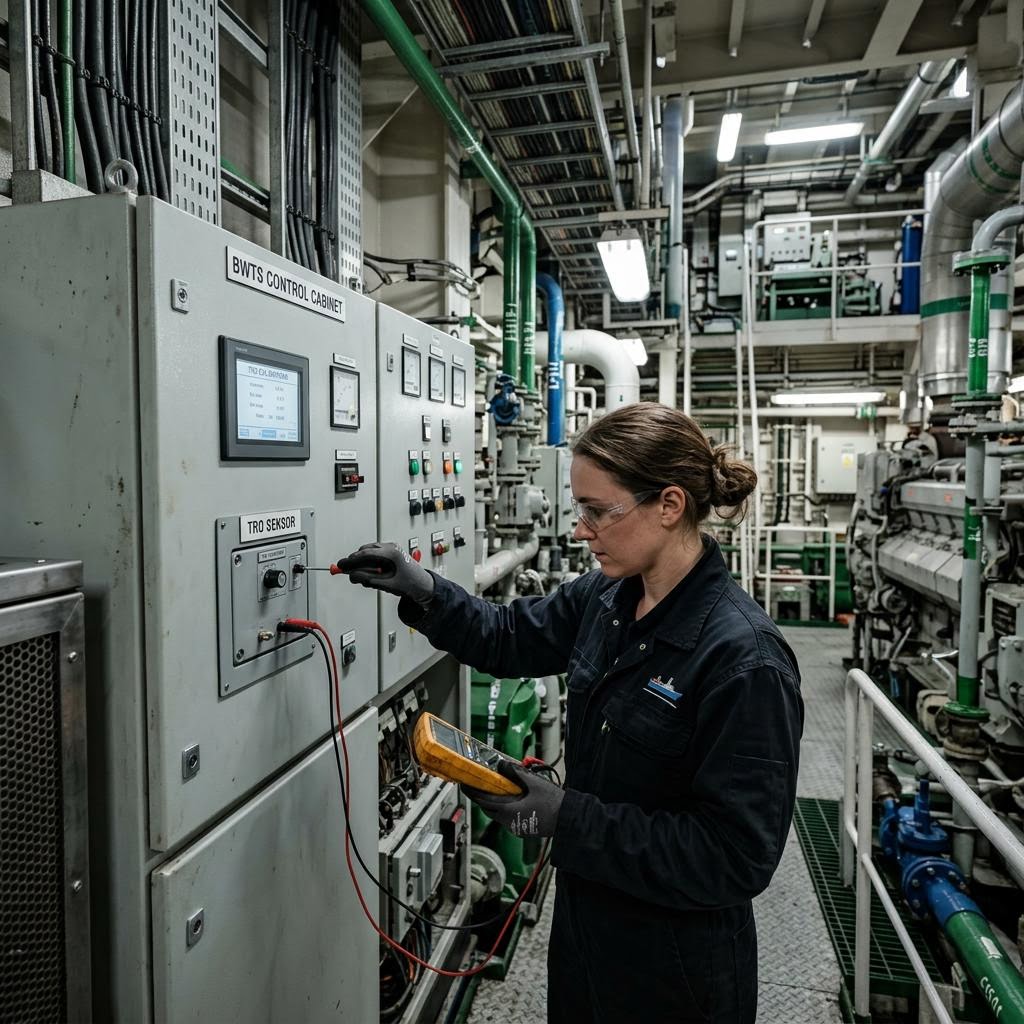
A ballast water treatment system depends on the accuracy of its measuring instruments as much as on its treatment stage. Every UV-intensity probe, total residual oxidant (TRO) analyser, flow meter and pressure transmitter drifts over time, and if it drifts far enough the control system either under-doses (risking a failed D-2 discharge) or over-doses (wasting reagent and tripping alarms). This article explains what annual BWTS calibration covers, why it is mandatory under most type-approval conditions, and how Sea Clean coordinates calibration and verification against the manufacturer's schedule.
Key takeaways
- Annual calibration keeps TRO, UV-intensity, flow and pressure sensors accurate so the D-2 dose is genuinely correct, not just reported as correct.
- OEM manuals and type-approval conditions set calibration intervals; lapsed calibration can undermine the approval basis and expose the vessel at PSC.
- Verification checks whether a sensor is in tolerance; calibration adjusts it back into tolerance and restores traceability — they are not the same.
- Fouled sample lines, scaled quartz windows and expired reagents mimic sensor drift and must be reinstated before any adjustment is meaningful.
- Sea Clean provides Headway agent calibration and independent calibration support for Techcross, Erma First, Sunrui and other brands.
- Each visit produces as-found/as-left records with next-due dates, suitable for the PMS and for class and port state control.
Why Calibration Is a Compliance Requirement
A BWTS does not measure organisms directly; it controls a treatment dose using proxy instruments and assumes that a correct dose delivers a discharge within the IMO D-2 standard of fewer than 10 viable organisms per cubic metre for the 50µm-and-above size class. If the sensor that governs that dose is inaccurate, the treatment can be biologically inadequate while the control panel still reports green. Calibration is what keeps the reported value tied to the true value.
Type-approval under the IMO BWMS Code (resolution MEPC.300(72)) and USCG 46 CFR 162.060 is granted on the basis of a specific control philosophy, and the operation and maintenance manual issued with that approval sets calibration intervals for each critical sensor. Skipping those intervals can invalidate the approval basis and expose the vessel during a port state control inspection, because inspectors increasingly ask to see calibration certificates alongside the ballast water record book.
TRO analysers on electrochlorination and chemical-injection systems are the most sensitive to drift because they rely on colorimetric or amperometric chemistry that degrades with reagent age and membrane fouling. UV-intensity sensors on UV systems fog and age, reading lower than reality and forcing unnecessary lamp replacements, or higher than reality and permitting under-treatment. Both cases are corrected only by scheduled calibration against a traceable reference.
What the Annual Calibration Scope Covers
A full annual calibration addresses every instrument the control logic depends on: TRO or total oxidant analysers, UV-transmittance and UV-intensity sensors, ballast flow meters, differential-pressure transmitters across the filter, salinity and temperature probes, and any pH or ORP sensors used in neutralisation control. Each is compared against a reference and adjusted so its output matches the true measured value across its working range, not just at a single point.
For TRO analysers, calibration typically involves preparing or supplying certified standard solutions, checking the zero and span, replacing worn reagent lines and membranes, and confirming the neutralisation set-point still triggers before overboard discharge. For UV sensors, the reference sensor is compared against the installed probe under a known lamp output, and quartz-sleeve fouling is assessed because it corrupts the reading independently of the sensor itself.
Flow and pressure instruments are verified because dose is calculated as concentration multiplied by flow; a flow meter reading 10 percent high causes a proportional dosing error. The engineer records the as-found and as-left values for every instrument, so the vessel has documentary evidence of the drift that existed before calibration and the corrected state afterwards — the record most inspectors want to see.
Calibration Versus Verification
Calibration and verification are distinct and are often confused. Verification checks whether a sensor still reads within tolerance and produces a pass/fail result; calibration is the adjustment that brings a sensor back into tolerance and re-establishes traceability to a reference standard. A verification alone does not restore accuracy — it only tells you whether restoration is needed.
Some analysers are field-adjustable and can be genuinely calibrated on board by the attending engineer using certified standards. Others, particularly certain sealed TRO analysers and reference UV sensors, are designed to be exchanged or returned to a laboratory for calibration against equipment the vessel cannot carry. Knowing which instruments fall into which category prevents wasted attendances and lets the correct spares or exchange units be pre-staged.
Where an instrument must be laboratory-calibrated, Sea Clean coordinates the exchange so the vessel receives a calibrated unit and returns the drifted one, keeping the system operable throughout. This distinction matters for planning: field calibration fits into a normal port call, whereas an exchange programme needs lead time to have the certified unit in the right port at the right ETA.
Sensor Drift, Fouling and Practical Failure Modes
The commonest real-world calibration problem is not the sensor electronics but the sample path feeding it. On TRO systems, sample lines silt up, membranes foul with organics, and reagent pumps lose prime, all of which produce readings that look like sensor drift but are actually a dirty measurement. A competent calibration visit cleans and reinstates the sample path before adjusting anything, otherwise the calibration is meaningless within weeks.
UV-intensity sensors commonly read low because the quartz window in front of them scales with the same mineral deposits that coat the lamp sleeves. Calibrating the sensor without cleaning that window simply hides a treatment problem behind a corrected number. The engineer therefore inspects and cleans optical surfaces as part of the same visit and distinguishes true sensor ageing from fouling.
Reagents for colorimetric TRO measurement have a defined shelf life, frequently 6 to 12 months, and expired reagent is a leading cause of apparent analyser failure. Sea Clean supplies in-date, correctly labelled reagents with the calibration visit so the analyser has usable chemistry immediately, and advises on onboard storage to protect shelf life between attendances.
Multi-Brand Capability and Documentation
Sea Clean is an authorized Headway Technology agent, so calibration of Headway OceanGuard TRO analysers and instruments is carried out with manufacturer backing and genuine reference standards. For other makes — Techcross, Erma First, Sunrui BalClor, Alfa Laval PureBallast, Optimarin, Wärtsilä, JFE BallastAce, Panasia and De Nora — Sea Clean provides independent calibration and verification support and does not claim manufacturer authorization for those brands.
Every calibration closes with a report giving as-found and as-left readings, the reference standards used, the instruments adjusted or exchanged, and the next due date derived from the OEM interval. This document is written for the vessel's planned maintenance system and for presentation to class and port state control, and it is the evidence that satisfies an inspector asking whether the measuring chain is trustworthy.
To arrange annual calibration, send the vessel name and IMO number, BWTS make and model, the analyser and sensor types fitted, and the intended port and ETA to post@seaclean.no. Sea Clean's engineers attend vessels across Norway and the North Sea, typically within 24 hours for planned calls, and coordinate worldwide attendance as flights, visas and port access allow so calibration is completed before the next compliant discharge is required.
Fitting Calibration Into the Maintenance Calendar
The most efficient approach is to align sensor calibration with the annual health check and any due sensor replacements, so a single attendance closes several maintenance items and produces one consolidated record. Bundling calibration with reagent restocking and filter or lamp renewal reduces the number of separate boardings and the disruption to cargo operations.
For fleets, Sea Clean can map calibration due-dates across vessels so instruments are done during natural port calls rather than emergency deviations, which controls cost and avoids the scramble that follows a failed inspection. A calibration that lapses is far more expensive to resolve reactively than one planned around the vessel's existing schedule.
Because calibration underpins whether a discharge is genuinely compliant rather than merely reported as compliant, it sits at the centre of a defensible D-2 monitoring programme. Sea Clean coordinates the calibration itself, the supporting reagent supply, and — where a discharge sample is needed to demonstrate performance — the independent laboratory analysis through accredited ISO 17025 parties, keeping the whole evidence chain consistent.
Frequently asked questions
How often must BWTS sensors be calibrated?
Intervals are set by the system's operation and maintenance manual under its type approval, and are commonly annual for critical instruments such as TRO analysers and UV-intensity sensors. Some sensors need more frequent verification. Sea Clean works to the OEM-specified interval and records the next due date on every report.
Can TRO analysers be calibrated on board?
Some field-adjustable analysers can be calibrated on board using certified standard solutions, while certain sealed analysers and reference UV sensors must be exchanged or laboratory-calibrated. Sea Clean coordinates the exchange so a calibrated unit is fitted and the drifted one returned, keeping the system operable.
Does Sea Clean calibrate non-Headway systems?
Yes. Sea Clean is an authorized Headway agent and also provides independent calibration and verification support for Techcross, Erma First, Sunrui, Alfa Laval, Optimarin and other brands. For non-Headway systems the support is independent and not manufacturer-authorized.
Why does my sensor drift so quickly after calibration?
Rapid apparent drift usually indicates a fouled sample line, a scaled quartz window or expired reagent rather than a failing sensor. A proper calibration reinstates the sample path and optical surfaces first, and Sea Clean supplies in-date reagents so the measurement holds between visits.
Sources
Related articles
- BWTS TRO Sensor Calibration and Verification
- TRO Sensor Reagent Supply and Shelf Life Management
- BWTS Annual Health Check: Full System Condition Survey
- TRO Monitoring in Ballast Water Systems: Measuring Total Residual Oxidant
- De Nora BalPure BWTS Service Support
- TRO Calibration vs Verification: What Is the Difference