BWTS System Function Check for Inspection Readiness
Updated
A system function check is a focused, defined-scope service that confirms a ballast water treatment system actually starts, treats, neutralises and alarms correctly before an inspection, a survey or a voyage where compliant ballasting will be required. It is narrower and faster than an annual health check but answers the question that matters most operationally: is the system ready to perform right now? This article explains what a function check covers, when to use it, and how Sea Clean carries it out across brands.
Key takeaways
- A function check is a focused, time-bounded service that proves the BWTS starts, treats, neutralises and alarms correctly right now.
- It is the right service before a PSC inspection, a class survey, a charter demonstration or a voyage into a strictly regulated region.
- The check verifies the measuring chain and neutralisation, not just power-up, so it cannot wrongly pass a quietly under-treating system.
- Function checks are snapshots of readiness; annual health checks are full condition surveys — the two are complementary.
- Sea Clean provides Headway agent function checks and independent function-check service for Techcross, Erma First, Sunrui and other brands.
- Each check closes with a short readiness report suitable for the vessel's files and for presentation to an inspector.
What a Function Check Is For
A function check confirms operability rather than surveying long-term condition. Its purpose is to prove the system will do its job on the next real ballast operation: the treatment stage engages, the dose reaches design, sensors read true, neutralisation works on discharge, and alarms behave as intended. It is the practical answer to a superintendent asking whether the vessel is ready for its next compliant ballasting.
Because it is focused and time-bounded, a function check fits neatly into a normal port call and is the right service before a port State control inspection, a class survey, a charter that requires demonstrated compliance, or a voyage into a strictly regulated region. It gives the operator confidence the system is genuinely ready, not merely assumed ready because no alarm has appeared.
The function check is deliberately narrower than the annual health check. It does not attempt a full condition survey or scheduled renewals; it verifies present operability. Where the check reveals a deeper problem, that finding feeds into a fuller health check or a targeted repair — the function check is the fast diagnostic that tells you which you need.
What the Check Covers
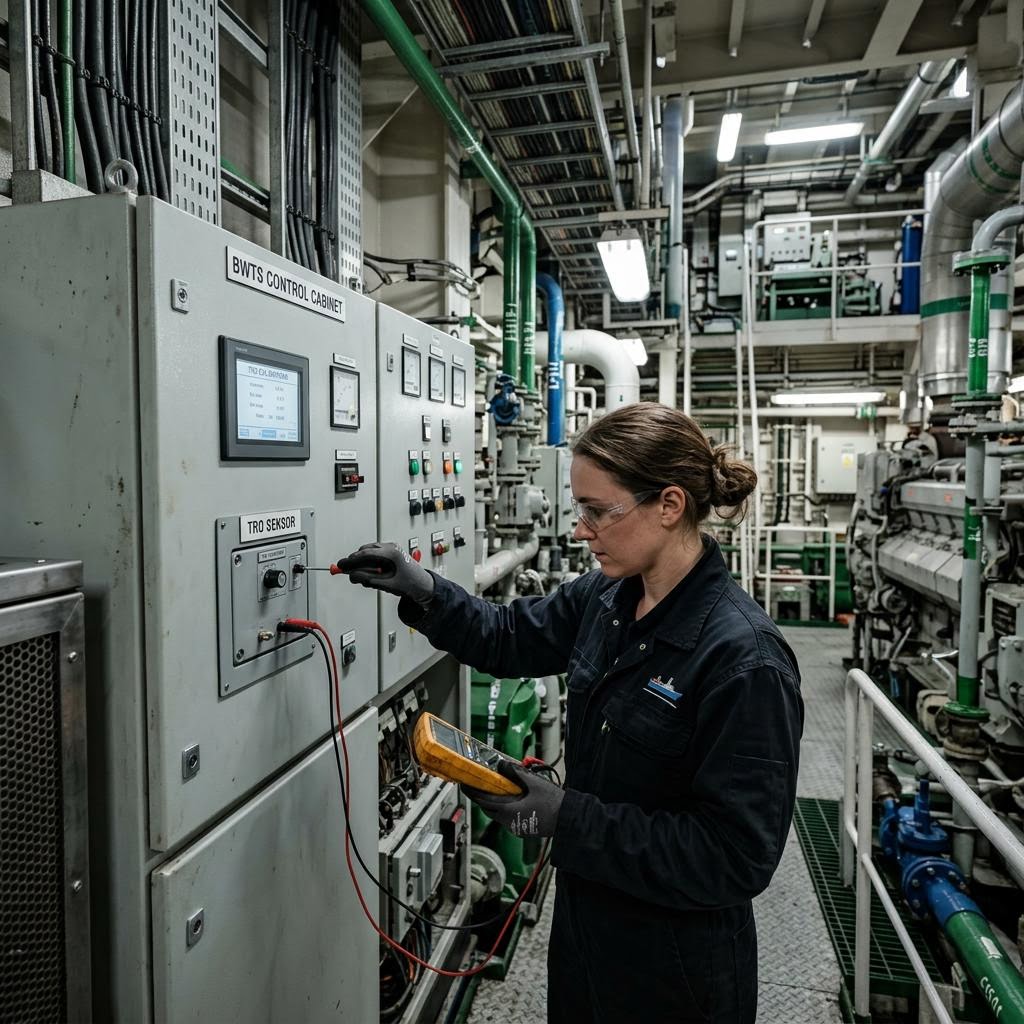
The engineer runs the system through its operating sequence, either on a live ballast operation or a controlled functional test, and confirms it starts, treats and stops correctly. The treatment stage is checked for design performance — cell output for electrochlorination, lamp strike and dose for UV, dosing-pump delivery for chemical injection — so the system is proven to treat, not just to power up.
The measuring chain is verified: TRO or oxidant analysers, UV-intensity sensors, flow and pressure instruments are checked to read within tolerance, and sample lines are confirmed to be feeding them cleanly. Because the control system doses on these readings, a function check that skips them can wrongly pass a system that is quietly under-treating.
Neutralisation is confirmed on the discharge side for oxidant-based systems, so the treated water leaves within the permitted residual, and the alarm and interlock behaviour is exercised to confirm the system will stop or alert correctly on a genuine fault. The result is a clear statement of whether the system is operationally ready and, if not, exactly what is wrong.
When to Use a Function Check Versus a Health Check
Use a function check when the question is operational readiness on a short timescale — before an inspection, a survey, a charter demonstration or a critical voyage — and when the system has been maintained but needs proving. It is the efficient choice when time alongside is limited and the goal is confidence rather than a full overhaul.
Use an annual health check when the question is long-term condition and OEM-scheduled maintenance is due: wear parts, calibration, treatment-stage assessment and a full condition record. The two are complementary — a function check is a snapshot of readiness, a health check is a full service — and many operators use function checks between annual health checks to stay confident through the year.
A function check is also the right first response when a system has shown intermittent alarms but is not clearly broken. It quickly separates a genuine fault needing repair from a system that is fundamentally sound but poorly operated or lightly out of tune, so the operator spends effort where it is actually needed.
Multi-Brand Function Checks
Sea Clean is an authorized Headway Technology agent and performs manufacturer-backed function checks on OceanGuard systems. For Techcross, Erma First, Sunrui BalClor, Alfa Laval PureBallast, Optimarin, Wärtsilä, JFE BallastAce, Panasia, De Nora and similar makes, Sea Clean provides independent function-check service across UV, electrochlorination and chemical-dosing designs and does not claim manufacturer authorization for those brands.
Whatever the technology, the engineer boards with the tools and the likely consumables to confirm operation and to correct minor faults found during the check — a fouled sample line, a set-point drift, a sticking valve. The aim is to leave the vessel with a system proven ready, not just a list of things to fix later.
The check closes with a short report stating whether the system is operationally ready, the readings taken, and any items found, written for the vessel's files and for presentation to an inspector. That document is the evidence that the operator verified readiness rather than assumed it.
Booking a Function Check
To arrange a function check, send the vessel name and IMO number, BWTS make and model, the reason for the check (inspection, survey, charter, voyage), and the intended port and ETA to post@seaclean.no. Because the scope is defined and the check is time-bounded, it is straightforward to fit into a confirmed alongside window.
Sea Clean's engineers attend vessels across Norway and the North Sea, commonly within 24 hours for planned calls, and coordinate worldwide attendance as flights, visas and port access allow, with non-European ports served by arrangement. For a check timed to a specific inspection or survey, early notice ensures the engineer is on board with margin before the event.
Where a function check uncovers a deeper problem, Sea Clean can extend the visit into a targeted repair or plan a fuller health check, and can supply the parts and reagents needed. Starting with a focused function check keeps cost proportionate and directs any further work precisely at what the check found.
Turning a Check Into Confidence
The value of a function check is that it replaces assumption with evidence at exactly the moment it matters — the days before an inspection or a critical ballast operation. Systems that sit idle between ballast operations can develop faults that only appear under load, and a function check surfaces those before they become a detention or a failed discharge.
For vessels trading into regions with intensive enforcement, or ahead of a concentrated inspection campaign, a function check is a low-cost insurance step that demonstrates diligence and catches the faults inspectors look for. It is far cheaper than the disruption of a system that fails when an inspector asks to see it operate.
Building periodic function checks into the operating routine — particularly before scheduled surveys and demanding voyages — keeps the system continuously inspection-ready between annual health checks. Sea Clean can plan these around the vessel's schedule so readiness is maintained without unnecessary attendances.
Frequently asked questions
How is a function check different from a health check?
A function check is a fast, focused verification that the system is operationally ready now; an annual health check is a full condition survey with OEM-scheduled renewals and calibration. Many operators use function checks between health checks to stay confident through the year.
When should I book a function check?
Book one before a port State control inspection, a class survey, a charter that requires demonstrated compliance, or a voyage into a strictly regulated region — or when a system has shown intermittent alarms and you need to know whether it is genuinely faulty.
Can a function check be done during a normal port call?
Yes. Because the scope is defined and time-bounded, a function check fits into a confirmed alongside window. Send the vessel and system details, the reason for the check, and the port and ETA to post@seaclean.no so the engineer boards with margin before any scheduled event.
What happens if the check finds a fault?
Minor faults such as a fouled sample line or a set-point drift are corrected during the visit. If a deeper problem is found, Sea Clean can extend into a targeted repair or plan a fuller health check and supply the required parts and reagents, directing further work precisely at what was found.