BWTS Annual Service and Planned Maintenance
Updated
Planned maintenance keeps a ballast water treatment system reliable and survey-ready, and it is far cheaper than an emergency call-out. This article describes what a BWTS annual service typically covers across filter, treatment and control stages, how it differs between UV and electrochlorination systems, and how Sea Clean carries out and documents the work.
Key takeaways
- Planned maintenance moves the discovery of wear to a controlled moment and is far cheaper than emergency repair.
- The core annual scope covers filtration, control and monitoring, sensor calibration, and the treatment stage.
- UV service centres on lamps, quartz sleeves, the wiper and the UV intensity sensor.
- Electrochlorination service centres on the electrolyser cell, the TRO analyser and neutralisation dosing.
- Documented readings, parts and function tests give evidence for class and port state surveys.
- Headway service uses authorized procedures and genuine parts; other brands are served as independent service.
Why Planned Maintenance Pays
A BWTS is a process plant that runs intermittently, often in difficult water, and then sits idle between ballast operations. That duty cycle is hard on sensors, lamps, cells and filters, and faults frequently appear when the system is started for a port call rather than during the quiet periods. Planned maintenance moves the discovery of wear to a controlled moment instead of a critical one.
Regulators and class also expect the system to be maintained to its type-approval conditions and the maker's instructions. A documented service history supports surveys and port state inspections and demonstrates that the equipment is being kept fit for purpose, not just run until it stops.
The commercial case is simple: a scheduled service that replaces a worn part during a routine call is far cheaper than an urgent attendance, a missed berth, or a contingency situation in a strict port. Planned maintenance is the lower-risk and lower-cost path.
The Core Annual Scope
A typical annual service starts with the filtration stage: inspecting the screen or element for damage and fouling, checking the backflush mechanism and differential-pressure instruments, and confirming the automatic cleaning cycle operates correctly. The filter protects the rest of the system, so its condition is checked first.
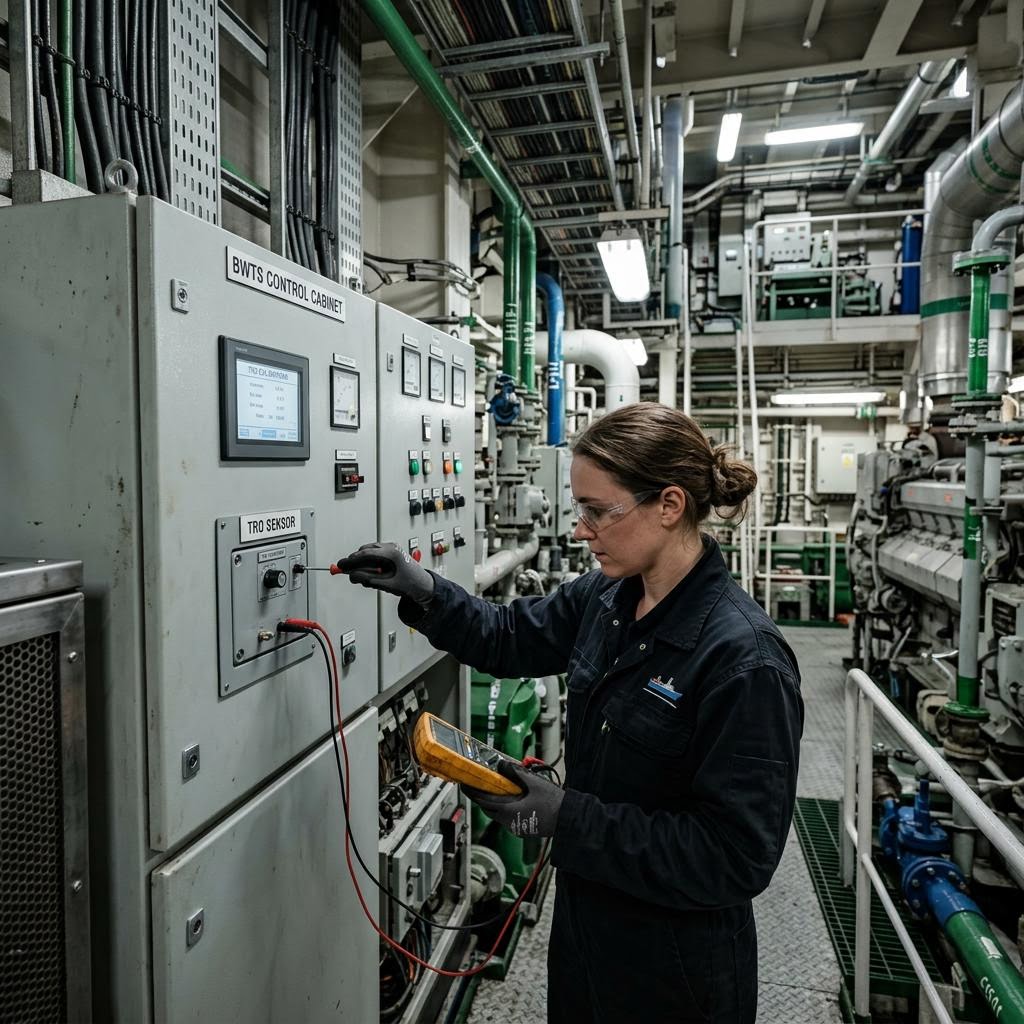
The control and monitoring side is then reviewed: software and alarm function, valve operation and feedback, flow measurement, and the calibration or verification of key sensors such as TRO on electrochlorination systems and UV intensity on UV systems. Power supplies, rectifiers and connections are inspected for condition and security.
Finally the treatment stage is examined according to the technology, and consumables and reagents are checked for stock and shelf life. The service closes with function testing so the system is confirmed to operate as intended, not merely inspected on paper.
UV System Maintenance
On UV systems the central items are the lamps, the quartz sleeves and the wiper or cleaning mechanism. Lamps lose output over their service life even before they fail, so hours are tracked and lamps replaced before they drop the delivered dose below the validated level. Quartz sleeves are inspected for fouling and scaling that block UV transmission.
The UV intensity sensor is checked and, where required, verified or calibrated so its reading genuinely reflects the dose reaching the water. The wiper system that keeps sleeves clean during operation is exercised and serviced, since a failed wiper quickly lets fouling reduce performance.
Seals, O-rings and the treatment chamber are inspected for leaks and condition. Because UV performance is invisible in normal running, this stage relies on measured intensity and lamp records rather than appearance alone.
Electrochlorination System Maintenance
On electrochlorination systems the electrolyser cell is the heart of the plant, and annual service includes inspecting and, where needed, cleaning the cell to remove scaling and deposits that reduce chlorine generation. The TRO analyser, which governs both treatment and neutralisation, is verified or calibrated against reagent standards so dosing is correct.
Neutralisation and the associated dosing of sodium thiosulfate or equivalent are checked so that discharged water meets the residual limit. Power supplies and rectifiers that drive the cell are inspected, and any hydrogen handling or ventilation associated with electrolysis is confirmed to function safely.
Because cell performance and TRO accuracy drift gradually, this maintenance is what keeps the system both compliant and safe between services. Reagents for the TRO analyser are confirmed in date and replenished as part of the visit.
Records, Spares and Documentation
A service is only as useful as its record. Sea Clean documents what was inspected, the readings taken, the parts fitted, the calibration results and the function-test outcome, so the vessel holds evidence for class and port state. This record also builds a history that shows trends, such as a cell or sensor approaching the end of its life.
The visit is a natural point to review the onboard spares holding. Carrying the right filter elements, lamps or cell consumables, sensor spares and reagents lets the crew handle minor issues without a call-out and shortens any future urgent repair. Sea Clean recommends a holding matched to the system and the trade.
Aligning the service date with a scheduled port call or a class survey keeps disruption to a minimum. A planned annual service combined with a parts top-up in one attendance is the efficient way to keep the system ready.
How Sea Clean Delivers the Service
Sea Clean is an authorized Headway Technology agent, so annual service on Headway OceanGuard systems is carried out with manufacturer-aligned procedures and genuine parts. For other makes the same disciplined scope is delivered as independent service: Sea Clean services, calibrates and supplies parts for systems such as Techcross, Erma First, Sunrui and others without claiming OEM authorisation by those brands.
Attendance is scheduled to suit the vessel's itinerary, with the engineer arriving with the consumables, calibration standards and likely spares for the specific system. For Norway and North Sea calls this is usually arranged easily; for worldwide calls attendance is set as flights, visas and port access allow, with parts shipped ahead where useful.
Where a full attendance cannot be scheduled in time, Sea Clean can guide the crew through interim checks remotely and supply the parts and reagents needed, with a full service at the next suitable opportunity. The aim is continuous, documented readiness rather than a single annual event in isolation.
Frequently asked questions
How often should a BWTS be serviced?
Most systems need at least an annual planned service plus routine crew checks, in line with the maker's instructions and type-approval conditions. The exact interval depends on the system, its running hours and the water it operates in, and should be aligned with a port call or class survey.
What is checked during a BWTS annual service?
The service covers the filtration stage, the control and monitoring system, sensor calibration or verification, and the treatment stage, followed by function testing. Consumables and reagents are checked for stock and shelf life, and the work is documented for class and port state.
What is different between UV and electrochlorination service?
UV service focuses on lamps, quartz sleeves, the wiper and the UV intensity sensor, while electrochlorination service focuses on the electrolyser cell, the TRO analyser and neutralisation dosing. Both include filter, control and function checks, but the treatment-stage work differs by technology.
Can Sea Clean service non-Headway systems?
Yes. Sea Clean is an authorized Headway agent and delivers the same disciplined annual scope for other makes as independent service. It services, calibrates and supplies parts for systems such as Techcross, Erma First and Sunrui without claiming OEM authorisation by those brands.